Search Header Logo
Ecosystem

Ecosystem

Assessment

Presentation

Science

8th Grade

Easy

NGSS
MS-LS2-4, MS-LS2-1, MS-LS2-2

+7

Standards-aligned

Created by

Kim Tran

Used 3+ times

FREE Resource

4 Slides • 46 Questions

1

Ecosystem

By Kim Tran

media

2

Impact on Food Web

disturbances that affects ecosystems; natural disasters, changes to population, and human intervention

  • disturbances and changes in population: increase or decrease in the total number of a certain species

  • Natural Disasters: tornadoes, diseases, drought, wildfires, and volcanic eruptions

  • Human Activities: resource extractions (taking out natural resources from Earth), pollution, nutrient loading, eutrophication (like using fertilizers), and nonnative species

3

Multiple Choice

Question image
Which of the following would be the most likely effect, if there were a sudden increase in the cricket population?
1
There would be a decrease in the small bird population.
2
There would be a decrease in the grass/flowers population.
3
There would be a decrease in the mice population.
4
There would be an increase in the grass/flowers population.

4

Multiple Choice

Question image
If additional snakes are introduced into this ecosystem, there will most likely be an immediate decrease in the _________.  
1
hawk population
2
rabbit population
3
wildflower population
4
grass population

5

Multiple Choice

Climate change and plate tectonics are examples of _____ environmental change (8.11B).

1

long-term

2

short-term

3

no-term

6

Multiple Choice

Temperature, light, air, water, and soil are all _____ parts of the environment (8.11A)

1

alive

2

biotic

3

abiotic

4

living

7

Multiple Choice

What are all members of one kind of organism that live in a particular area?
1
population
2
microrganisms
3
community
4
environment

8

Multiple Choice

When two species have the same niche, or are going for the same resource, they will:
1
compete
2
both die
3
eat each other
4
do not affect each other

9

Multiple Choice

Eutrophication is caused by

1

excess nutrients building up in the water.

2

industrial point-source pollution.

3

unlined landfills and septic tanks.

4

wastewater from homes mixing with drinking water.

10

Multiple Choice

Which would most likely happen if too many nutrients entered an estuary?

1

Nutrients would be used up by the fish and plants, keeping the estuary in balance.

2

Algal blooms would lower dissolved oxygen levels, causing fish to suffocate.

3

Algal blooms would decrease, leaving few food resources for fish.

4

Nutrients would sink to the bottom, increasing soil deposition.

11

Multiple Choice

Eutrophication is caused by...

1

fossil fuel burning in power plants.

2

automobiles burning fossil fuels.

3

over fertilizing farm fields.

4

limestone rocks in a body of water.

12

Multiple Choice

The arrows in a food chain or web represents what?
1
They point to the organism that is being eaten.
2
It shows how sunlight flows within an ecosystem.
3
They show what direction the energy is flowing between organisms. 
4
They represent how water is transferred within a habitat.

13

Multiple Choice

Why are invasive species considered a threat to native species in ecosystems?

1

Invasive species do not compete for resources with native species

2

Invasive species do not alter the physical environment of the ecosystem

3

Invasive species help native species thrive

4

Invasive species compete for resources, prey on native species, introduce new diseases, and alter the physical environment of the ecosystem.

14

Multiple Choice

As you work your way up the energy pyramid, what happens to the energy?

1

It increases

2

It decreases

3

It stays the same

4

Nothing

15

Multiple Choice

What percentage of energy typically passes to the next trophic level?

1

50%

2

10%

3

25%

4

90%

16

Multiple Choice

True or False: Decreasing a population in an ecosystem will affect other populations in the ecosystem.

1

True

2

False

17

Multiple Choice

What happens when you remove a species from the beginning of a food web?

1

Every other population is affected

2

Only populations directly connected to the removed species are affected

3

Nothing - everything stays the same

18

media

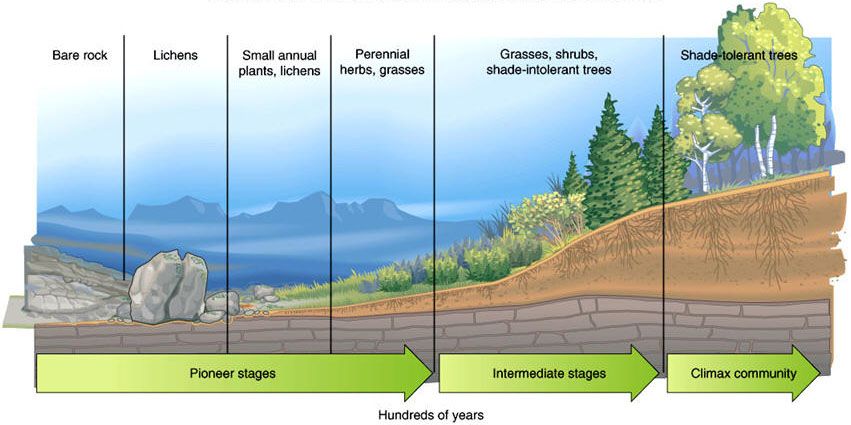
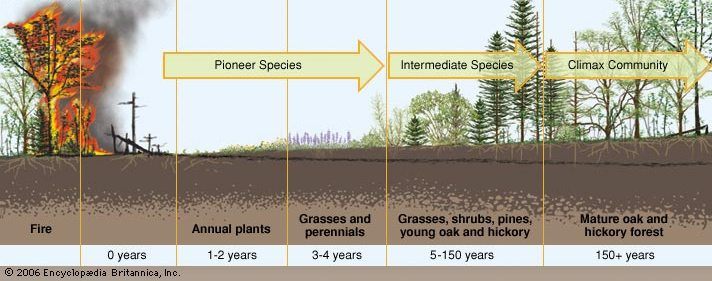
Primary Succession- Establishment of a community in an area of BARE ROCK or BARE SAND, no topsoil present. Pioneer species include mosses and lichens. Can take up to hundreds of years to form into a climax community.

Secondary Succession
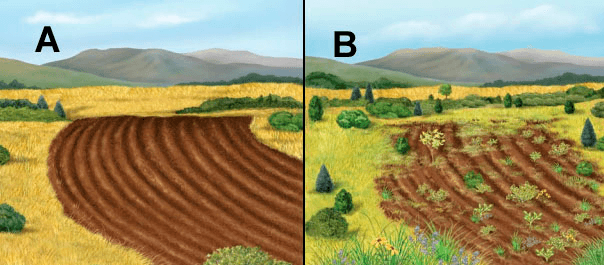
- Occurs after a disturbance (can be natural disaster or manmade). Soil is still present. Pioneer species include annual plants, grasses and herbs. Takes several decades to form back into a climax community.

Ecological Succession
process of one ecological community gradually changing into another

19

Multiple Choice

Question image
What are examples of pioneer species in a primary succession?
1
Bushes and Shrubs
2
Oak trees
3
Mossess and Lichens 
4
A rose Bush

20

Multiple Select

Invasive species --- [choose 3]

1

take over the habitat of other organisms.

2

increases the populations of native organisms.

3

decrease biodiversity.

4

increase biodiversity.

5

cause the populations of native organisms to decrease.

21

Multiple Select

Invasive species can cause or lead to the --- [choose 2]

1

increase of native plants and animals.

2

habitats to be permanently altered.

3

decrease of invasive plants and animals.

4

extinction of native plants and animals.

22

Multiple Choice

If an invasive plant grows in a forest, then:
1
sunlight is more abundant.
2
native plant growth decreases.
3
windy days increase.

23

Multiple Choice

Question image
When taken to a new habitat, non-native plants often threaten native plants of the new habitat.  Why do they do this?
1
Non-native plants are able to mutate rapidly
2
Non-native  plants cause native animals to relocate
3
Non-native plants are able to be used for medicine
4
Non-native plants compete with native plants for resources

24

Multiple Choice

Question image
What is the most important function of pioneer species?
1
To create rocks
2
To create soil and add nutrients to the environment 
3
To look nice
4
Food for animals 

25

Multiple Choice

Question image
A climax community is ….
1
the beginning of a new ecological succession.
2
the rocks in a new environment.
3
the fire that will cause destruction.
4
an area that reaches its greatest growing potential.

26

Multiple Choice

Question image
What is the difference between primary and secondary succession?
1
Primary succession already has soil.
2
Primary has soil and secondary does not
3
soil is present in both
4
primary has no soil and secondary has soil

27

Multiple Choice

Question image
Why does primary succession take longer to reach climax community?
1
Because trees do not perform photosyntheses.
2
Because climax community is in a forrest.
3
Because primary succession already has soil
4
Because primary succession does not have soil

28

Multiple Choice

Which is the correct order in primary succession?
1
Rocks, Lichens & Mosses, Bushes & Shrubs, Trees
2
Lichens & Mosses, Rocks, Trees, Bushes & Shrubs 
3
Trees, Bushes and Shrubs, Lichens & Mosses, Lichens & Mosses
4
Rocks, Grass, Trees, Bushes & Shrubs

29

Multiple Choice

Question image
The picture shows what type of succession?
1
primary
2
secondary
3
tertiary
4
quadanary

30

Multiple Choice

Question image
The picture shows what type of succession?
1
primary
2
secondary
3
tertiary
4
quadanary

31

Multiple Choice

Question image
This is an example of...
1
Climax communities
2
Secondary succession
3
Lichen
4
Pioneer species

32

Multiple Choice

Question image
What type of succession is shown going from figure A to figure B?
1
primary succession
2
ecological succession
3
secondary succession
4
intermediate

33

Multiple Choice

Reaches a climax community quicker because soil is already present
1
primary succession 
2
secondary succession
3
both types of succession

34

Multiple Choice

Succession that occurs in an area with NO SOIL
1
ecological succession 
2
primary succession 
3
secondary succession
4
pioneer speciles

35

Multiple Choice

Which of the following is a pioneer species in secondary succession?

1

Mature oak trees

2

Shrubs

3

Grasses

4

Pines

36

media

  • Resilience- ability to maintain balanced even after a disturbance

  • Diversity- the more species diversity an ecosystem has the better chance of sustainability

  • Evaluating Ecosystem Health- collecting data like plant production, rate plants form more organic matter

Biodiversity

37

Multiple Choice

Question image
What does biodiversity mean?
1
Only one species in an area.
2
The different amount of species in an area
3
All abiotic life
4
Nitrogen fixation

38

Multiple Choice

Question image
 Which biome is more likely to survive a change in the environment?
1
High (rich) biodiversity
2
Low (poor) biodiversity

39

Multiple Choice

An ecosystem that is not sustainable can break down when a natural disaster occurs. This can lead to organisms in the ecosystem either leaving the area or dying off.

Increased biodiversity results in a more sustainable ecosystem because -

1

F. A greater number of plant species means that there is less barren land

2

G. A greater variety of species present allows more organisms to adapt after changes occur

3

H. The transition area between two ecosystems is narrower.

4

J. There are fewer species to be affected by environmental stresses

40

Multiple Choice

Question image

Students in a science class visited four local ecosystems. The students observed the species present in each ecosystem and recorded their observations in the table.

Based on these observations, which ecosystem is likely to be the LEAST sustainable?

1

A. Ecosystem 1, because it has the fewest species.

2

B. Ecosystem 2, because it includes both aquatic and terrestrial species.

3

C. Ecosystem 3, because it has few predators.

4

D. Ecosystem 4, because it supports many animals.

41

Multiple Choice

Question image
High biodiversity is 
1
having a lot of the same organism.
2
having a few of the same organism.
3
having a lot of variety of different organisms.
4
only having one of each organism. 

42

Multiple Choice

Question image
Which habitat exhibits the greatest biodiversity?
1
A habitat with 15 different species with about 300 individuals each
2
A habitat with 10 different species with about 75 individuals each
3
A habitat with 4 different species with about 150 individuals each
4
A habitat with only one species with about 2000 individual

43

Multiple Choice

Which ecosystem below has the HIGHEST biodiversity?

1
2
3

44

Multiple Choice

Question image
What type of organism makes its own food?
1
consumer
2
carnivore
3
producer
4
animal

45

Multiple Choice

Question image

What would happen if the grizzly bear decreased in this food web?

1

There would be less red tail hawks.

2

There would be more deer.

3

There would be a decrease in chipmunks.

4

There would be increase in butterflys.

46

Multiple Choice

Why is biodiversity important for the health of organisms in an ecosystem?

1

It causes more competition and stress.

2

It provides more resources and homes for different species.

3

It limits resources, making it hard for organisms to grow.

4

It reduces the number of dominant species.

47

Multiple Choice

What can we do to help a forest with low biodiversity become stable again?

1

Add one strong species to take over.

2

Remove predators to let prey grow.

3

Bring back native species and protect their homes.

4

Increase human management of the forest.

48

Multiple Choice

How does more biodiversity affect the services ecosystems provide to humans?

1

It reduces available services.

2

It increases resources and stability.

3

It doesn't change services.

4

It complicates service management.

49

Multiple Choice

Question image

What is a population?

1

All the organisms living in an area

2

The living and non-living organisms in an area

3

A group of the same species living in an area

50

Multiple Choice

If the amount of food or resources available increases, the carrying capacity for an animal:
1
Stays the same
2
Increases
3
Decreases
4
Fluctuates

Ecosystem

By Kim Tran

media

Show answer

Auto Play

Slide 1 / 50

SLIDE