

Urbanization

Presentation
•
Science
•
9th - 12th Grade
•
Medium
+2
Standards-aligned

Barbara White
Used 13+ times
FREE Resource
20 Slides • 11 Questions
1

Urbanization
High School
2
Learning Objectives
Define urbanization and distinguish between land cover and land use.
Explain the primary causes of urbanization, including economic opportunities and rural-to-urban migration.
Describe the major environmental and social impacts of urbanization, both positive and negative.
Identify the challenges of rapid urbanization and the importance of sustainable urban planning.


3
Key Vocabulary
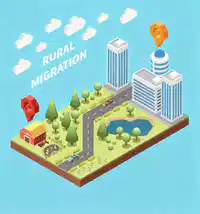
Urbanization
The process of population shift from rural to urban areas, causing the physical growth of cities.
Land Cover
The physical material like vegetation, structures, or water that is present on the land's surface.
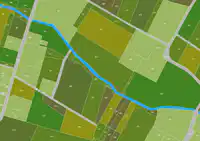
Land Use
How humans utilize and manage land for various activities like farming, housing, or industrial purposes.

Suburb
A smaller town or residential area situated on the outskirts of a larger, major city.
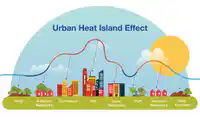
Heat Island
An urban area that becomes much warmer than its surrounding rural areas because of human activities.
4
What Is Urbanization?
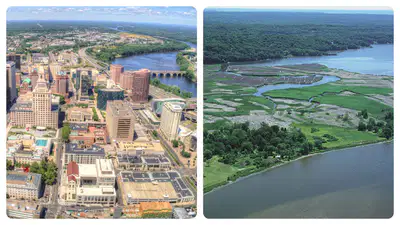
Urbanization is the shift of people from rural to urban areas.
This global phenomenon leads to the physical growth of cities and towns.
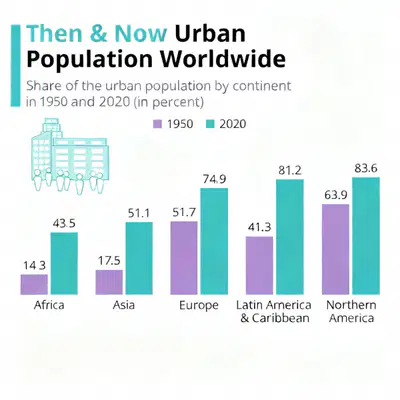
Over half the world’s population now lives in urban areas.
Projections show this will rise to 68% of the world’s population by 2050.
5
Solved Example 1
The world population is projected to be 9.7 billion in 2050. If 68% of people will live in urban areas, calculate the urban population. Round to one decimal place.
Step 1: Analyze and Sketch the Problem
Goal: Calculate the urban population in 2050.
Knowns: Total projected population = 9.7 billion, Percentage in urban areas = 68%.
Unknown: Urban population in 2050.
Formula: Urban Population = Total Population × (Percentage / 100)
6
Solved Example 1
The world population is projected to be 9.7 billion in 2050. If 68% of people will live in urban areas, calculate the urban population. Round to one decimal place.
Step 2: Solve for the Unknown
7
Solved Example 1
The world population is projected to be 9.7 billion in 2050. If 68% of people will live in urban areas, calculate the urban population. Round to one decimal place.
Step 3: Evaluate the Answer
Rounding to one decimal place gives 6.6 billion.
The question asks for the urban population, and our calculation provides that number based on the given data. The answer is reasonable.
8
Multiple Choice
Which statement best defines urbanization?
A decrease in the total global population living in cities.
An increase in the amount of land used for farming.
The movement of people from cities to surrounding suburbs.
The process of population shift from rural areas to urban areas.
9
Land Cover vs. Land Use
Land Cover
Refers to the physical materials that cover the surface of the land.
Examples of land cover include trees, grass, crops, wetlands, and water bodies.
It can also include man-made features like buildings, pavement, and roads.

Land Use
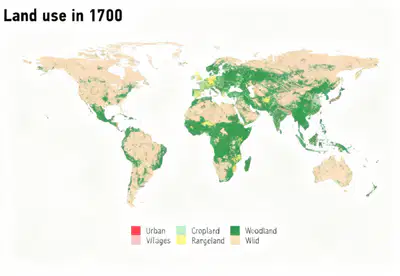
This describes the different ways in which human beings utilize the land.
Land use is directly influenced by the existing land cover of an area.
Common examples are farming, mining, residential areas, and recreational parks.
10
Solved Example 2
A city with a population of 2,500,000 has a total land area of 500 square kilometers. Calculate the population density of the city to determine how many people live per square kilometer.
Step 1: Analyze and Sketch the Problem
Goal: Calculate the population density of the city.
Knowns: Total Population = 2,500,000 people; Total Land Area = 500 km2.
Unknown: Population Density = ?
Formula: Population Density = Total Population / Total Land Area
11
Solved Example 2
A city with a population of 2,500,000 has a total land area of 500 square kilometers. Calculate the population density of the city to determine how many people live per square kilometer.
Step 2: Solve for the Unknown
Use the formula for population density: Population Density = Total Population / Total Land Area.
Substitute the known values and calculate the result: Population Density = 2,500,000 people / 500 km2 = 5,000 people/km2.
12
Solved Example 2
A city with a population of 2,500,000 has a total land area of 500 square kilometers. Calculate the population density of the city to determine how many people live per square kilometer.
Step 3: Evaluate the Answer
To verify the answer, multiply the population density by the total land area: 5,000 people/km2 × 500 km2 = 2,500,000 people.
The result matches the total population, confirming that the population density is 5,000 people per square kilometer.
13
Multiple Choice
Human activities like farming, grazing, and residential development are best described as what?
Land Use
Land Cover
Land Preservation
Urban Sprawl
14
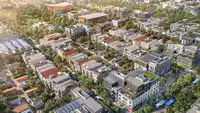
Urban, Suburban, and Rural Areas

Urban
An area mostly covered with buildings, roads, and many people.
A human population of 2,500 or more is required.
Major cities like Miami are examples of urban centers.
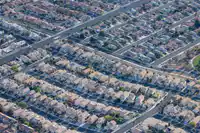
Suburb
A smaller city or town located just outside a larger city.
These are primarily residential but connected to the nearby urban center.
They offer a blend of urban access and quieter living spaces.
Rural
This is land not classified as urban or suburban.
It includes natural landscapes like forests and large open spaces.
Farmlands, rangelands, and deserts are also considered to be rural.
15
Multiple Choice
Which of the following best describes a smaller city or town located outside of a larger city?
A rural area
A heat island
A suburb
An urban center
16
Causes of Urbanization
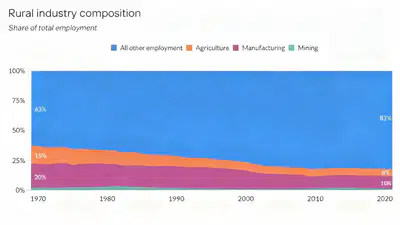
Urbanization accelerated with the Industrial Revolution, starting a new era of city growth.
Cities offer economic opportunities and jobs in manufacturing, technology, and other services.
People move from rural areas for better services like healthcare and education.
Factories and transport routes like railways and highways fuel city growth and development.

17
Solved Example 3
In 1950, a country's urban population was 20 million. By 2020, it grew to 80 million. What was the percentage increase in the urban population over this period?
Step 1: Analyze and Sketch the Problem
Goal: Calculate the percentage increase in the urban population.
Knowns: Initial Population (1950) = 20 million; Final Population (2020) = 80 million.
Unknown: Percentage Increase = ?
Formula: Percentage Increase = ((Final Value - Initial Value) / Initial Value) * 100
18
Solved Example 3
In 1950, a country's urban population was 20 million. By 2020, it grew to 80 million. What was the percentage increase in the urban population over this period?
Step 2: Solve for the Unknown
19
Solved Example 3
In 1950, a country's urban population was 20 million. By 2020, it grew to 80 million. What was the percentage increase in the urban population over this period?
Step 3: Evaluate the Answer
The urban population more than doubled, so the increase must be over 100%. A 300% increase means the population quadrupled.
This matches the data, as the population grew from 20 million to 80 million (a fourfold increase). Therefore, the answer is logical.
20
Multiple Choice
According to the content, what is a primary factor that draws people from rural areas to urban areas?
More job opportunities
A desire to live farther from transportation routes
The decline of the Industrial Revolution
More open space and less pollution
21
Environmental Impacts of Urbanization
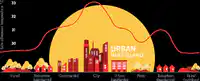
Heat Islands
Cities can become warmer than surrounding rural areas.
Concrete and asphalt absorb and retain more heat.
This phenomenon can alter local weather patterns.

Waste and Pollution
Urban areas generate large amounts of waste.
Burning fossil fuels for resources causes air pollution.
Cities also experience noise and light pollution.
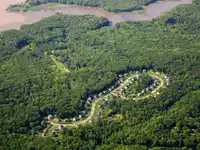
Habitat Destruction
Natural areas are cleared for buildings and roads.
This expansion destroys the homes of wildlife.
It leads to a loss of biodiversity.
22
Multiple Choice
What is a "heat island"?
A city that relies entirely on renewable energy sources.
A rural area with unusually high temperatures due to farming.
A designated preservation area within a city for wildlife.
An urban area that is significantly warmer than its surrounding areas.
23
Benefits of Urbanization
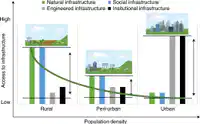
Efficiency
Serving dense populations requires less fuel and fewer resources.
It is easier and more efficient to distribute goods.
Providing services to people becomes more resource-efficient.
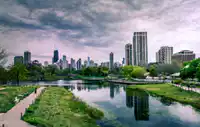
Land Preservation
Urban centers focus human activity into a smaller area.
This helps to preserve land for agriculture and wilderness.
More room is left for biodiversity and open spaces.
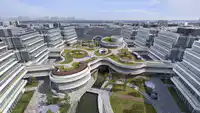
Innovation
Cities often have universities and advanced research centers.
A high concentration of knowledge helps to foster ideas.
This leads to the development of new modern technologies.
24
Multiple Choice
Which of the following is an environmental benefit of urbanization?
Urbanization eliminates the need to import resources like food and water.
The creation of heat islands helps regulate local weather patterns.
Dense urban centers can leave more room for wilderness and agriculture.
Urban sprawl helps to create new habitats for a variety of wildlife.
25
Common Misconceptions About Urbanization
Misconception | Correction |
|---|---|
Urbanization is a modern phenomenon. | The first cities emerged thousands of years ago. |
Cities are entirely bad for the environment. | Their density can help preserve land elsewhere. |
Urbanization only means cities are getting bigger. | It is a population shift from rural to urban areas. |
26
Multiple Choice
What is the primary reason urbanization can lead to the formation of "heat islands"?
Because the high population density generates a large amount of body heat.
Because there is less wind in cities to cool the area down.
Because cities are often located in naturally warmer climates near the coast.
Because infrastructure like roads and buildings absorb and retain more heat than natural land cover.
27
Multiple Choice
How did the Industrial Revolution contribute to the rise of urbanization?
It created new industries and factory jobs in central locations, drawing people away from farming.
It improved transportation, making it easier for people to live in the countryside and work in the city.
It led to the discovery of new farming techniques that required fewer workers.
It made rural life more difficult, forcing people to abandon their farms.
28
Multiple Choice
How does the development of a new residential suburb affect both land use and land cover?
The land use changes to residential, which in turn changes the land cover from natural vegetation to buildings and roads.
The land cover changes to residential, which in turn changes the land use from buildings to natural vegetation.
The land use and land cover are independent, so a change in one does not affect the other.
The development of a suburb only affects land use, not land cover.
29
Multiple Choice
Given the impacts of urbanization, what is the most likely outcome if a city expands without proper urban planning?
A seamless integration of new infrastructure with no negative environmental effects.
An increase in traffic congestion, habitat destruction, and social inequality.
A decrease in pollution, the formation of heat islands, and population growth.
An increase in land preservation, resource efficiency, and public transportation.
30
Summary
Urbanization is the movement of people from rural areas to cities.
Land cover is the land’s physical surface; land use is how humans use it.
Economic opportunities and better services are key drivers of urbanization.
Urbanization can cause heat islands, pollution, and habitat loss.
Well-planned cities can be efficient and encourage innovation.
Sustainable urban planning helps manage the challenges of population growth.
31
Poll
On a scale of 1-4, how confident are you about the concepts covered in today's review?
1
2
3
4
Urbanization
High School
Show answer
Auto Play
Slide 1 / 31
SLIDE
Similar Resources on Wayground

23 questions
Forensics: Observation
Presentation
•
9th - 12th Grade
23 questions
Plastic Pollution Awareness
Presentation
•
KG - 12th Grade
25 questions
Bohr Models
Presentation
•
10th - 12th Grade
21 questions
Climate Part 1: Spheres of the Earth
Presentation
•
9th - 12th Grade
24 questions
Ecology
Presentation
•
10th - 12th Grade
22 questions
The Moon
Presentation
•
8th - 12th Grade
25 questions
Biome Quiz Review
Presentation
•
9th - 12th Grade
24 questions
Cell Cycle: Checkpoints and Cancer
Presentation
•
9th - 12th Grade
Popular Resources on Wayground
11 questions
Hallway & Bathroom Expectations

Quiz
•
6th - 8th Grade
10 questions
HCS SCI 03 Summer School Assessment 2
Quiz
•
3rd Grade
11 questions
Home Scope
Quiz
•
7th - 8th Grade
12 questions
2026 TAP Technology in the Classroom
Presentation
•
Professional Development
15 questions
HCS SCI 05 Summer School Assessment 2 Review
Quiz
•
5th Grade
15 questions
HCS SCI 04 Summer School Review 2
Quiz
•
4th Grade
59 questions
Geometry Unit 3 Review
Quiz
•
9th - 12th Grade
14 questions
FAST ELA READING SMAPLE TEST MATERIALS

Passage
•
3rd Grade