

USH Chapter 8, Part C

Presentation
•
English
•
9th Grade
•
Medium
+19
Standards-aligned

Beth Harrison
Used 1+ times
FREE Resource
15 Slides • 23 Questions
1

2

3
Multiple Choice
Which of the following best describes the lifestyle of most Plains Indians?
They lived as nomads, following buffalo herds.
They settled permanently and farmed the land.
They lived in large cities and traded with Europeans.
They spent most of their time at sea.
4
Multiple Choice
What type of government did the Plains Indian nations have?
The were ruled by a governing council but anyone could help make decisions.
They had no form of government
They had a single leader, a dictator.
They had republic, much like the United States government.
5

6
Multiple Choice
What were some of the main reasons that ranchers, miners, and farmers coming onto the Plains led to conflict with Native Americans?
They brought new technology to the Plains.
They deprived Native Americans of hunting grounds and broke treaties.
They helped Native Americans relocate peacefully.
They traded fairly with the Plains Indians.
7
Fill in the Blanks
8

9
Open Ended
Explain how the delay in annuity payments contributed to the Dakota Sioux Uprising.
10

11
Fill in the Blanks
12
Drag and Drop
13

14
Multiple Select
Which of the following leaders were involved in the Lakota Sioux's defense of their territory? (Check all that apply)
Red Cloud
Crazy Horse
Sitting Bull
Little Crow
15
Multiple Choice
Captain Fetterman and 80 troops were lured into a trap by_____.
The battle was known as the Fetterman Massacre.
Crazy Horse
Little Crow
Red Cloud
Sitting Bull
16

17
Fill in the Blanks
18
Multiple Choice
The Cheyenne, led by Chief _______, went to Fort Lyon to negotiate a peace treaty with the US army.
Black Kettle
Sitting Bull
Little Crow
Crazy Horse
19

20
Fill in the Blanks
21
Open Ended
Describe the impact of the Sand Creek events on relations between Native Americans and settlers.
22

23
Multiple Choice
What was the main reason Congress formed the Indian Peace Commission in 1867?
To create two large reservations for Native Americans
To end the Civil War
To encourage buffalo hunting
To assimilate Native Americans into American society
24
Multiple Choice
Under the Indian Peace Commission, who would run the reservations?
The governor of the state where the reservation is located
The Ruling Council of the tribe
The agents of the Bureau on Indian Affairs.
US army commander stationed at the reservation.
25

26
Open Ended
How did the disappearance of buffalo impact Native Americans on the southern Plains in the 1870s?
27

28
Multiple Select
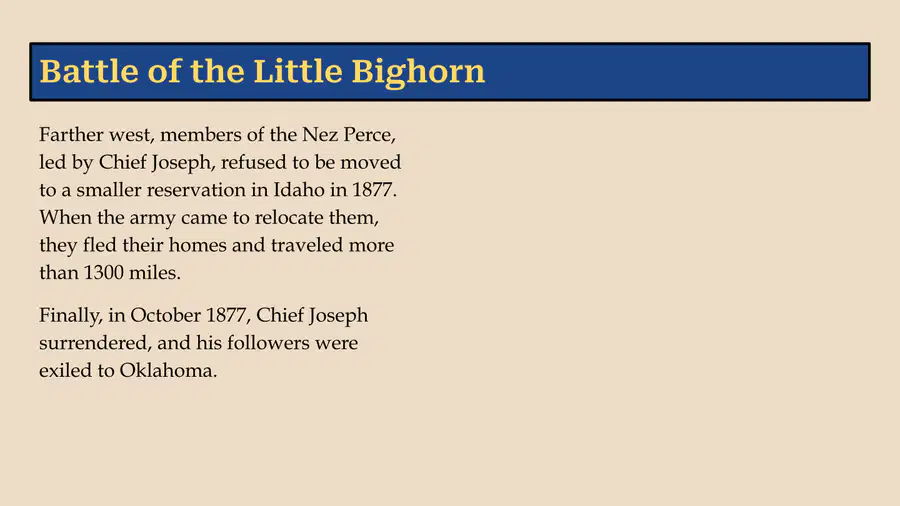
Which of the following events were direct consequences of the Battle of the Little Bighorn?
(Check all that apply.)
Custer and his soldiers were killed
Sitting Bull fled to Canada
The Lakota were forced to return to the reservation
The Dawes Act was passed
29
Drag and Drop
30
31
Fill in the Blanks
32

33
Open Ended
Describe the significance of the Ghost Dance and its role in the events at Wounded Knee.
34

35
Multiple Choice
Who wrote A Century of Dishonor?
Helen Hunt Jackson
Stephen Long
Abraham Lincoln
Sitting Bull
36
Fill in the Blanks
37
38
Multiple Choice
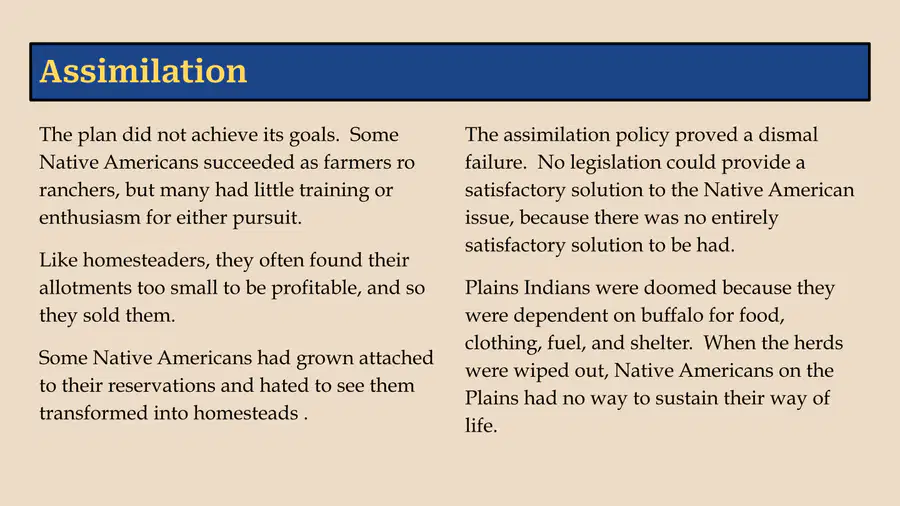
Why did the assimilation policy fail to achieve its goals for Native Americans on the Plains?
Many Native Americans had little training or enthusiasm for farming or ranching.
The government provided too much land to each Native American family.
Native Americans were able to sustain their traditional way of life.
The buffalo herds increased, providing more resources for Native Americans.
Show answer
Auto Play
Slide 1 / 38
SLIDE
Similar Resources on Wayground

35 questions
Poetry Elements Notes
Presentation
•
9th Grade
31 questions
Unit 7- Lesson 7 Grade 9 General
Presentation
•
9th Grade
33 questions
6.2 Intro to Quadratics
Presentation
•
9th Grade
34 questions
2) Harmony (chord notes) + recognition of notes
Presentation
•
9th Grade
27 questions
Passive Voice - Past Simple
Presentation
•
9th Grade
32 questions
Prepositions
Presentation
•
9th Grade
30 questions
Fragments, Comma Splices, and Fused Sentences
Presentation
•
10th Grade
29 questions
Unusual sports from around the world
Presentation
•
10th Grade
Popular Resources on Wayground
11 questions
Hallway & Bathroom Expectations

Quiz
•
6th - 8th Grade
10 questions
HCS SCI 03 Summer School Assessment 2
Quiz
•
3rd Grade
11 questions
Home Scope
Quiz
•
7th - 8th Grade
12 questions
2026 TAP Technology in the Classroom
Presentation
•
Professional Development
15 questions
HCS SCI 05 Summer School Assessment 2 Review
Quiz
•
5th Grade
15 questions
HCS SCI 04 Summer School Review 2
Quiz
•
4th Grade
59 questions
Geometry Unit 3 Review
Quiz
•
9th - 12th Grade
14 questions
FAST ELA READING SMAPLE TEST MATERIALS

Passage
•
3rd Grade