

Chapter 5 (tissues) PowerPoint

Presentation
•
Science
•
6th - 8th Grade
•
Medium
Standards-aligned

Davida Walls
Used 5+ times
FREE Resource
68 Slides • 30 Questions
1

2

3
Multiple Choice
Which type of tissue is primarily responsible for producing body movement?
Epithelial tissue
Connective tissue
Muscular tissue
Nervous tissue
4

5
Multiple Choice
Which type of tissue is responsible for conducting impulses for coordination, regulation, integration, and sensory reception?
Epithelial
Connective
Muscle
Nervous
6

7

8
Multiple Choice
Micrographs help in the study of tissues and what information can be obtained from observing different tissue sections because
the _____ features of _____ can be studied
microscopic, features
macroscopic, features
9

10
Multiple Select
Which of the following are general characteristics of epithelial tissues?
Widespread throughout the body
Contain many blood vessels
Anchored to underlying connective tissues by a basement membrane
Cells are loosely packed
11

12
Multiple Choice
Which of the following is NOT a function of epithelial tissues?
Protection
Absorption
Movement
Secretion
13
Multiple Choice
Epithelial tissues are classified by cell shape and the number of ___ layers.
tissue
14

15
Multiple Choice
All of these are the main structural and functional features of simple squamous epithelium EXCEPT:
Single layer
flattened
secretion and absorption
diffusion and filtration
16

17
Multiple Choice
Which of the following best describes the structure and location of simple squamous epithelium as shown in the diagram?
A single layer of flat cells lining blood vessels and air sacs of lungs
Multiple layers of cube-shaped cells lining kidney tubules
A single layer of tall, elongated cells lining the intestine
Multiple layers of flat cells covering the skin
18

19
Multiple Select
Which of the following are functions of simple cuboidal epithelium?
Urine formation in the kidneys
Secretion in glands
Protection against abrasion
Absorption of nutrients
20
Open Ended
Compare the main structural differences between simple squamous epithelium and simple cuboidal epithelium, and explain how these differences relate to their functions.
21

22

23
Fill in the Blanks
24

25

26
Multiple Select
Which of the following features are present in the simple columnar epithelium as shown in the diagram?
Microvilli
Goblet cells
Multiple layers of cells
Nuclei near the basement membrane
27
Open Ended
Explain the significance of microvilli and goblet cells in the function of simple columnar epithelium.
28
29

30
Multiple Choice
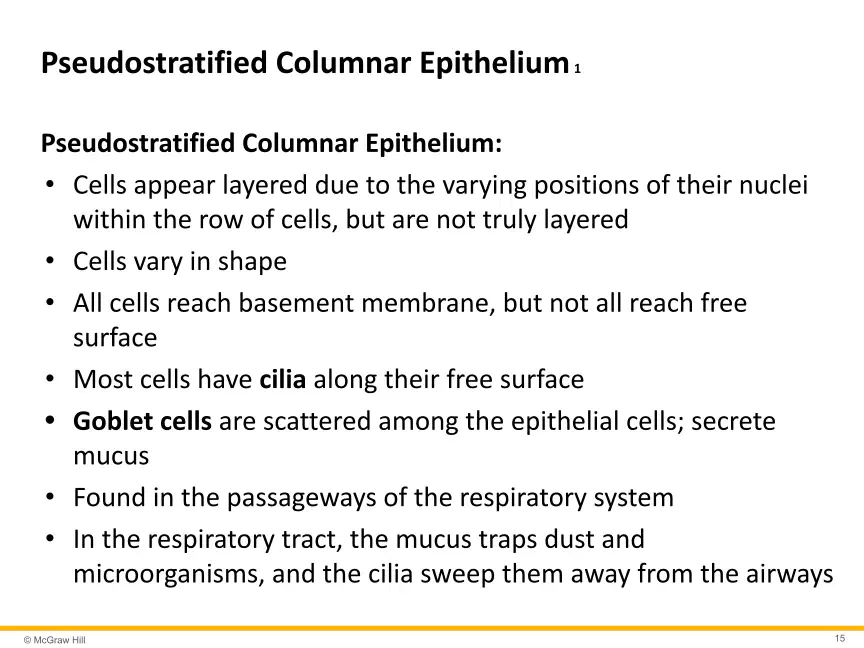
Which of the following best describes the function of cilia in pseudostratified columnar epithelium?
They secrete mucus to trap dust and microorganisms
They sweep mucus and trapped particles away from the airways
They provide structural support to the tissue
They divide to replace damaged cells
31

32

33
Multiple Select
Which of the following are characteristics of stratified squamous epithelium?
Composed of many layers of flattened cells
Undergoes keratinization in the skin
Lines ducts of sweat glands
Provides greater protection than a single cell layer
34
Open Ended
Compare the structure and function of pseudostratified columnar epithelium and stratified squamous epithelium.
35

36
Fill in the Blanks
Type answer...
37

38
Open Ended
Describe how the structure of stratified cuboidal epithelium relates to its function in glandular ducts.
39
Multiple Choice
What is the main advantage of having stratified cuboidal epithelium lining the ducts of glands?
It allows for rapid diffusion
It provides greater protection than a single cell layer
It secretes hormones
It absorbs nutrients
40

41

42
Multiple Choice
Which of the following best describes the structure and location of stratified columnar epithelium?
Consists of several layers with columnar cells on the surface, found in male urethra and large gland ducts
Consists of a single layer of flat cells, found in air sacs of lungs
Consists of several layers with squamous cells on the surface, found in skin
Consists of cube-shaped cells, found in kidney tubules
43

44
Fill in the Blanks
Type answer...
45

46
Labelling
Label the types of epithelial tissues by dragging them to their correct locations.
Stratified squamous
Simple squamous
Stratified columnar
Pseudostratified
Simple cuboidal
Simple columnar
47
Multiple Select
Which of the following are functions of transitional epithelium?
Stretchability
Protection
Absorption
Filtration
48
Open Ended
Compare the structural differences between stratified columnar epithelium and transitional epithelium, and explain how these differences relate to their functions.
49

50
Multiple Choice
Match the epithelial tissue type with its primary function: Simple squamous epithelium, Stratified squamous epithelium, Transitional epithelium, Stratified columnar epithelium.
Filtration; Protection; Stretchability; Protection, secretion
Protection; Filtration; Secretion; Stretchability
Secretion; Stretchability; Filtration; Protection
Stretchability; Protection; Secretion; Filtration
51

52
Multiple Choice
What is the main difference between exocrine and endocrine glands?
Exocrine glands secrete into ducts, endocrine glands secrete into body fluids or blood
Exocrine glands secrete hormones, endocrine glands secrete enzymes
Exocrine glands are made of squamous cells, endocrine glands are made of cuboidal cells
Exocrine glands are found only in the skin, endocrine glands are found only in the brain
53

54

55

56

57
Multiple Choice

58

59

60

61

62

63

64

65

66

67

68

69
Multiple Choice

Which of the following is NOT a reason why BLOOD is a connective tissue?
cells are loosely packed
ground substance includes clotting fibers
extracellular matrix is liquid
functions to bind and support
70

71

72

73

74

75

76

77

78

79

80

81

82

83

84

85

86

87

88

89

90

91

92

93

94

95

96

97
Open Ended
How do the structural differences among the four major tissue types contribute to their specific functions in the human body?
98
Multiple Choice
Which of the following is NOT one of the four major types of tissues in the human body?
Epithelial tissue
Connective tissue
Digestive tissue
Muscular tissue
Show answer
Auto Play
Slide 1 / 98
SLIDE
Similar Resources on Wayground

92 questions
Project Management Foundations
Presentation
•
KG
96 questions
Properties of Operations on the set of Integers
Presentation
•
7th Grade
90 questions
Units 5 & 6: The Universe, Sun, Earth, & Moon
Presentation
•
8th Grade
92 questions
Sol 7.2
Presentation
•
7th Grade
95 questions
EOC MAP Math Slides
Presentation
•
7th Grade
91 questions
Unit Lessons
Presentation
•
7th Grade
99 questions
Test de Posit Vente Commerce Niveau 4
Presentation
•
KG
Popular Resources on Wayground
11 questions
Hallway & Bathroom Expectations

Quiz
•
6th - 8th Grade
10 questions
HCS SCI 03 Summer School Assessment 2
Quiz
•
3rd Grade
11 questions
Home Scope
Quiz
•
7th - 8th Grade
12 questions
2026 TAP Technology in the Classroom
Presentation
•
Professional Development
15 questions
HCS SCI 05 Summer School Assessment 2 Review
Quiz
•
5th Grade
15 questions
HCS SCI 04 Summer School Review 2
Quiz
•
4th Grade
59 questions
Geometry Unit 3 Review
Quiz
•
9th - 12th Grade
14 questions
FAST ELA READING SMAPLE TEST MATERIALS

Passage
•
3rd Grade