

Calculus 5.1: Mean Value Theorem and Critical Points

Presentation
•
Mathematics
•
9th - 12th Grade
•
Easy
Standards-aligned

J Barrientos
Used 2+ times
FREE Resource
48 Slides • 3 Questions
1
By J Barrientos
2
We will determine the critical points of a function.
Objective #2
We will use the Mean Value Theorem to determine when the derivative of a function is equal to its average rate of change.
Objective #1
3
Setup
In Topic 1 we discussed the Intermediate Value Theorem. The IVT allowed us to determine whether a function had a specific value over a given interval when certain conditions were met. In this lesson we are going to on the Mean Value Theorem, which will allow us to take a similar approach with the derivative.
4
Discuss
Think about this scenario. You wake up in Harlingen in the morning, and you drive to Austin, where you end the day.
Which direction can you guarantee that you drove that day? Discuss with your partner how you know you can guarantee this.
5
Discuss
Think about this scenario. You wake up in Harlingen in the morning, and you drive to Austin, where you end the day.
Answer: You can guarantee that you drove NORTH.
How do we know?
Austin, is due north of Harlingen. And while we don't know the exact route that was driven, you had to have gone north to have ended up north. Could you have driven in the other directions? Yes, but we can't guarantee.
6

7
Idea
When we talk about direction, that is similar to the slope of a graph. So how can we take this concept and formalize it in calculus?
8
MVT
If a function f is continuous on over the interval [a, b] and differentiable over the interval [a, b], then there exists a point within that open interval where the instantaneous rate of change (derivative) equals the average rate of change over the interval.
9
MVT
In other words, there must be a point where f'(x) = AROC as long as the function is continuous and differentiable on a given interval [a, b].
10

f(x) is continuous and differentiable
f'(x) = AROC
MVT
11
Example #1
12
Example #1
13
Example #1
14
Things to Note
If you are going to apply the MVT always ensure a function is continuous or differentiable.
Ensure there are no corners or cusps on a graph.
15
Math Response
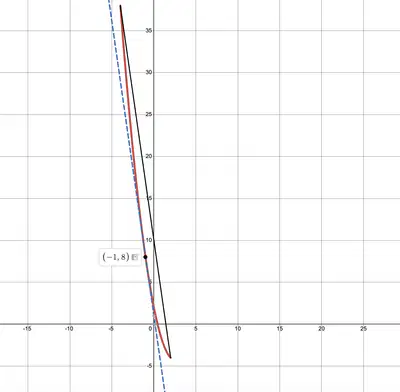
Use the function f(x)=x2−10x+3 on the interval [-1, 4] to determine when the IROC equals the AROC.
16
Using the MVT, find where the IROC = AROC
17
18
Using the MVT, find where the IROC = AROC
19
Using the MVT, find where the IROC = AROC
20
Using the MVT, find where the IROC = AROC
21
Math Response
Using the MVT, find the value of x where the IROC = AROC of the given function.
f(x)=x3−2x2+10x−1[2,5] Round to two decimal places as needed.
22
On a given interval, you will have a y-value at each of the end points of the interval. Every y-value exists between these two y-values.
Only looks at y-values.
IVT
The derivative must equal the average rate of change.
Only looks at derivative and slope.
MVT
23
24
25
Setup
Next, we are going to focus on identify the critical points of a function. An important part of mathematics and calculus is understanding the behaviors and properties of a function.
Critical points will help us 'shape' a function by simply knowing its behaviors.
26
What is a Critical Point?
As the name implies, a critical point is an important point of a function.
Specifically it is 'A point on a function where the derivative of the function is either zero or undefined'.
27
Discuss
What happens when the slope of a graph is 0?
What happens when the slope is undefined?
28
When do they occur?
Critical Points will occur when graphs have a Horizontal Tangent Line (0 slope), at corners, and at cusps.
29
Types of Critical Points
There are two types of critical points you will encounter:
- Absolute (Global) or Relative (Local) Maximum/Minimum
- Points of Inflection (Lesson 5.4)
Why do Maximums/Minimums occur?
30
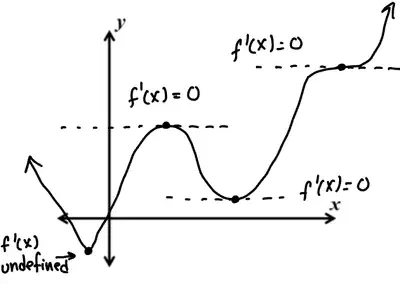
On a graph, critical points can be found where the derivative is equal to 0 or undefined.
Critical Points on a Graph
31
How do we find them?
Take the derivative of a given function.
Set the derivative equal to 0 and/or set the denominator equal to 0 if rational.
Solve for the value of x. Check the domain.
32
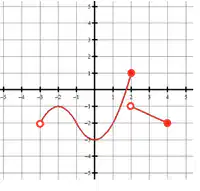
Graph Example
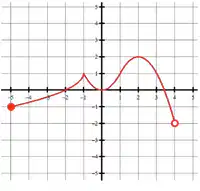
Identify the critical points on the following graph. Identify the types of critical points.
33
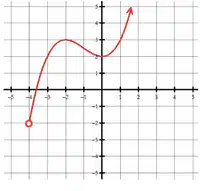
Graph Example
Identify the critical points on the following graph. Identify the types of critical points.
34
Graph Example
Identify the critical points on the following graph. Identify the types of critical points.
35
Extreme Value Theorem
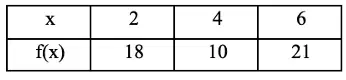
If a function is continuous on a closed and bounded interval [a, b], it is guaranteed to have an absolute max and minimum within that interval.
*Note that this does not tell us where the maximum or minimum is located, only that it exists in the interval.
36
From a Table

37
From a Table
38
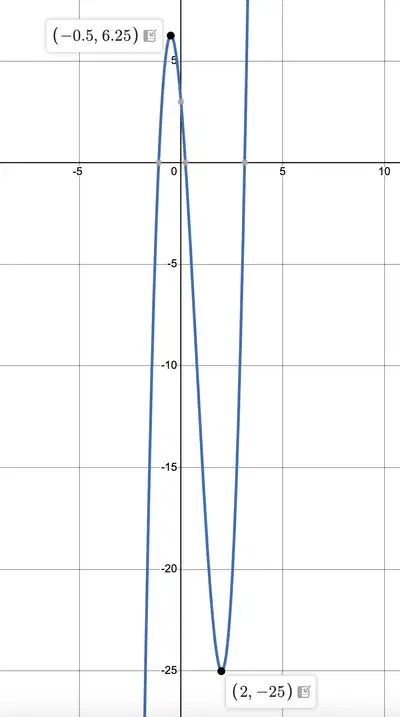
Function Example
39
Function Example
40
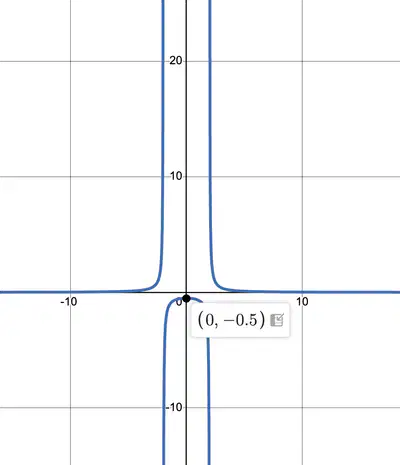
Function Example
41
Function Example
42
Function Example
43
Function Example
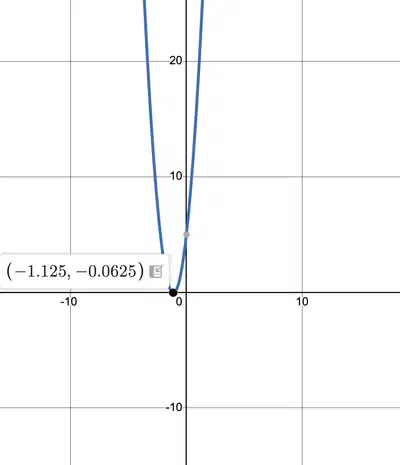
44
Function Example
45
Function Example
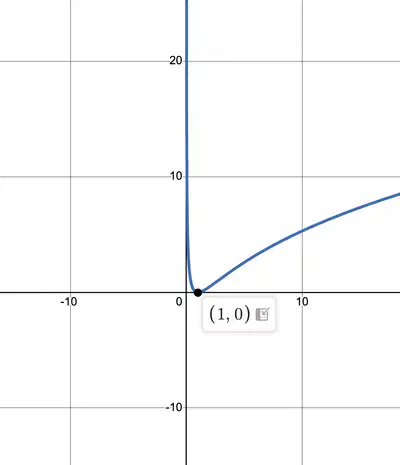
46
Function Example
47
Function Example
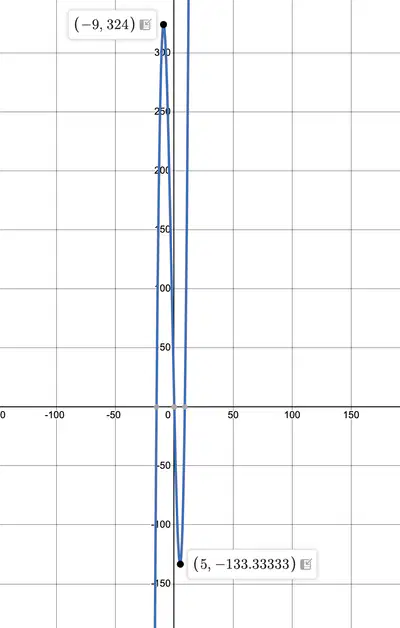
48
Function Example
49
Function Example
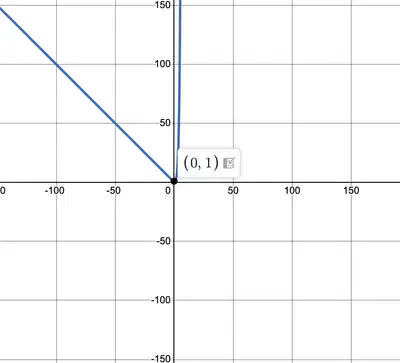
50
Multiple Select
f(x)=31x3−3x2+8x+14
Find the critical numbers of f(x). Select ALL that apply
x=2
x=0
x= -4
x= -2
x = 4
51
AP Exam Questions
By J Barrientos
Show answer
Auto Play
Slide 1 / 51
SLIDE
Similar Resources on Wayground

44 questions
Phase Diagrams and Heating/Cooling Curves
Presentation
•
9th - 12th Grade
48 questions
Math Mindset and Attitudes Survey
Presentation
•
9th - 12th Grade
46 questions
3.1 - 3.4 Review_Alg2
Presentation
•
9th - 12th Grade
45 questions
Skeletal System
Presentation
•
9th - 12th Grade
46 questions
End Behavior of a Polynomial Function
Presentation
•
9th - 12th Grade
42 questions
4-3 Logarithmic Functions
Presentation
•
9th - 12th Grade
46 questions
A2 Final Exam Review 22-23 S1 (Pt. 2)
Presentation
•
9th - 12th Grade
45 questions
Angles
Presentation
•
9th - 12th Grade
Popular Resources on Wayground
10 questions
How much do you know about our Portrait of an Eagle?

Quiz
•
10th Grade
10 questions
Fast Food Slogans
Quiz
•
6th - 8th Grade
21 questions
Continents and Oceans
Quiz
•
6th Grade
20 questions
Parts of Speech
Quiz
•
5th Grade
16 questions
Subject & Predicate
Quiz
•
5th Grade
25 questions
Multiplication Facts
Quiz
•
5th Grade
12 questions
Map Skills
Quiz
•
3rd Grade
22 questions
Continents and Oceans
Quiz
•
5th Grade
Discover more resources for Mathematics
20 questions
Graphing Inequalities on a Number Line
Quiz
•
6th - 9th Grade
10 questions
Translating Algebraic Expressions
Quiz
•
9th Grade
20 questions
Exponent Rules
Quiz
•
8th - 9th Grade
20 questions
Function or Not a Function
Quiz
•
8th - 9th Grade
10 questions
Literal Equations
Quiz
•
9th Grade
18 questions
Discrete Vs. Continuous Practice
Quiz
•
9th Grade
10 questions
Solving Absolute Value Equations
Quiz
•
9th Grade
10 questions
Identifying equations
Quiz
•
KG - University