
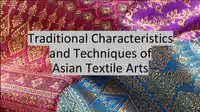
Traditional Characteristics and Techniques of Asian Textile Arts

Presentation
•
Arts
•
8th Grade
•
Easy

Kwisstinski Lmr
Used 2+ times
FREE Resource
0 Slides • 23 Questions
1
Multiple Choice
Which of the following is a key feature of Shu Embroidery?
It uses loose stitches for simple designs.
It is associated with Beijing.
It is tightly stitched, leading to intricate designs.
It originated in the Tang Dynasty.
2
Multiple Choice
Which key feature distinguishes Shu Embroidery from other types of Chinese embroidery?
Gradual color transitions where threads blend smoothly from one color to another
Imitates painting, engraving, and calligraphy
Displays different images on each side
Delicate lines and elegant designs
3
Multiple Choice
What is a common subject depicted in Shu Embroidery?
Pandas
Lions
Birds
Flowers
4
Open Ended
Compare the artistic techniques used in Shu Embroidery and Xiang Embroidery based on their key features.
5
Multiple Select
Which of the following are features of Xiang Embroidery?
Imitates painting, engraving, and calligraphy
Displays different images on each side
Depicts humans, birds, and animals such as lions and tigers
Gradual color transitions
6
Open Ended
How do the subjects and artistic styles of Shu, Xiang, and Su embroidery reflect the cultural and regional influences of their respective provinces?
7
Fill in the Blanks
Type answer...
8
Open Ended
Explain how Su embroidery achieves its detailed and colorful designs. Use examples from the images.
9
Multiple Choice
Which of the following is NOT a characteristic of Su embroidery from Jiangsu Province?
Uses thin needles for detailed patterns
Mixes different colored threads for the desired hue
Mirror images on both sides
Features motifs of dragons and sun-worshipping birds
10
Fill in the Blanks
Type answer...
11
Multiple Select
Which features distinguish Yue Embroidery from Guangdong Province?
Mirror images on both sides
Motifs of dragons, phoenixes, and sun-worshipping birds
Flat, two-dimensional designs
Uses thin needles for detailed patterns
12
Fill in the Blanks
Type answer...
13
Open Ended
Describe the unique weaving technique used in Kesi silk weaving from Suzhou.
14
Multiple Choice
Which of the following qualities is NOT mentioned as a reason why Kesi is prized?
High-quality materials
Vibrant colors
Detailed craftsmanship
Low cost
15
Fill in the Blanks
Type answer...
16
Multiple Select
Which steps are involved in the process of applique embroidery as described in the image?
Cutting fabric into patterns
Attaching patterns to base fabric
Securing edges with stitches
Dyeing the fabric
17
Open Ended
Describe the process of traditional Chinese tie-dye and explain how the final design is achieved.
18
Fill in the Blanks
Type answer...
19
Multiple Choice
Why is brocade considered an intricate art form?
Because it uses simple patterns
Because it can be made quickly
Because it requires complex skills and only a small amount can be produced daily
Because it is made from cotton
20
Multiple Choice
Which materials are commonly used to create the luminous patterns in brocade cloth?
Cotton and wool
Silk, gold, and peacock feather yarn
Linen and silver
Polyester and nylon
21
Fill in the Blanks
Type answer...
22
Multiple Choice
Which of the following is NOT one of China’s four famous brocades?
Shu Brocade
Song Brocade
Yun Brocade
Han Brocade
23
Multiple Choice
What role did the Silk Road trade play in the development of embroidery in China?
It introduced new embroidery techniques from Europe.
It helped embroidery flourish by increasing its popularity and trade.
It caused embroidery to decline due to competition.
It limited embroidery to only royal families.
Which of the following is a key feature of Shu Embroidery?
It uses loose stitches for simple designs.
It is associated with Beijing.
It is tightly stitched, leading to intricate designs.
It originated in the Tang Dynasty.
Show answer
Auto Play
Slide 1 / 23
MULTIPLE CHOICE
Similar Resources on Wayground

18 questions
Scatter Plots
Presentation
•
8th Grade
18 questions
Inductive and Deductive Reasoning in Arguments
Presentation
•
8th Grade
18 questions
Lesson 07: Observing More Patterns in Scatter Plots | Unit 6: Associations in Data
Presentation
•
8th Grade
15 questions
Lembaga Keuangan
Presentation
•
8th Grade
21 questions
Age of Exploration Review
Presentation
•
7th Grade
17 questions
English SPM
Presentation
•
8th Grade
18 questions
Chapter 18: A Long Walk to Water
Presentation
•
8th Grade
15 questions
Weather vs Climate
Presentation
•
7th - 9th Grade
Popular Resources on Wayground
19 questions
Naming Polygons

Quiz
•
3rd Grade
10 questions
Prime Factorization
Quiz
•
6th Grade
20 questions
Math Review
Quiz
•
3rd Grade
15 questions
Fast food
Quiz
•
7th Grade
20 questions
Main Idea and Details
Quiz
•
5th Grade
20 questions
Context Clues
Quiz
•
6th Grade
20 questions
Inferences
Quiz
•
4th Grade
19 questions
Classifying Quadrilaterals
Quiz
•
3rd Grade
Discover more resources for Arts
12 questions
Cartoon Characters
Quiz
•
5th - 8th Grade
11 questions
Listening Rhythm Patterns
Quiz
•
6th - 8th Grade
20 questions
Super Hero Quiz
Presentation
•
6th - 12th Grade
30 questions
Dynamics and Articulation
Quiz
•
6th - 8th Grade
36 questions
Music Symbols and Definitions
Quiz
•
6th - 8th Grade
20 questions
Rhythm Quiz 1
Quiz
•
6th - 8th Grade