
Cellular Energy Expansion and Review

Presentation
•
Biology
•
9th - 12th Grade
•
Practice Problem
•
Medium

Everett Cooper
Used 2+ times
FREE Resource
15 Slides • 19 Questions
1
Cellular Energy Expansion and Review
By Everett Cooper
2
Assignment Overview
The Expansion and Review
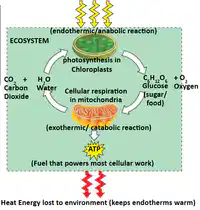
Today you will review the parts of Photosynthesis and Cellular Respiration. As well as adding new details to our knowledge of cellular energy. Diving into more detail on how energy/ATP is created. On the next page is your instructions for the rest of this assignment.
3
Instructions
Review Slides: Review questions will be titled review questions. They are all things that we have gone over in class together. You can use your notes on these questions if you want but it won't be one for one. (You might have to think.
Expansion Slides: The expansion slides will have to parts. An informational section and question. I want you to write the new vocab word in your notebook and then go to the next slide and answer the question about that slide.
4
Photosynthesis Review and Expansion
5
Multiple Choice
Review Question: Where does all energy ultimately come from.
Food
Chlorophyl
ATP
6
Multiple Choice
Review Question: Where in the cell does photosynthesis occur?
Chlorophyl
7
Multiple Choice
Review Question: What is the main product for photosynthesis?
8
Multiple Choice
Review Question: Which of these are the chemical equations for photosynthesis?
Oxygen + Water + light energy -> Glucose + Carbon Monoxide
Oxygen + Glucose -> Carbon Dioxide + Water + chemical energy
None of these.
Carbon Dioxide + Water +Light Energy-> Oxygen + Glucose
9
Multiple Choice
Review Questions: What are the inputs for photosynthesis?
Sunlight, oxygen, and water
10
Multiple Choice
Review Question: What are the main outputs of photosynthesis?
11
Expansion Slides
12
Photosynthesis is more complex than you thought.
The are actually two parts of photosynthesis.
The two parts of photosynthesis are light dependent reactions and light independent interactions. Light dependent reactions use light and water to create oxygen, a small amount of energy, and electron carrier. While independent reactions use CO2 and the products from the dependent to create Glucose.
13
The two types of reactions. (right this in your notebook.)
Also called the Calvin Cycle
Uses the Carbon Dioxide, ATP, and NADPH.
Creates Glucose.
Light Independent interactions
Uses water and Sunlight
Makes Oxygen, a small amount of ATP and NADPH
Light dependent interactions
14

15
Multiple Select
Expansion Question: What are the two types of reactions in photosynthesis? (Choose 2)
Light Independent
Light Dependent
The krebs Cycle
Oxygen dependent
16
Multiple Select
Expansion Question: Which of the photosynthesis inputs are used during the light dependent reactions? (Choose 2)
Light
Carbon Dioxide
Water
17
Multiple Select
Expansion Question: Which of the photosynthesis inputs are used during the light independent reactions? (Choose 1)
Light
Carbon Dioxide
Water
18
Multiple Choice
Expansion Question: Which of the reaction types produces Oxygen?
Light Dependent
Light Independent
19
Multiple Choice
Expansion Question: Which of the reaction types produces Glucose?
Light Dependent
Light Independent
20
Cellular Respiration Expansion and Review
21
Cellular Respiration Review Questions
22
Multiple Select
Review Questions: What are the inputs for cellular respiration? (Select 2)
Water
Oxygen
Carbon Dioxide
Glucose
23
Multiple Choice
Review Question: What is the main goal of cellular respiration?
To produce ATP (Chemical)
To produce glucose.
To produce Oxygen.
To produce Light energy.
24
Multiple Choice
Review Questions: What are the inputs for cellular respiration?
25
Multiple Choice
Review Questions: What are the outputs for cellular respiration?
26
Cellular respiration expansion questions.
27
Cellular respiration is more complex than you think?
There are three different parts cellular respiration.
Glycolysis,
Krebs Citric Acid Cycle or just Krebs Cycle.
Electron Transport Chain
28
Glycolysis (Write this down)
Uses the glucose from photosynthesis or eating.
Turns Sugar into Pyruvate.
Is anerobic (Does not use oxygen).
Create small amount of ATP and NADPH.
29
Krebs Cycle (Write this down)
Pyruvates are brought into the mitochondria.
Pyruvates are broken down into ATP, and electron carriers.
Carbon Dioxide is produced here.
Small amount of ATP is made.
30
Electron Transport Chain (Write in your notes)
Final step in breaking down Glucose if oxygen is present.
Electrons are transported down the transport chain to make the majority of ATP Chemiosmosis.
31
Multiple Select
Expansion Question: Select the three parts of cellular respiration.
Glycolysis
Light dependent reactions
Krebs Cycle
Electron Transport chain
Light independent reactions
32
Multiple Choice
Expansion Questions: What is the main function of glycolysis?
Turns glucose to pyruvate.
Turns carbon dioxide into ATP
Turns fatty acids into glucose.
To produce proteins from amino acids.
33
Multiple Choice
Expansion Question: What is the primary function of the krebs cycle?
To turn pyruvates into ATP and electron carriers (NADH and FADH2)
34
Multiple Choice
Expansion Question: The electron transport chain is responsible for making what?
Light energy.
The majority of the Water
The majority of Carbon Dioxide
The majority of the ATP
Cellular Energy Expansion and Review
By Everett Cooper
Show answer
Auto Play
Slide 1 / 34
SLIDE
Similar Resources on Wayground

25 questions
03.18.24 Populations and Carrying Capacity
Presentation
•
9th - 12th Grade
25 questions
Gas Laws
Presentation
•
9th - 12th Grade
26 questions
6.04: DNA Replication
Presentation
•
9th - 12th Grade
25 questions
Human Impact on the Environment
Presentation
•
9th - 12th Grade
28 questions
The Phosphorus Cycle
Presentation
•
9th - 12th Grade
27 questions
Cell Structure and Function
Presentation
•
9th - 12th Grade
28 questions
Viruses
Presentation
•
8th - 12th Grade
28 questions
Food Chains and Webs
Presentation
•
9th - 12th Grade
Popular Resources on Wayground
24 questions
PBIS-HGMS Day 10

Quiz
•
6th - 8th Grade
10 questions
HCS SCI 03 Summer School Review 3
Quiz
•
3rd Grade
11 questions
Home Scope
Quiz
•
7th - 8th Grade
15 questions
HCS SCI 05 Summer School Assessment 3 Review
Quiz
•
5th Grade
35 questions
Lufkin Road Middle School Student Handbook & Policies Assessment
Quiz
•
7th Grade
18 questions
Geo 11.3 Area of Circles and Sectors
Quiz
•
9th - 11th Grade