Search Header Logo
5.4 Net Ionic Equations Lesson

5.4 Net Ionic Equations Lesson

Assessment

Presentation

Chemistry

10th Grade

Practice Problem

Medium

NGSS
HS-PS1-7, HS-PS2-5, HS-PS1-3

+2

Standards-aligned

Created by

D. Ramirez

Used 1+ times

FREE Resource

27 Slides • 24 Questions

1
media

2

media

3

Open Ended

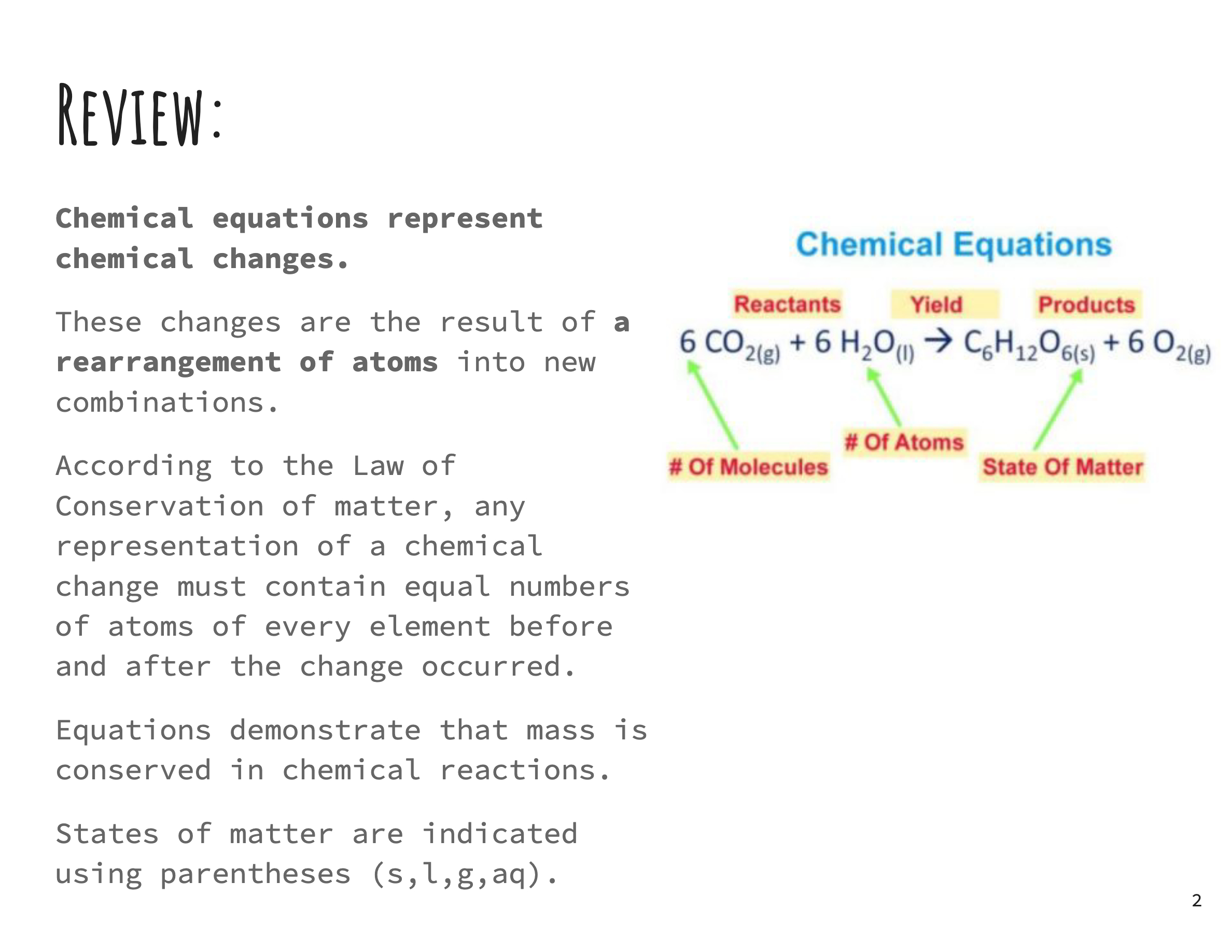
How does the Law of Conservation of Matter influence the way we write chemical equations?

4

Open Ended

According to the Law of Conservation of matter, a chemical equation must contain equal numbers of atoms of every element before and after the change occurred. Why is this important in chemical reactions?

5

media

6

media

7

Fill in the Blank

A solution of NaCl(aq) contains positive and negative ions that can move freely throughout the solution. The movement of ions allows ___ to flow through the solution.

8

Open Ended

Question image

Explain why distilled water does not conduct electricity, while saltwater does.

9
media

10

Multiple Choice

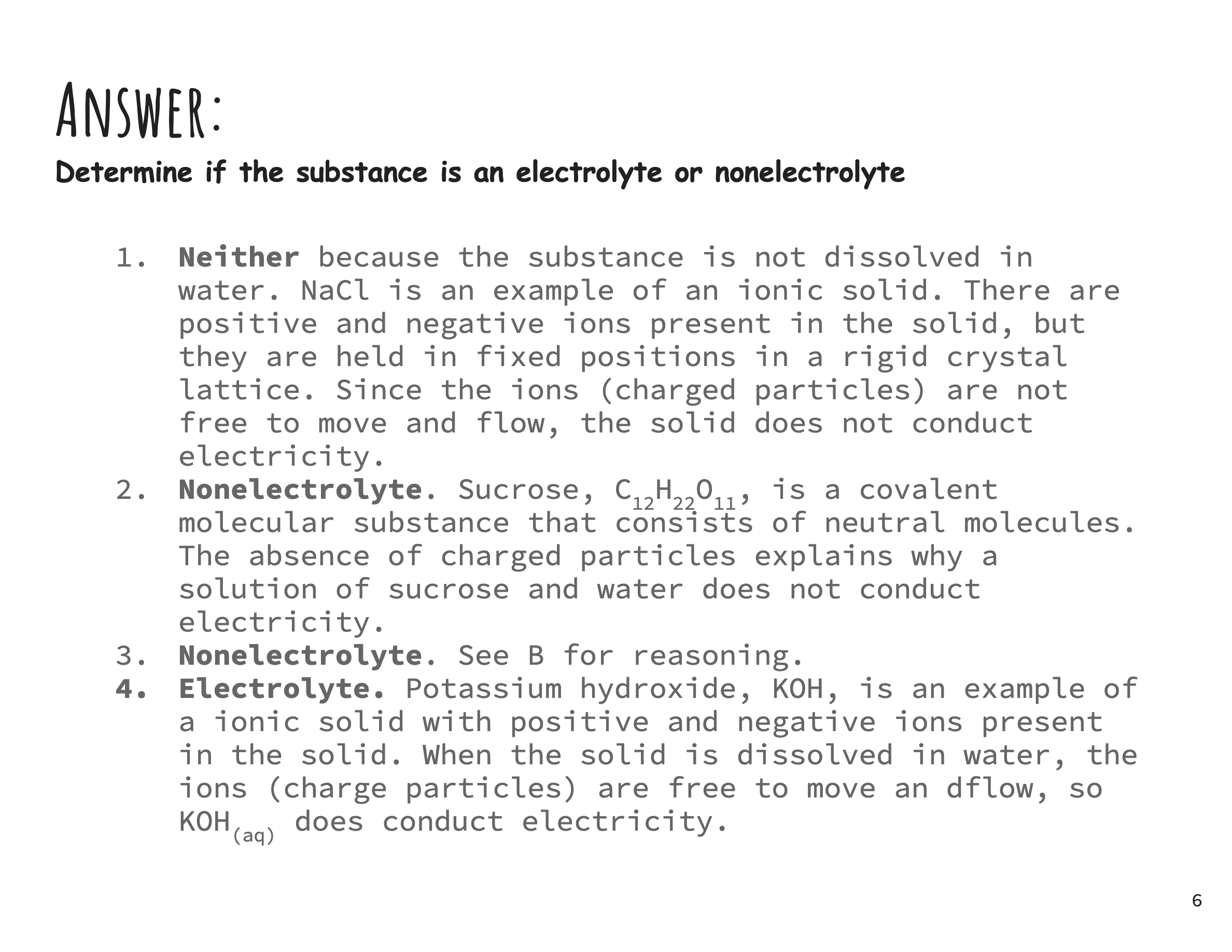
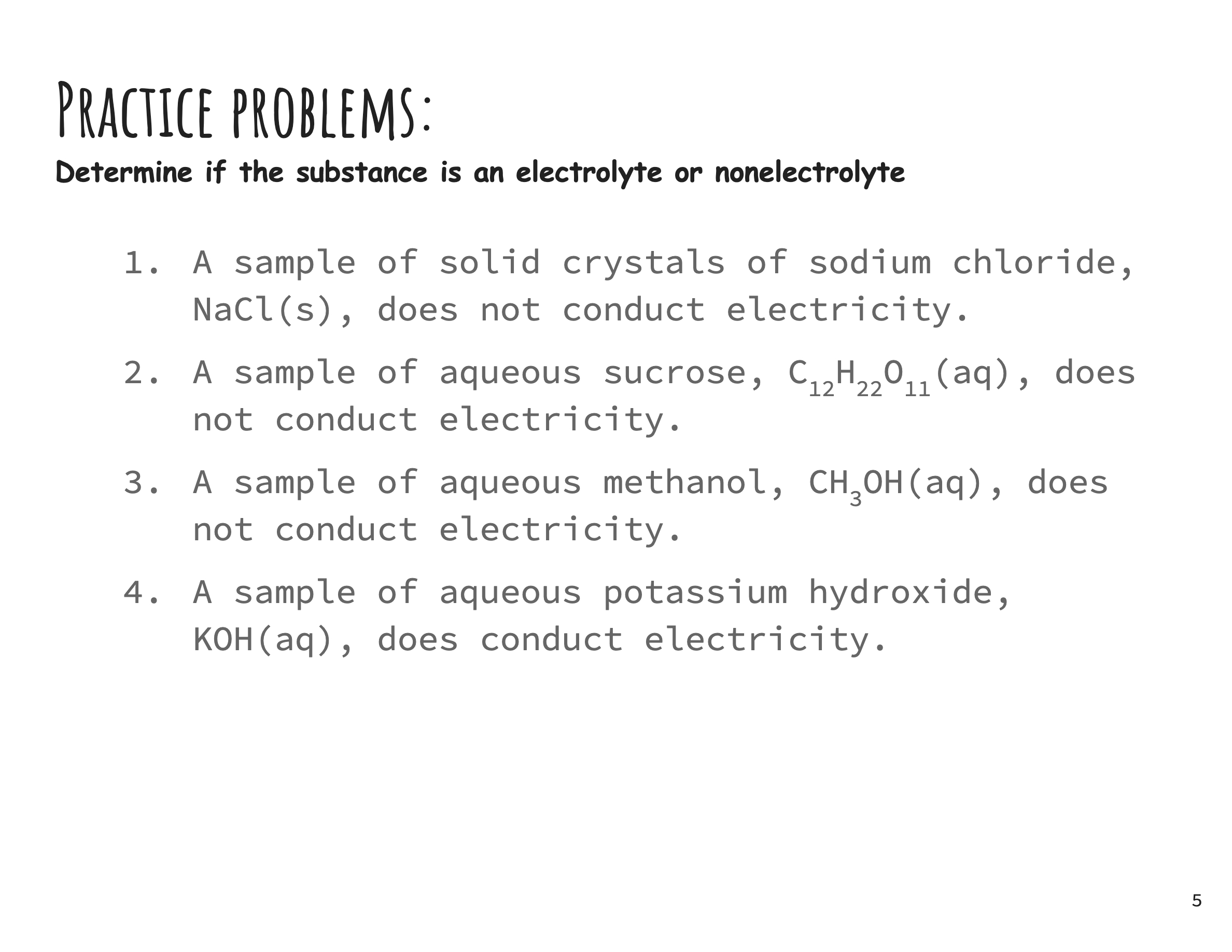
Which of the following substances is an electrolyte?

1

Solid NaCl

2

Aqueous sucrose

3

Aqueous methanol

4

Aqueous KOH

11

media

12

media

13

Open Ended

What do you notice about the dissolution equations for ionic versus covalent solutes in water?

14

media

15

media

16

Multiple Choice

What is the main difference between electrolytes and nonelectrolytes in terms of their behavior in water?

1

Electrolytes dissociate into ions, nonelectrolytes do not

2

Electrolytes dissolve but nonelectrolytes do not

3

Electrolytes are always solids, nonelectrolytes are liquids

4

Electrolytes are organic compounds, nonelectrolytes are inorganic

17

Multiple Choice

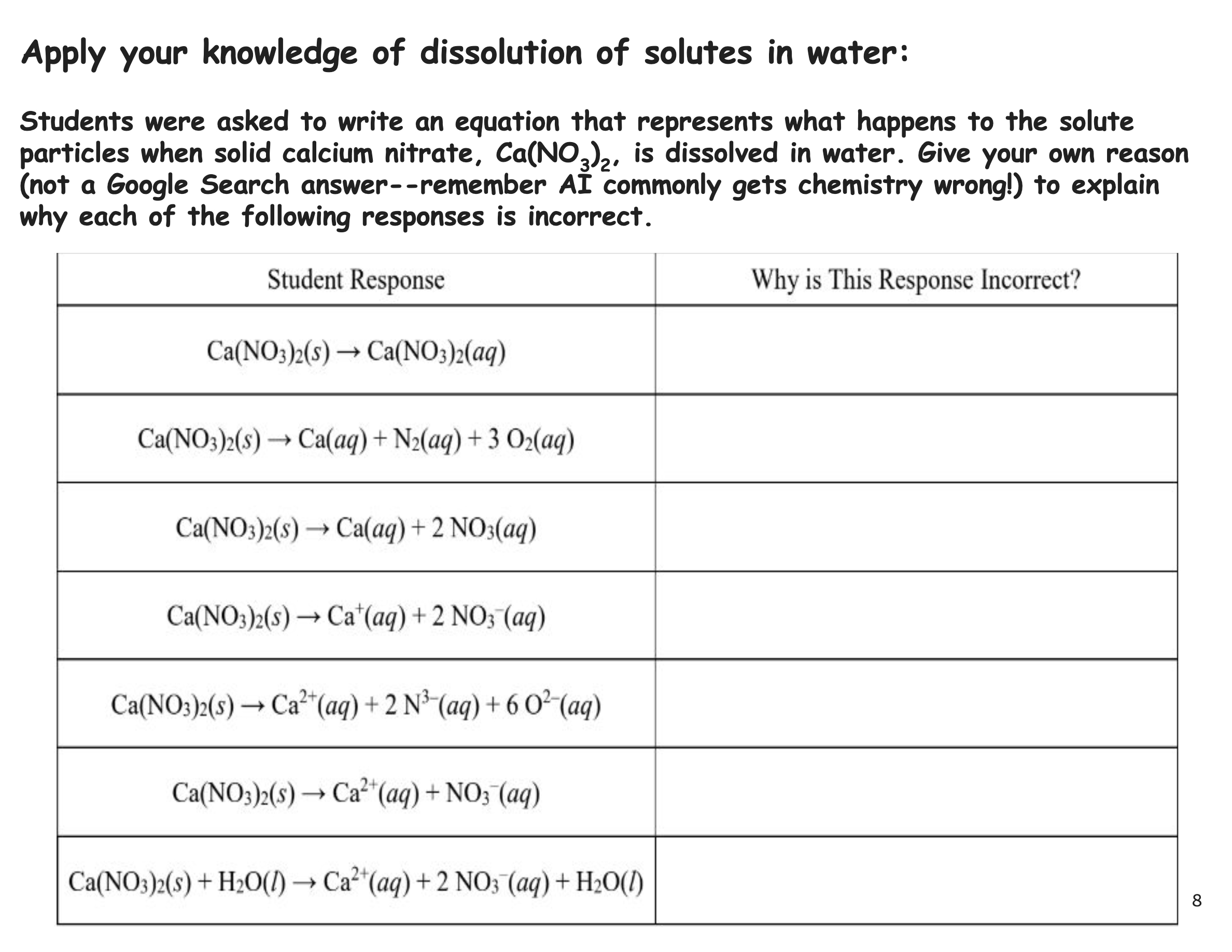
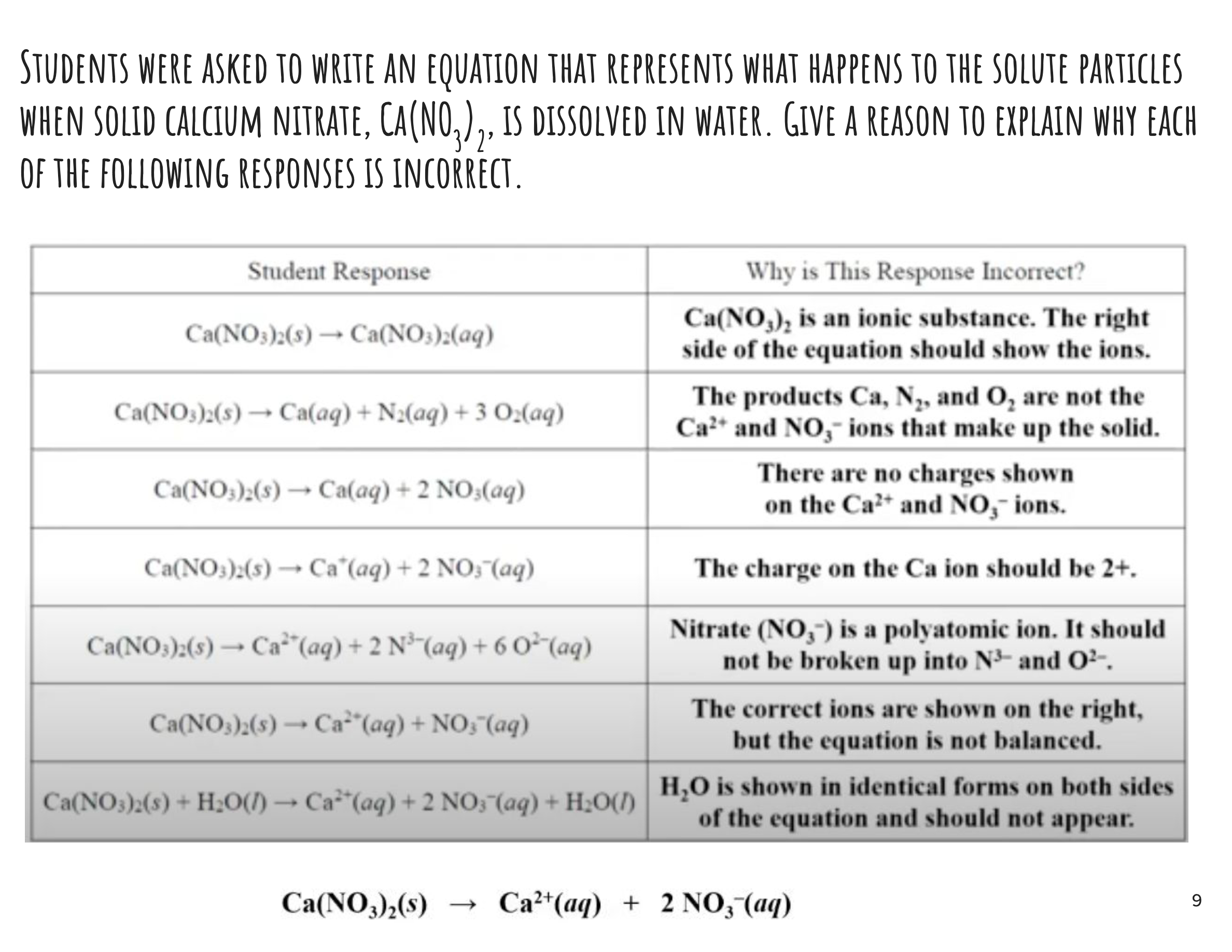
Which student response correctly represents the dissolution of solid calcium nitrate, Ca(NO3)2, in water?

1

Ca(NO3)2(s) → Ca(NO3)2(aq)

2

Ca(NO3)2(s) → Ca2+(aq) + 2 NO3-(aq)

3

Ca(NO3)2(s) → Ca(aq) + 2 NO3(aq)

4

Ca(NO3)2(s) → Ca2+(aq) + NO3-(aq)

18

Open Ended

Explain why it is important to show the charges on ions when writing equations for ionic substances dissolving in water.

19

Multiple Choice

Which of the following equations correctly represents the dissolution of calcium nitrate, Ca(NO3)2, in water?

1

Ca(NO3)2(s) → Ca(NO3)2(aq)

2

Ca(NO3)2(s) → Ca(aq) + 2 NO3(aq)

3

Ca(NO3)2(s) → Ca2+(aq) + 2 NO3-(aq)

4

Ca(NO3)2(s) + H2O(l) → Ca2+(aq) + 2 NO3-(aq) + H2O(l)

20

media

21

Fill in the Blank

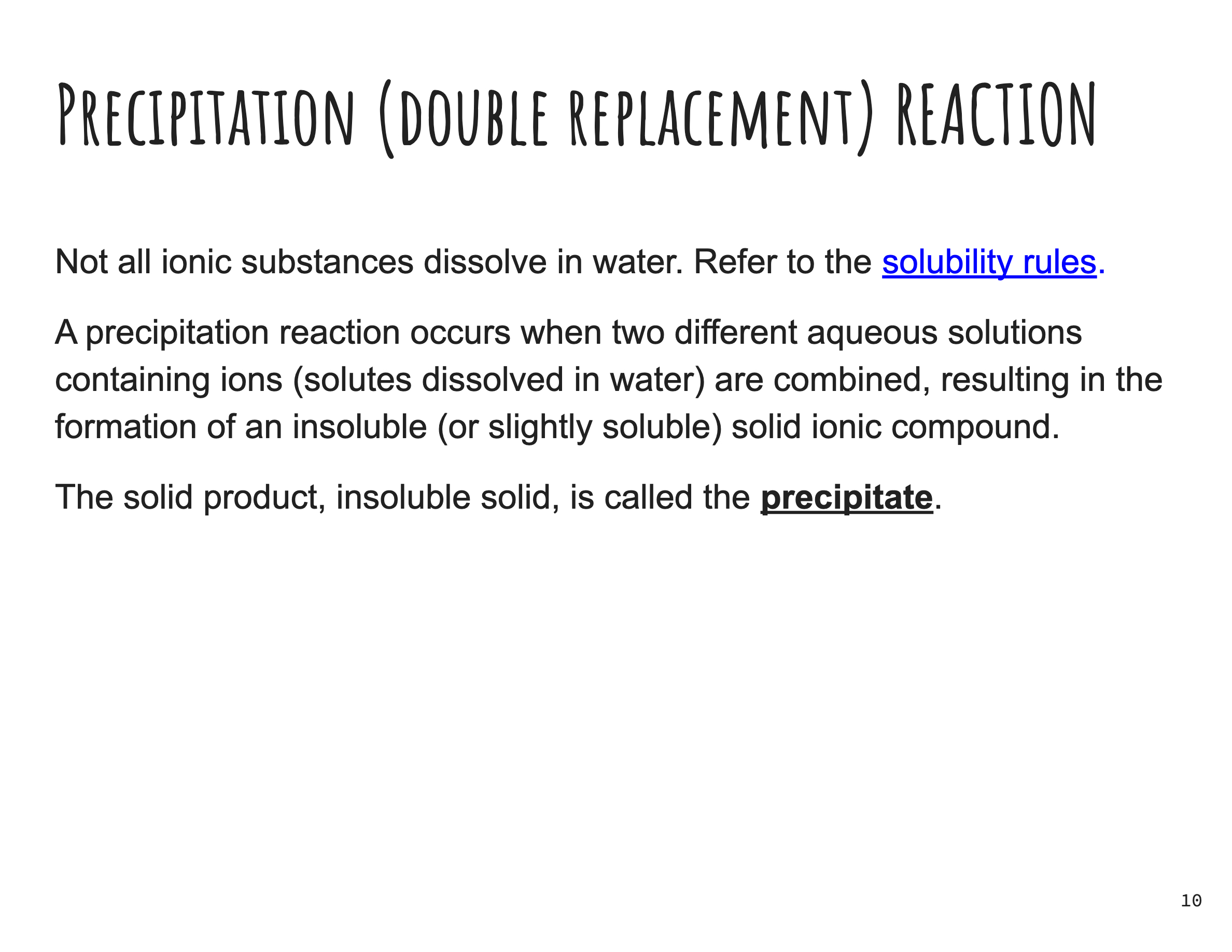
The solid product formed in a precipitation reaction is called the ___.

22

media

23

media

24

Multiple Select

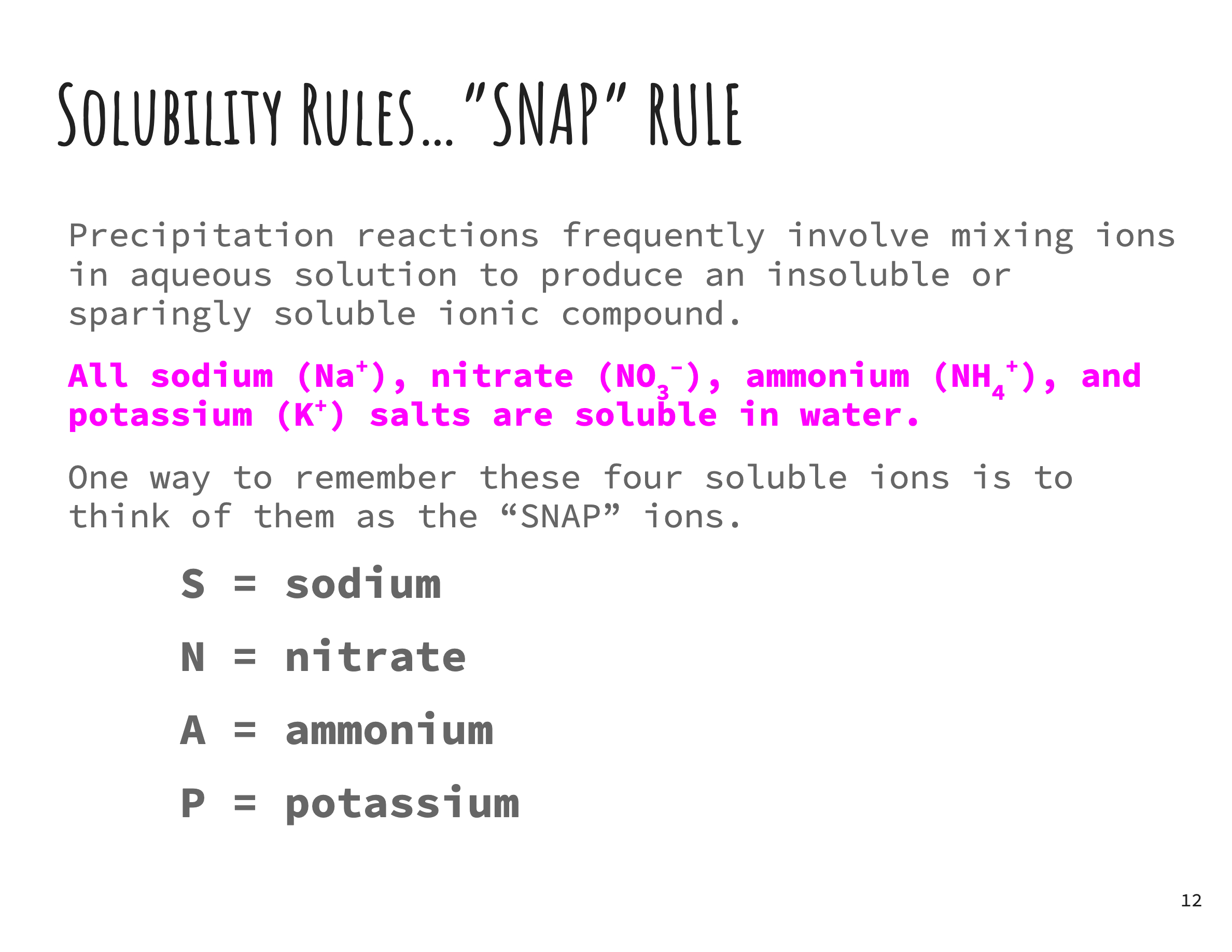
Which of the following ions are always soluble in water according to the SNAP rule?

1

Na+

2

NO3-

3

NH4+

4

CO3^2-

25

media

26

Multiple Choice

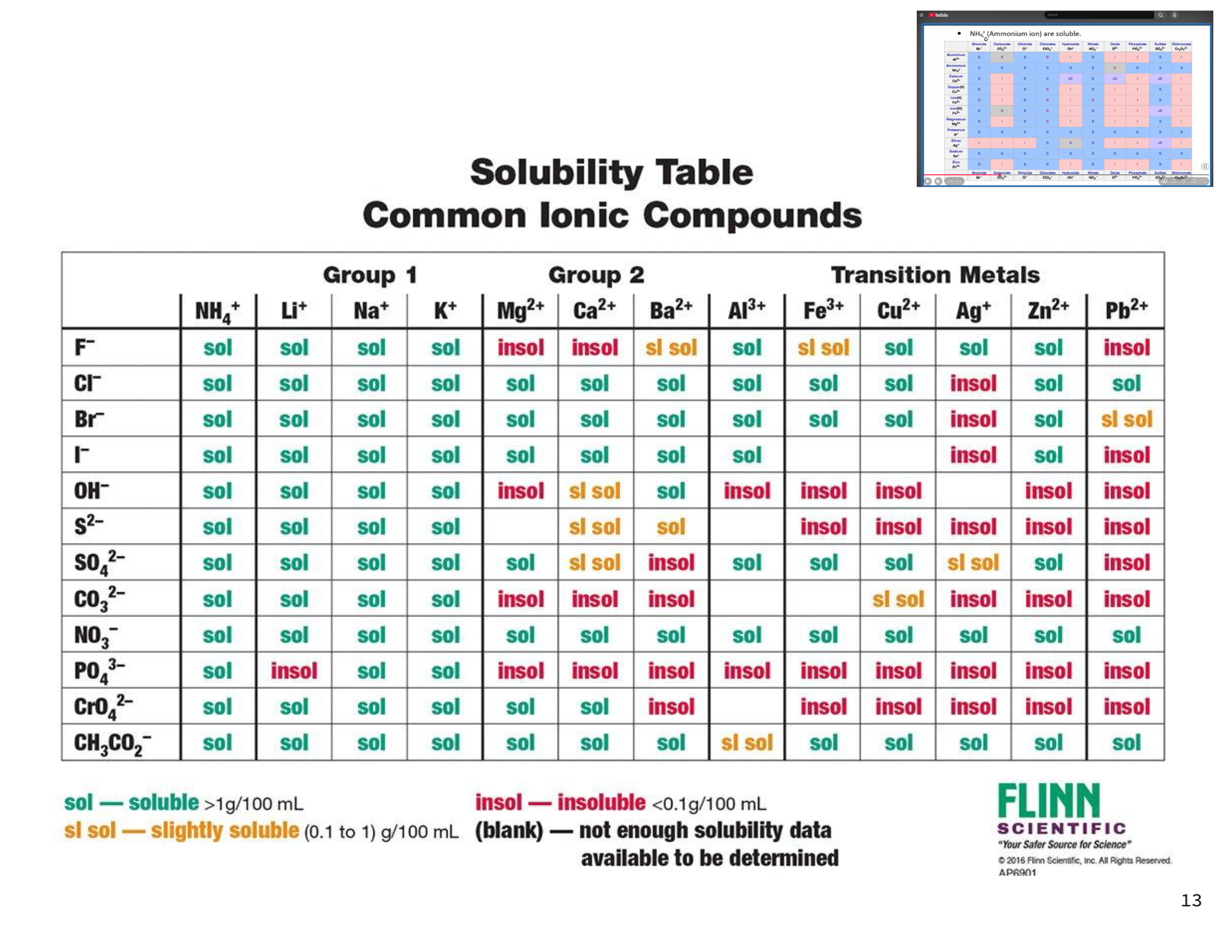
Based on the solubility table, which of the following compounds is insoluble in water?

1

NaCl

2

KNO3

3

CaCO3

4

NH4Br

27

media

28

Open Ended

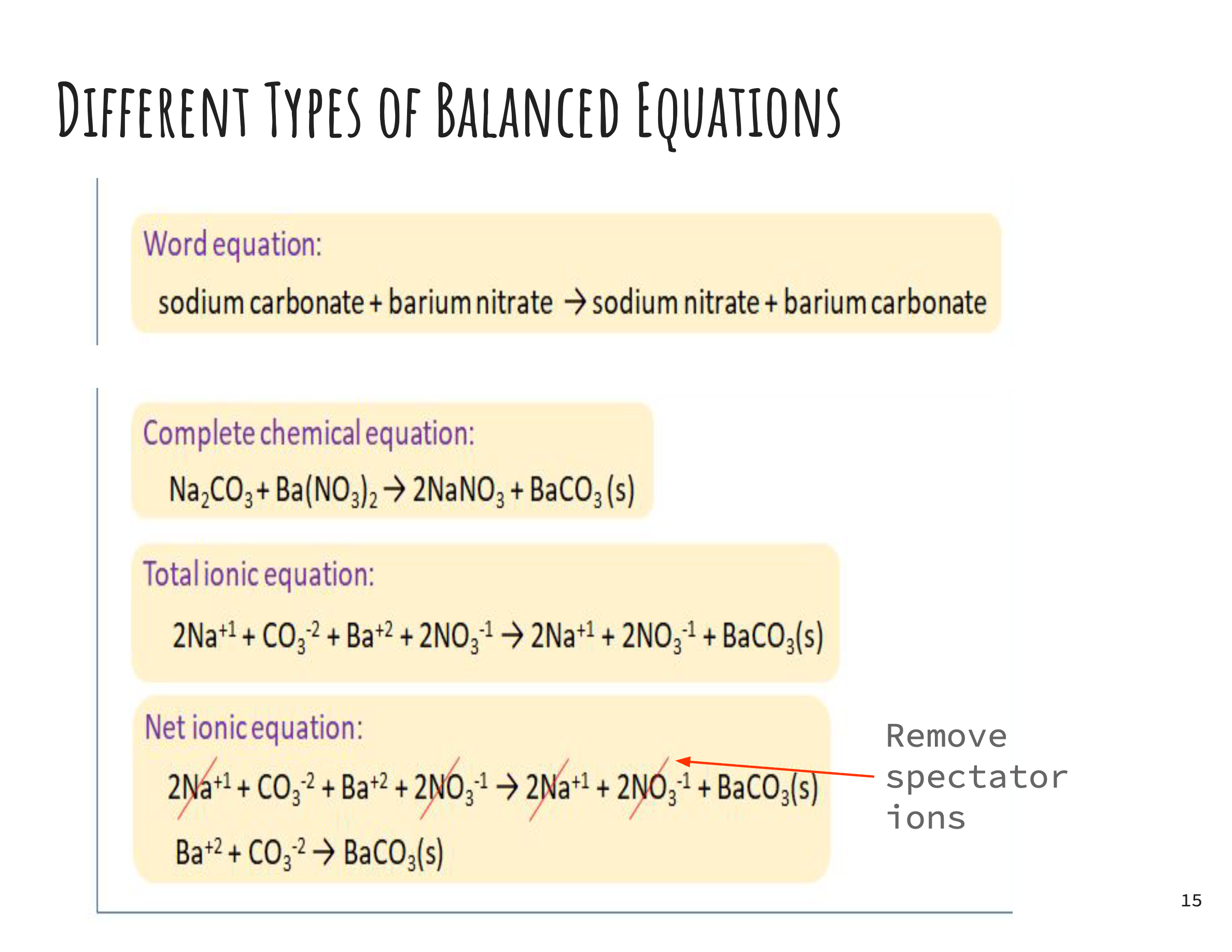
Describe the difference between a molecular equation and a net ionic equation for a precipitation reaction.

29

media

30

Multiple Choice

Why is it important to understand net ionic equations in chemistry?

1

Because they help us balance chemical equations

2

Because they show only the species that actually participate in the reaction

3

Because they indicate the color changes in reactions

4

Because they help identify the type of chemical reaction

31

Multiple Choice

Which type of balanced equation only shows the particles that change during a reaction and removes spectator ions?

1

Word equation

2

Complete chemical equation

3

Total ionic equation

4

Net ionic equation

32

Multiple Select

Which of the following ions are typically written as their ions in total ionic equations when present in aqueous solution?

1

Sodium

2

Chloride

3

Nitrate

4

Potassium

33

media

34

media

35

Open Ended

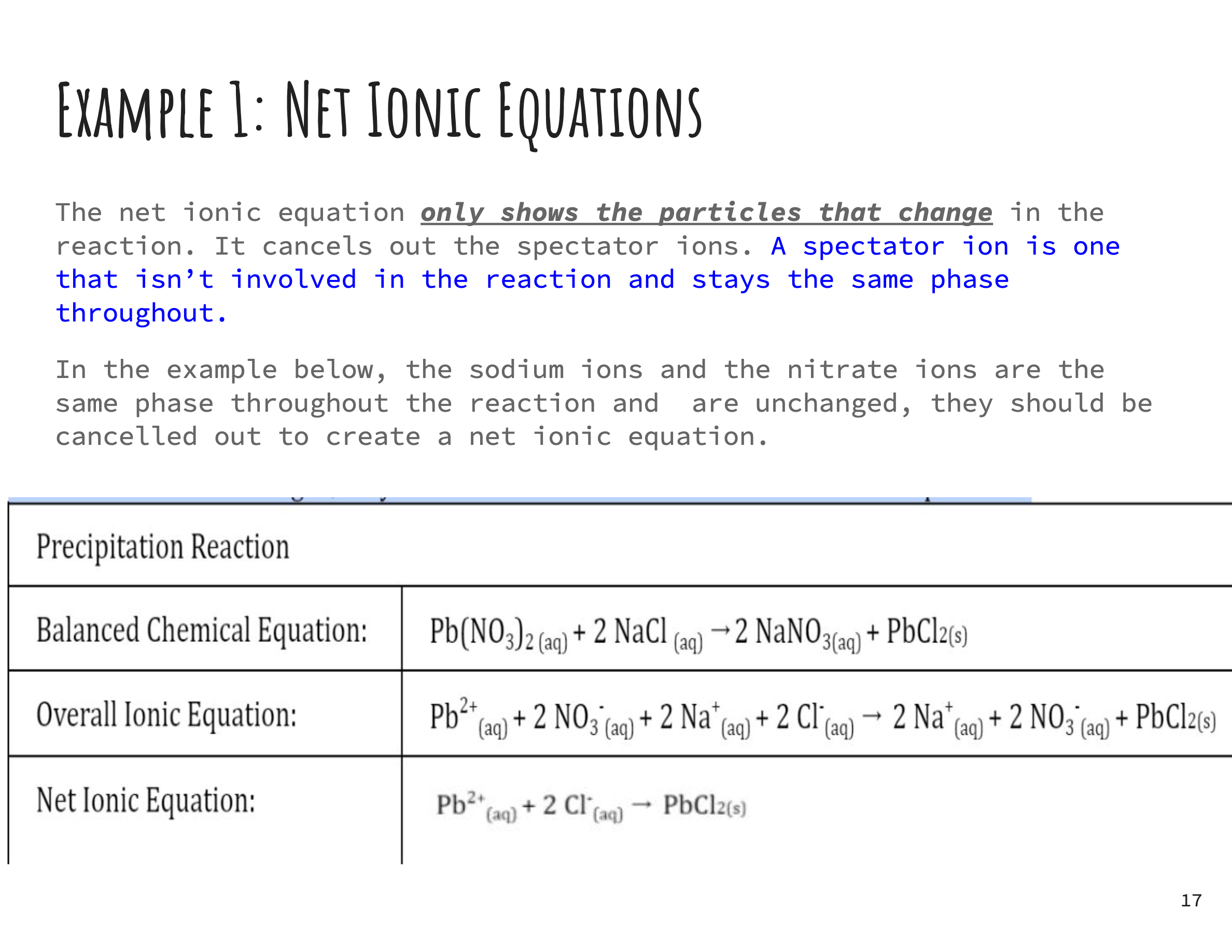
Why is it important to identify and remove spectator ions when writing net ionic equations?

36

Fill in the Blank

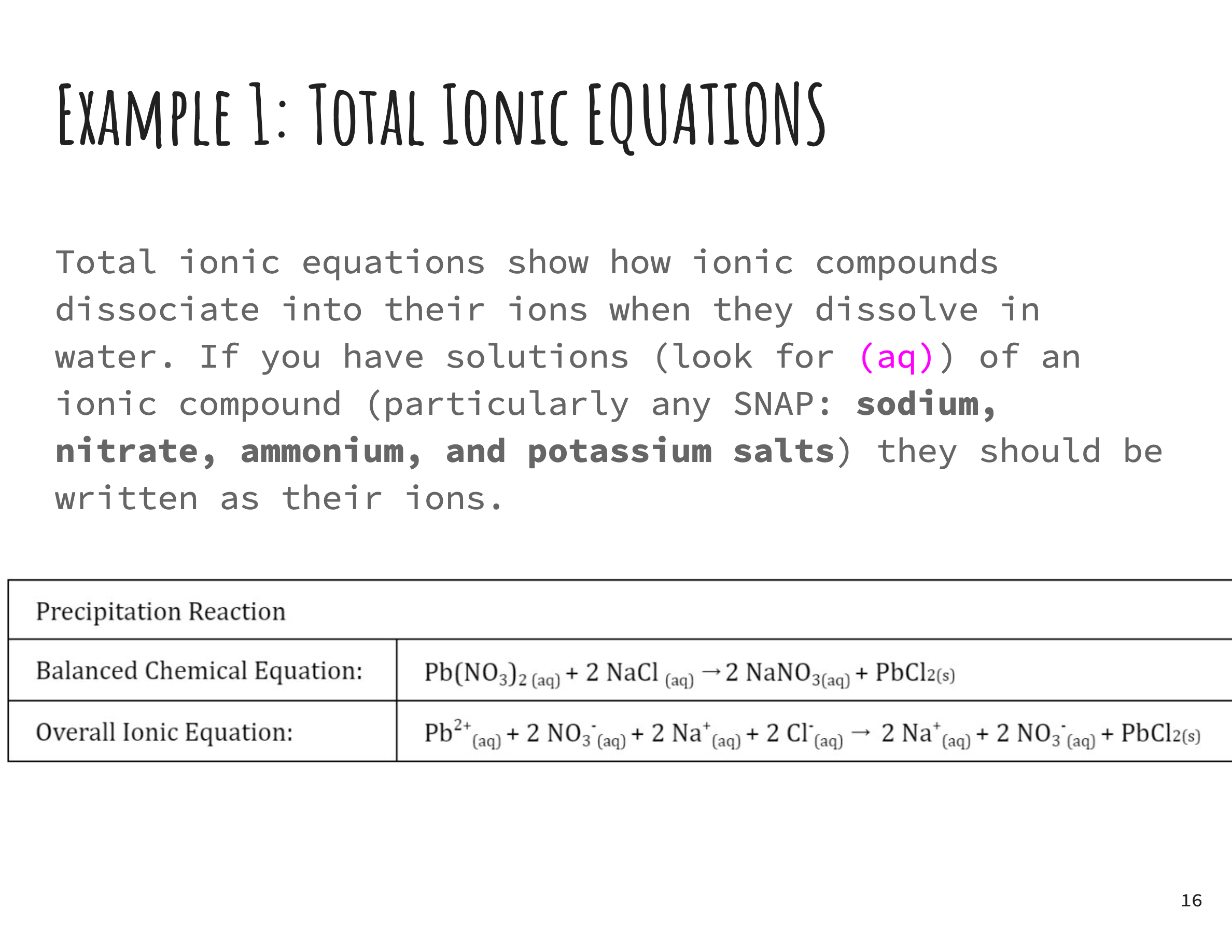
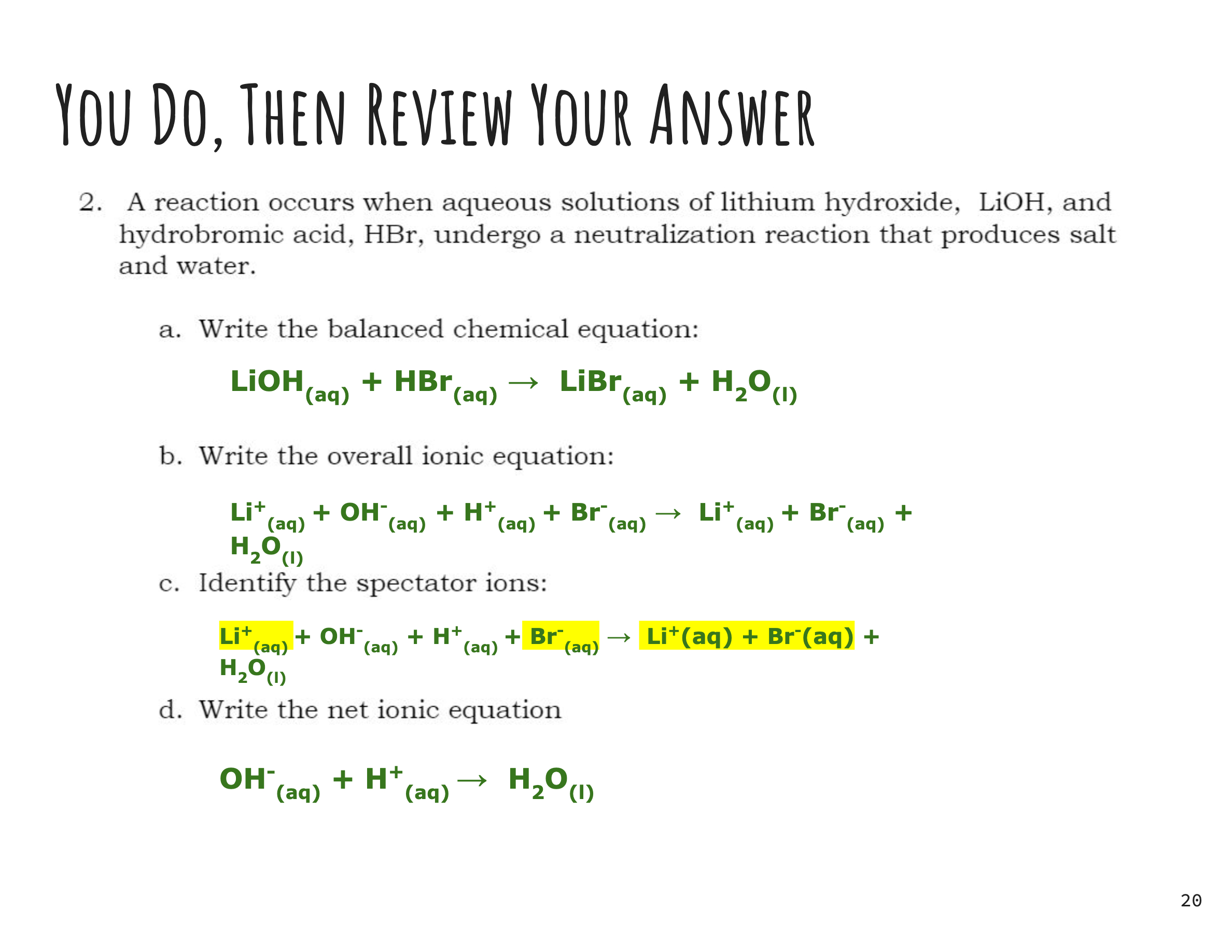
A spectator ion is one that isn’t involved in the reaction and stays the same phase throughout. Fill in the blank: In the reaction between Pb(NO3)2 and NaCl, the spectator ions are ___ and ___.

+
-

37

Multiple Choice

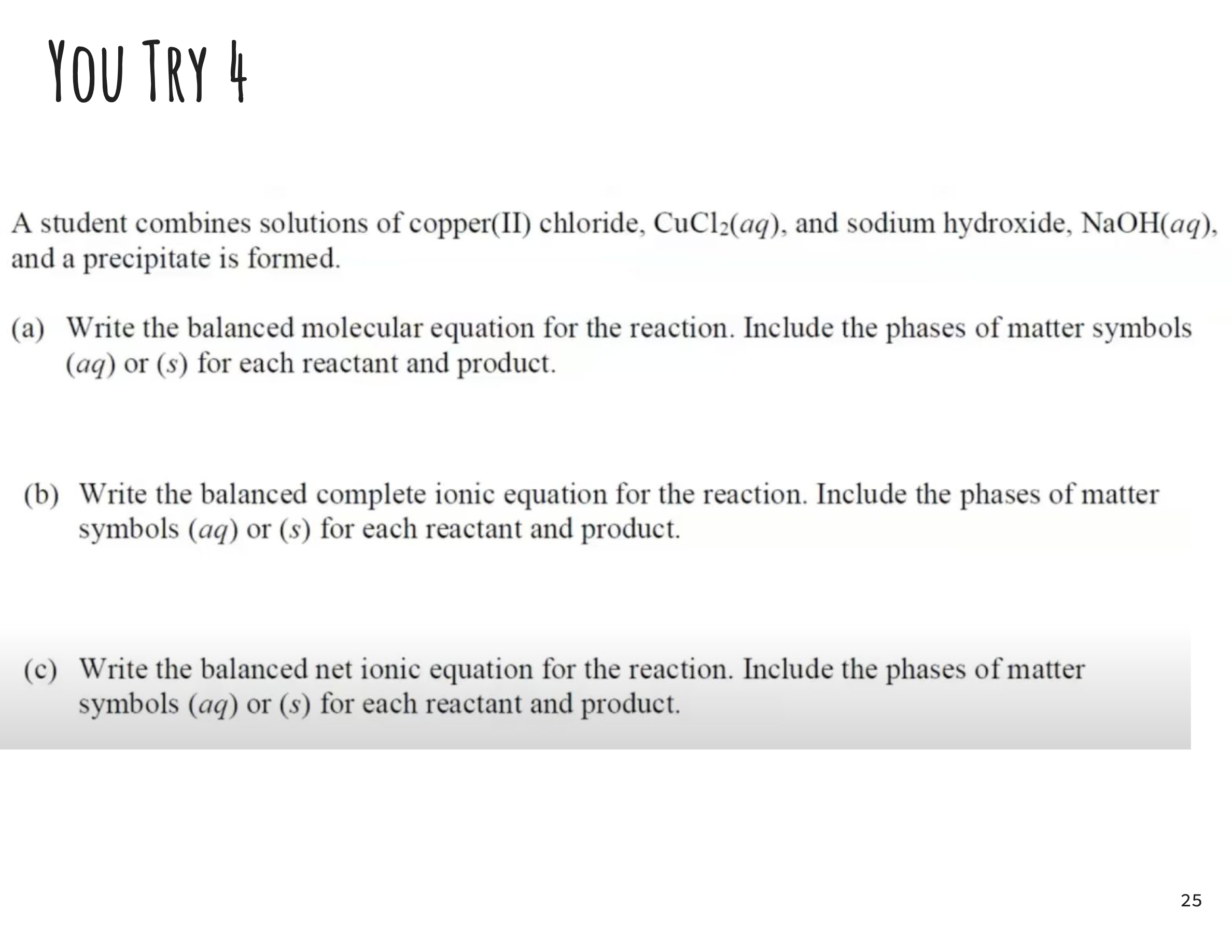
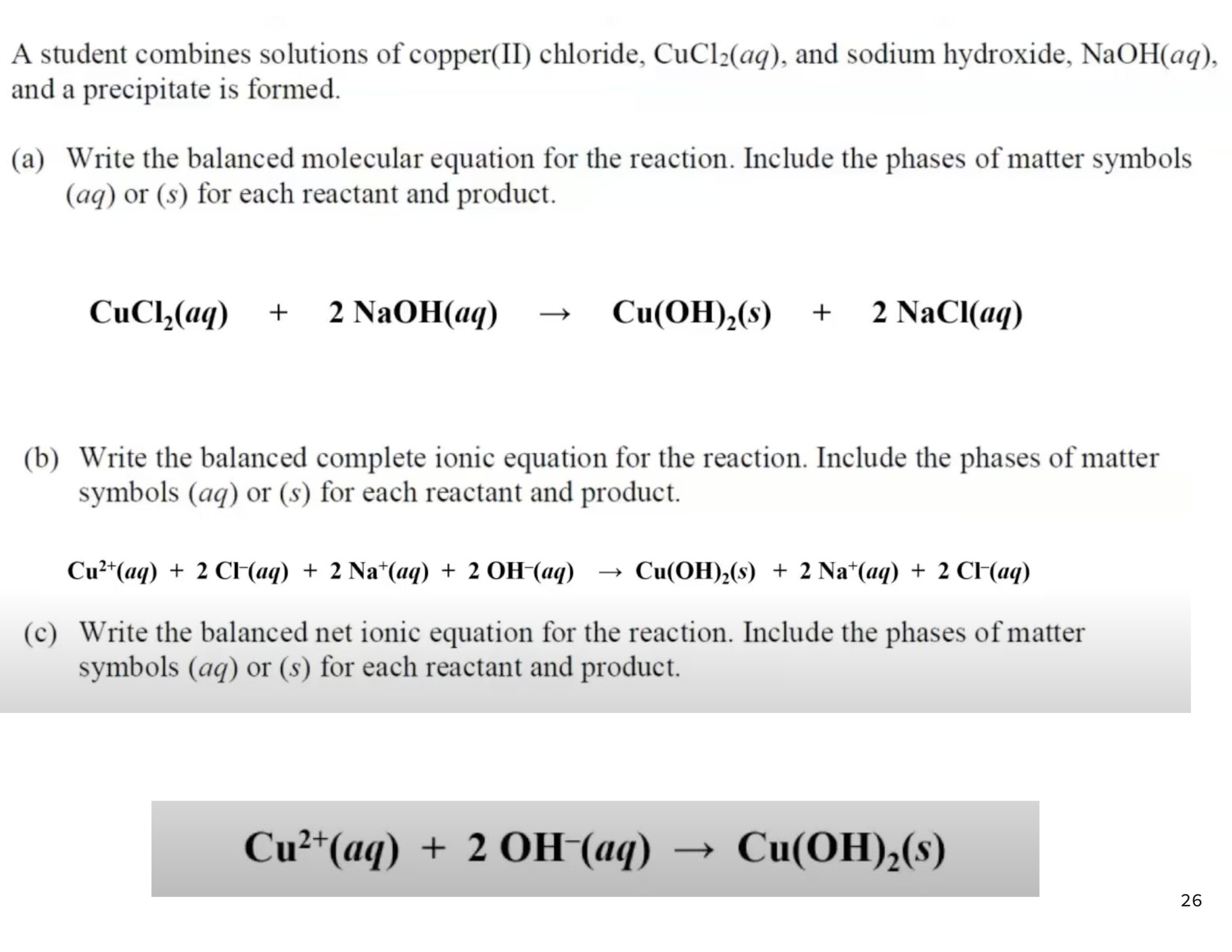
Which of the following equations represents the complete ionic equation for the reaction between copper(II) chloride and sodium hydroxide?

1

Cu2+(aq) + 2 Cl-(aq) + 2 Na+(aq) + 2 OH-(aq) → Cu(OH)2(s) + 2 Na+(aq) + 2 Cl-(aq)

2

CuCl2(aq) + 2 NaOH(aq) → Cu(OH)2(s) + 2 NaCl(aq)

3

Cu2+(aq) + 2 OH-(aq) → Cu(OH)2(s)

4

CuCl2(aq) + 2 NaOH(aq) → CuCl2(s) + 2 NaOH(aq)

38

media

39

Multiple Choice

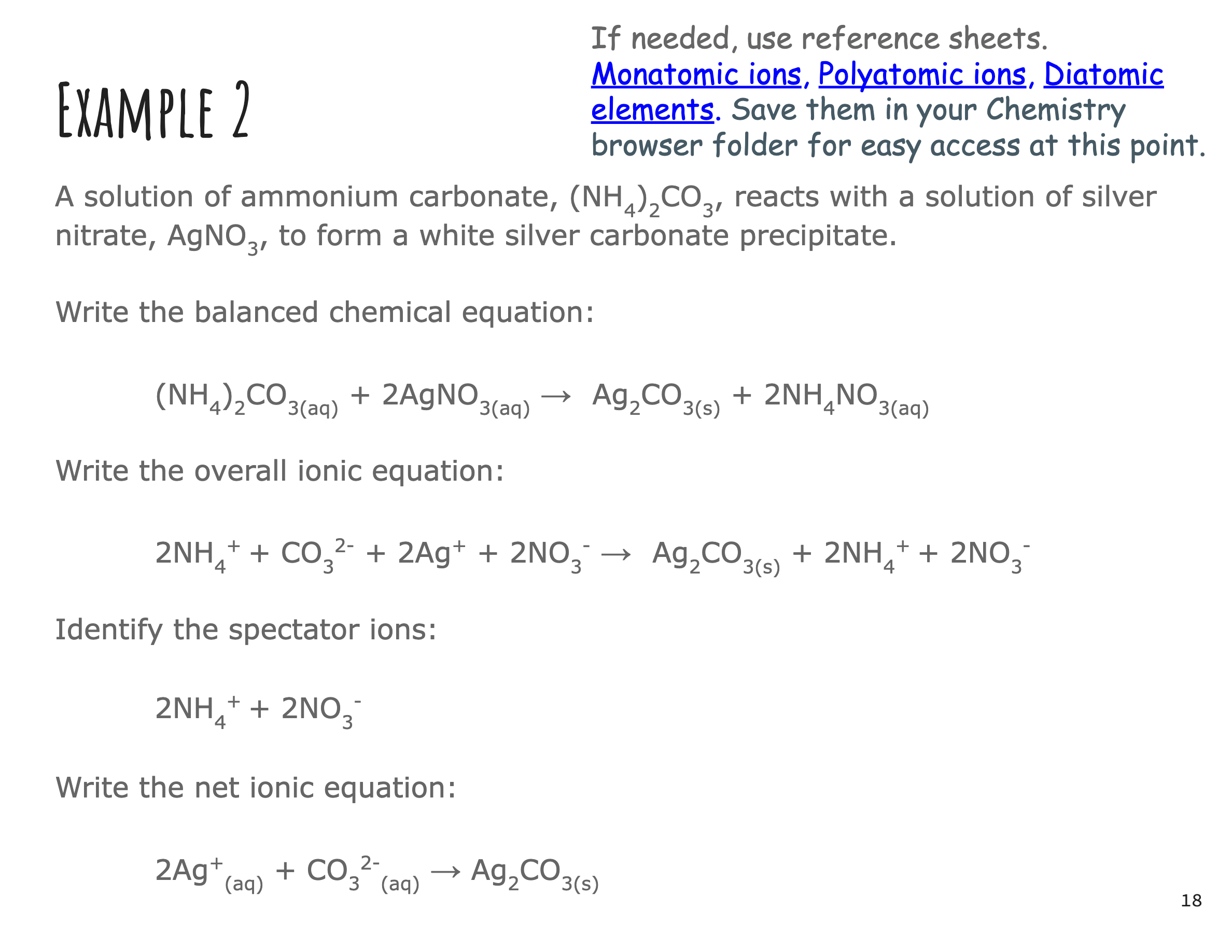
In the reaction between ammonium carbonate and silver nitrate, which ions are removed to write the net ionic equation?

1

NH4+ and NO3-

2

Ag+ and CO3^2-

3

NH4+ and Ag+

4

NO3- and CO3^2-

40

media

41

media

42

media

43

media

44

media

45

media

46

Multiple Choice

Which of the following is the correct balanced molecular equation for the reaction between barium chloride and potassium sulfate?

1

BaCl2(aq) + K2SO4(aq) → BaSO4(s) + 2 KCl(aq)

2

BaCl2(aq) + K2SO4(aq) → BaCl2(s) + K2SO4(aq)

3

BaCl2(aq) + K2SO4(aq) → BaSO4(aq) + 2 KCl(s)

4

BaCl2(aq) + K2SO4(aq) → BaCl2(aq) + K2SO4(s)

47

media

48

media

49

Multiple Select

Select all the ions that are spectator ions in the complete ionic equation for the reaction between barium chloride and potassium sulfate.

1

K+(aq)

2

Cl-(aq)

3

Ba2+(aq)

4

SO4 2-(aq)

50

Open Ended

How do net ionic equations help us understand what happens during a chemical reaction in solution?

51

media
media

Show answer

Auto Play

Slide 1 / 51

SLIDE