

Unit 6, Part 1: Outbreak of World War II

Presentation
•
History
•
9th - 12th Grade
•
Practice Problem
•
Easy

Brian Faehnrich
Used 1+ times
FREE Resource
27 Slides • 22 Questions
1

2
3

4
Multiple Choice
Which of the following were direct economic consequences of the Treaty of Versailles on Germany?
Germany experienced severe inflation and its currency lost value.
Germany gained new territories and resources.
Germany's economy boomed due to reparations.
Germany was relieved from paying any war debts.
5

6
Multiple Choice
How did the failure of the Treaty of Versailles contribute to the rise of authoritarian leaders in Europe?
7

8
Multiple Select
Which of the following statements about the spread of totalitarianism after World War I are correct?
Economic depression fueled the rise of dictators.
Nationalism played a key role in the rise of totalitarian leaders.
Democratic governments flourished across Europe.
Dictators sought territorial expansion.
9
10
Multiple Choice
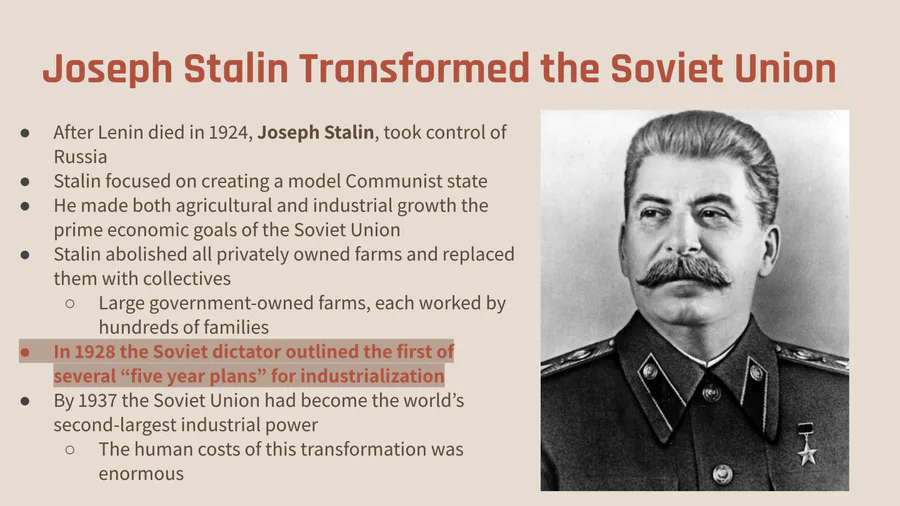
Joseph Stalin's 'five year plans' were primarily aimed at increasing ___ in the Soviet Union.
11

12
Multiple Choice
Which best describes the characteristics of a totalitarian state as established by Stalin in the Soviet Union?
13

14
Multiple Select
Which of the following strategies did Benito Mussolini use to gain support in Italy?
Appealing to national pride
Promising peace and work
Ignoring economic problems
Playing on fears of communism
15

16
Multiple Choice
Which leader established the Fascist Party in Italy by 1921 and what title did he give himself?
Benito Mussolini, Il Duce
Adolf Hitler, Der Führer
Joseph Stalin, General Secretary
Francisco Franco, El Caudillo
17

18

19
20
Multiple Select
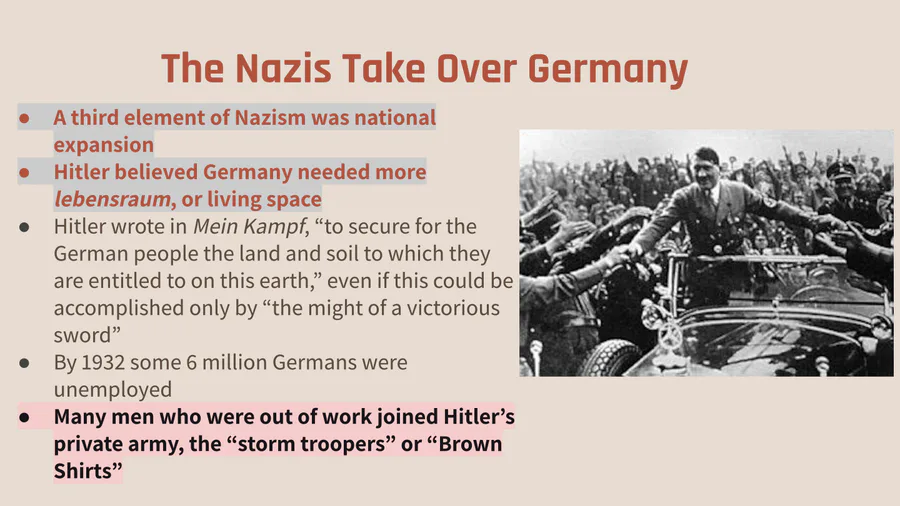
According to the slides, which of the following were core beliefs of Nazism as outlined in Mein Kampf?
Extreme nationalism
Racial purification
National expansion
Democratic reforms
21

22
Multiple Choice
What was the Third Reich, and why did Hitler believe it would last for a thousand years?
23

24
Multiple Choice
Which of the following is a similarity between Fascist Italy and Nazi Germany, according to the chart?
Extreme nationalism
State ownership of property
Eventual rule by working class
Wait for world revolution
25

26
Multiple Choice
What were some of the main reasons for dissatisfaction among the Japanese population during the rise of militarism in Japan?
Limited size of territory and crowded islands
Strong civilian control over the government
Economic prosperity and peace
Foreign occupation of Japan
27

28
Multiple Choice
How did the worldwide economic depression of the 1930s influence Japanese militarist leaders' ambitions?
It weakened their resolve to expand territory
It strengthened their desire to expand and gain resources
It led to the collapse of the Japanese government
It caused Japan to withdraw from international affairs
29

30

31
Multiple Choice
The formal alliance signed between Germany and Italy during the Spanish Civil War was known as the ___-Berlin Axis.
32
33
Multiple Choice
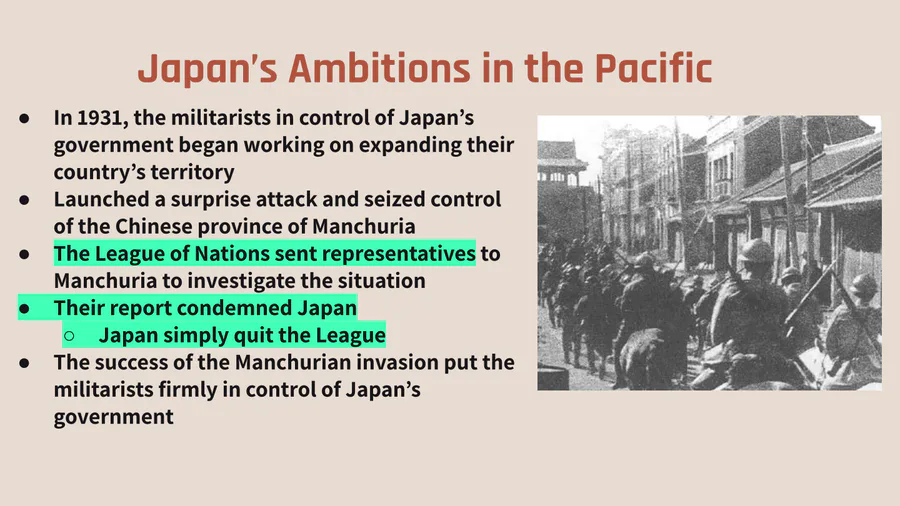
Which of the following actions did the League of Nations take in response to Japan's invasion of Manchuria?
Sent military forces to stop Japan
Condemned Japan and sent representatives to investigate
Supported Japan's expansion
Ignored the situation
34

35
Multiple Choice
As Germany expanded its territory in Europe, how did this affect Japanese ambitions in the Pacific?
It distracted Japan from its own expansion
It opened new opportunities for Japanese expansionists
It caused Japan to ally with China
It led to Japan reducing its military forces
36

37
Multiple Choice
What actions did Hitler take in violation of the Treaty of Versailles, and how did the League of Nations respond?
He withdrew Germany from the League of Nations and began a military buildup; the League did nothing to stop him.
He signed a peace treaty with France; the League imposed sanctions.
He reduced Germany's military; the League praised him.
He invaded Britain; the League declared war.
38

39
Multiple Choice
How did the League of Nations respond to Mussolini's invasion of Ethiopia, and what was the outcome for Ethiopia by May 1936?
They launched a military intervention and saved Ethiopia.
They imposed an effective economic boycott, but Ethiopia still fell.
They responded with talk of collective resistance, but their actions were ineffective and Ethiopia was conquered.
They ignored the invasion and Ethiopia remained independent.
40

41

42
Multiple Select
Which of the following statements about Hitler's actions toward Austria and Czechoslovakia are correct?
Austria was Hitler's first target for annexation.
Hitler claimed Czechs were abusing Sudeten Germans.
The US and the rest of the world intervened to stop Hitler.
France and Great Britain promised to protect Czechoslovakia.
43

44
Multiple Choice
Which best explains the significance of the Munich Agreement and how it impacted Czechoslovakia?
45

46
Multiple Choice
The policy of ___ refers to giving up principles to pacify an aggressor.
47

48
Multiple Choice
World War II started in the year ___.
49
Open Ended
What is one question you still have about how World War II began?
Show answer
Auto Play
Slide 1 / 49
SLIDE
Similar Resources on Wayground

46 questions
Seeds of Rebellion III
Presentation
•
9th - 12th Grade
42 questions
Graphing Systems of Inequalities
Presentation
•
9th - 12th Grade
39 questions
Historical Skills & Evaluating Sources
Presentation
•
9th - 12th Grade
45 questions
Trigonometric Ratios
Presentation
•
9th - 12th Grade
45 questions
Unit 7, Part 3: The Holocaust; World War II
Presentation
•
9th - 12th Grade
44 questions
Unit 2 Lesson 4 Atomic Theory and PEN
Presentation
•
10th - 12th Grade
42 questions
XI-World War II sec. III
Presentation
•
9th - 12th Grade
42 questions
English Reformation
Presentation
•
9th - 12th Grade
Popular Resources on Wayground
10 questions
How much do you know about our Portrait of an Eagle?

Quiz
•
10th Grade
10 questions
Fast Food Slogans
Quiz
•
6th - 8th Grade
21 questions
Continents and Oceans
Quiz
•
6th Grade
20 questions
Parts of Speech
Quiz
•
5th Grade
16 questions
Subject & Predicate
Quiz
•
5th Grade
25 questions
Multiplication Facts
Quiz
•
5th Grade
12 questions
Map Skills
Quiz
•
3rd Grade
22 questions
Continents and Oceans
Quiz
•
5th Grade
Discover more resources for History
10 questions
Exploring the Journey of Early Humans

Interactive video
•
6th - 10th Grade
10 questions
Exploring Jamestown: John Smith and Pocahontas
Interactive video
•
6th - 10th Grade
20 questions
The Early Colonies
Quiz
•
7th - 11th Grade
10 questions
Recap on Mesopotamia: Key Concepts and Facts
Interactive video
•
6th - 10th Grade
16 questions
Government Unit 2
Quiz
•
7th - 11th Grade
10 questions
Exploring Types of Government
Interactive video
•
6th - 10th Grade
16 questions
Students of Civics Unit 2: The Constitution
Quiz
•
7th - 11th Grade
15 questions
Unit 4
Quiz
•
10th Grade