
Chapter 2 Early Hominids
6th Grade
•21 Qs

Similar activities
Unit 5 Quiz Review
6th - 9th Grade
•18 Qs
East Asia
6th Grade
•16 Qs
New ideas and New Religions
6th Grade
•18 Qs
Prehistory Vocabulary
6th Grade
•20 Qs
Mod. 4.4 Struggle for Liberty
6th - 8th Grade
•21 Qs
Early Human Civilizations - Vocabulary
6th Grade
•22 Qs
Unit 9 Test Review Adapting Down Under: Pacific Realm
6th Grade
•20 Qs
ASHOKA
6th Grade
•19 Qs
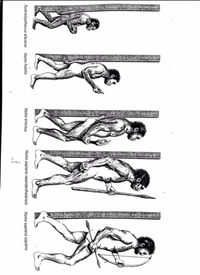
Chapter 2 Early Hominids

Quiz
•
History
•
6th Grade
•
Medium
Used 764+ times
FREE Resource

Enhance your content in a minute
21 questions
Show all answers
1.
MULTIPLE CHOICE QUESTION
30 sec • 1 pt
Prehistoric humans are called _________________.
2.
MULTIPLE CHOICE QUESTION
30 sec • 1 pt
_______________ specialize in studing the earliest hominids.
3.
MULTIPLE CHOICE QUESTION
30 sec • 1 pt
The remains of an early hominid that lived more than 3 million years ago was discovered by an American paleoanthropologist who nicknamed her _________.
4.
MULTIPLE CHOICE QUESTION
30 sec • 1 pt
An animal that walks on two feet is called a _______.
5.
MULTIPLE CHOICE QUESTION
30 sec • 1 pt
Named Homo habilis in honor of its ability to make tools, this hominid was also called __________.
6.
MULTIPLE CHOICE QUESTION
30 sec • 1 pt
Who was the first hominid to use fire?
7.
MULTIPLE CHOICE QUESTION
30 sec • 1 pt
Having a larger brain meant Upright Man were able to invent more complex tools such as strong hand-axes made of stone.
Access all questions and much more by creating a free account
Create resources
Host any resource
Get auto-graded reports

Continue with Google

Continue with Email

Continue with Classlink

Continue with Clever
or continue with

Microsoft
%20(1).png)
Apple

Others
Already have an account?
Similar Resources on Wayground
20 questions
Early Humans
Quiz
•
6th - 8th Grade
18 questions
Chapter 9 - Islam (TCI)
Quiz
•
6th - 8th Grade
19 questions
Ancient India Review
Quiz
•
6th Grade
20 questions
Egyptian Mythology
Quiz
•
6th Grade
20 questions
Chapter 7 Lesson 1: Rise of Greek Civilization
Quiz
•
6th Grade
18 questions
A Long Walk to Water
Quiz
•
6th - 8th Grade
20 questions
Ancient Israelites
Quiz
•
6th Grade
20 questions
Renaissance Formative Review
Quiz
•
6th Grade
Popular Resources on Wayground
15 questions
Fractions on a Number Line
Quiz
•
3rd Grade
20 questions
Equivalent Fractions
Quiz
•
3rd Grade
25 questions
Multiplication Facts
Quiz
•
5th Grade
54 questions
Analyzing Line Graphs & Tables
Quiz
•
4th Grade
22 questions
fractions
Quiz
•
3rd Grade
20 questions
Main Idea and Details
Quiz
•
5th Grade
20 questions
Context Clues
Quiz
•
6th Grade
15 questions
Equivalent Fractions
Quiz
•
4th Grade
Discover more resources for History
15 questions
Black History Month
Quiz
•
6th Grade
22 questions
Black History Month Luncheon
Quiz
•
6th - 8th Grade
13 questions
Southwest Asia and North Africa
Quiz
•
6th Grade
10 questions
The Impact of The Great Migration on the Harlem Renaissance

Interactive video
•
6th - 10th Grade
10 questions
Exploring the Geography of Ancient Egypt
Interactive video
•
6th - 10th Grade
27 questions
Latin America Government/Economic
Quiz
•
6th Grade
11 questions
Feudal Japan
Quiz
•
6th - 8th Grade
20 questions
World War II
Quiz
•
4th - 6th Grade