
Covalent Bonding
Authored by John Groll
Chemistry
10th - 12th Grade
NGSS covered
Used 6K+ times


AI Actions
Add similar questions
Adjust reading levels
Convert to real-world scenario
Translate activity
More...
About
Looking at these twenty questions, this quiz comprehensively covers covalent bonding in chemistry at the high school level, specifically appropriate for grades 10-12. The content spans fundamental concepts including valence electrons and electron sharing, progresses through bond types (single, double, triple), and advances to molecular formulas and nomenclature of covalent compounds. Students need to understand periodic table organization, particularly group numbers and valence electron patterns, the octet rule, and how atoms achieve stability through electron sharing rather than transfer. The quiz also requires knowledge of electronegativity differences that create polar versus nonpolar bonds, properties of covalent compounds including electrical conductivity, and the systematic naming conventions using prefixes like mono-, di-, tri-, penta-, and hexa- for molecular compounds. Created by John Groll, a Chemistry teacher in the United States who teaches grades 10 and 12. This quiz serves as an excellent formative assessment tool that can be deployed flexibly throughout a covalent bonding unit - as a pre-assessment to gauge student readiness, a mid-unit checkpoint to identify misconceptions, or a comprehensive review before summative evaluation. The progression from basic electron counting to advanced nomenclature makes it ideal for differentiated instruction, allowing teachers to assign specific question ranges based on student needs. Teachers can use this for warm-up activities by selecting 3-5 questions daily, as homework practice to reinforce classroom learning, or as a complete assessment covering NGSS HS-PS1-1 (predicting properties based on patterns of electrons) and supports common core mathematical practices through systematic problem-solving in chemical formulas and naming conventions.
Content View
Student View
20 questions
Show all answers
1.
MULTIPLE CHOICE QUESTION
1 min • 1 pt
How many valence electrons does nitrogen have?
Tags
NGSS.HS-PS1-2
NGSS.HS-PS1-1
2.
MULTIPLE CHOICE QUESTION
30 sec • 12 pts
What can be generalized about covalent bonds?
3.
MULTIPLE CHOICE QUESTION
30 sec • 12 pts
What is it called if there are three-pairs of electrons being shared?
Triple Bond
Three Single Bonds
Tribond
Double and Single Bond Combo
4.
MULTIPLE CHOICE QUESTION
30 sec • 12 pts
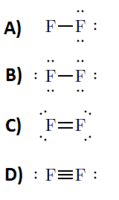
Which of the following is the best representation of a molecule of fluorine (F2)?
A
B
C
D
Tags
NGSS.MS-PS1-1
5.
MULTIPLE CHOICE QUESTION
30 sec • 12 pts
Carbon is in 4A, so how many bonds can it form based on electrons needed to fill its outer shell?
1
3
4
5
Tags
NGSS.HS-PS1-1
6.
MULTIPLE CHOICE QUESTION
1 min • 12 pts
What two types of atoms make a covalent bond?
Tags
NGSS.MS-PS1-1
7.
MULTIPLE CHOICE QUESTION
1 min • 1 pt
What is a diatomic element?
Access all questions and much more by creating a free account
Create resources
Host any resource
Get auto-graded reports

Continue with Google

Continue with Email

Continue with Microsoft
or continue with

%20(1).png)
Apple

Others
Already have an account?



