
Carrying Capacity and Limiting Factors
Authored by Laura Raper
Biology
8th - 9th Grade
NGSS covered
Used 1K+ times


AI Actions
Add similar questions
Adjust reading levels
Convert to real-world scenario
Translate activity
More...
About
This quiz thoroughly examines carrying capacity and limiting factors, core concepts in population ecology appropriate for 8th and 9th grade biology students. The questions assess students' understanding of how populations interact with their environment, requiring them to analyze population dynamics, interpret growth curves, and predict how environmental changes affect population sizes. Students must demonstrate their grasp of key ecological principles including how competition, predation, disease, and resource availability regulate population growth. The quiz moves beyond simple memorization by asking students to apply these concepts in various scenarios, such as predicting what happens when populations exceed carrying capacity or analyzing predator-prey relationships. Students need to understand that ecosystems have finite resources, that populations naturally fluctuate around sustainable levels, and that multiple factors work together to determine population size over time. Created by Laura Raper, a Biology teacher in the US who teaches grades 8 and 9. This assessment serves as an excellent tool for evaluating student comprehension of fundamental ecological principles through both conceptual understanding and practical application. Teachers can effectively use this quiz as a formative assessment during their ecology unit to gauge student progress, as a review activity before summative assessments, or as homework to reinforce classroom learning about population dynamics. The variety of question formats, from graph interpretation to scenario analysis, makes it versatile for different instructional needs including warm-up activities and guided practice sessions. This quiz aligns with Next Generation Science Standards MS-LS2-1 (analyzing and interpreting data on scale, proportion, and quantity to provide evidence for phenomena in ecosystems) and HS-LS2-1 (using mathematical representations to support explanations of factors affecting carrying capacity), helping students develop critical thinking skills about how organisms interact with their environment and how these interactions shape population sizes over time.
Content View
Student View
14 questions
Show all answers
1.
MULTIPLE CHOICE QUESTION
1 min • 1 pt
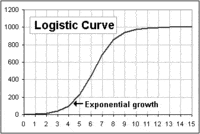
What is the carrying capacity of the following graph?
Tags
CCSS.HSF-IF.C.7E
2.
MULTIPLE CHOICE QUESTION
30 sec • 1 pt

Will competition increase/decrease the carrying capacity of an ecosystem for the animal in competition?
Tags
NGSS.HS-LS2-1
NGSS.HS-LS2-6
3.
MULTIPLE CHOICE QUESTION
1 min • 1 pt

When a population grows past the ecosystem's carrying capacity, what happens to the population?
Tags
NGSS.MS-LS2-1
NGSS.MS-LS2-4
4.
MULTIPLE CHOICE QUESTION
45 sec • 1 pt

If a disease destroying barley plants in a field swept through an ecosystem, what would happen to the barley eating bird population in the the field ?
Tags
NGSS.MS-LS2-1
NGSS.MS-LS2-4
5.
MULTIPLE CHOICE QUESTION
30 sec • 1 pt

If the amount of food or resources available increases, the carrying capacity for an animal:
Tags
NGSS.MS-LS2-1
NGSS.MS-LS2-4
6.
MULTIPLE CHOICE QUESTION
30 sec • 1 pt

In a forest ecosystem, which of the following is the best example of a limiting factor for a rabbit population?
Tags
NGSS.MS-LS2-1
NGSS.MS-LS2-4
7.
MULTIPLE CHOICE QUESTION
30 sec • 1 pt

If the carrying capacity of a predator decreases, what will happen to the carrying capacity of the prey?
Tags
NGSS.MS-LS2-1
NGSS.MS-LS2-4


Access all questions and much more by creating a free account
Create resources
Host any resource
Get auto-graded reports

Continue with Google

Continue with Email

Continue with Classlink

Continue with Clever
or continue with

Microsoft
%20(1).png)
Apple

Others
Already have an account?


