
SC.912.L.15.1 - Comparative Anatomy
9th - 11th Grade
•32 Qs

Similar activities
IASP Invitational 1 Science
9th - 12th Grade
•28 Qs
All
3rd Grade - Professional Development
•28 Qs
Cellular Respiration and Photosynthesis
9th Grade
•28 Qs
The Study of Life
9th - 10th Grade
•32 Qs
DNA to Protein Extra Review
9th Grade
•27 Qs
Macromolecules and Cell Membrane
8th - 10th Grade
•27 Qs
Macromolecules, Enzymes, & Water
9th - 12th Grade
•27 Qs
PLANT TISSUES
9th Grade
•28 Qs

SC.912.L.15.1 - Comparative Anatomy

Quiz
•
Biology
•
9th - 11th Grade
•
Practice Problem
•
Medium
+7
Standards-aligned

Arles Carballo
Used 251+ times
FREE Resource

Enhance your content in a minute
32 questions
Show all answers
1.
MULTIPLE CHOICE QUESTION
30 sec • 1 pt
Why don’t we have a complete fossil record of all life that’s ever lived?
Tags
NGSS.MS-LS4-1
2.
MULTIPLE CHOICE QUESTION
30 sec • 1 pt
Oceanic islands can be home to species found nowhere else on Earth. Why?
Tags
NGSS.MS-LS4-2
NGSS.MS-LS4-4
3.
MULTIPLE CHOICE QUESTION
30 sec • 1 pt

What do phylogenic trees do?
Tags
NGSS.MS-LS4-1
NGSS.MS-LS4-2
4.
MULTIPLE CHOICE QUESTION
30 sec • 1 pt
What is NOT true about the evidence that fossils provide?
Tags
NGSS.MS-LS4-1
5.
MULTIPLE CHOICE QUESTION
20 sec • 1 pt
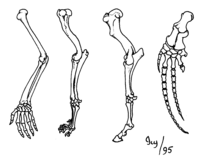
Structures with the same parts have different functions; suggests that organisms share a common ancestry
Tags
NGSS.MS-LS4-2
6.
MULTIPLE CHOICE QUESTION
30 sec • 1 pt

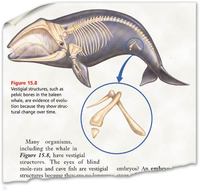
If an organism has a vestigial structure, that structure likely once had a function in a(n)
Tags
NGSS.MS-LS4-2
7.
MULTIPLE CHOICE QUESTION
30 sec • 1 pt
The process by which populations slowly change over time is called__________
Tags
NGSS.MS-LS4-4

Access all questions and much more by creating a free account
Create resources
Host any resource
Get auto-graded reports

Continue with Google

Continue with Email

Continue with Classlink

Continue with Clever
or continue with

Microsoft
%20(1).png)
Apple

Others
Already have an account?
Similar Resources on Wayground
29 questions
Grade 9 Ecology
Quiz
•
9th Grade
35 questions
Missouri Biology EOC Reveiw
Quiz
•
9th - 10th Grade
37 questions
CSHS PreAP Biology - Unit 1 (Basics of Exploring Life)
Quiz
•
9th - 10th Grade
35 questions
Pathogens
Quiz
•
11th - 12th Grade
27 questions
vertebral column + thoracic cage
Quiz
•
11th Grade
27 questions
EnvSci Fall Sem Exam Review
Quiz
•
9th Grade - University
34 questions
Unit 2 Biology
Quiz
•
10th - 12th Grade
28 questions
genetics
Quiz
•
9th - 10th Grade
Popular Resources on Wayground
15 questions
Fractions on a Number Line
Quiz
•
3rd Grade
20 questions
Equivalent Fractions
Quiz
•
3rd Grade
25 questions
Multiplication Facts
Quiz
•
5th Grade
22 questions
fractions
Quiz
•
3rd Grade
20 questions
Main Idea and Details
Quiz
•
5th Grade
20 questions
Context Clues
Quiz
•
6th Grade
15 questions
Equivalent Fractions
Quiz
•
4th Grade
20 questions
Figurative Language Review
Quiz
•
6th Grade
Discover more resources for Biology
20 questions
Cell Organelles
Quiz
•
10th Grade
20 questions
Cell Organelles
Quiz
•
9th Grade
20 questions
DNA & Protein Synthesis
Quiz
•
9th Grade
7 questions
Amoeba Sisters Dihybrid Cross Punnett Square

Interactive video
•
9th - 12th Grade
25 questions
photosynthesis and cellular respiration
Quiz
•
9th Grade
20 questions
Human Body Systems
Quiz
•
9th Grade
19 questions
Natural Selection
Quiz
•
9th Grade
20 questions
Pedigree Practice
Quiz
•
9th Grade