
4th Period - More Waves
Authored by William Stafford
Physics
9th - 11th Grade
Used 6+ times


AI Actions
Add similar questions
Adjust reading levels
Convert to real-world scenario
Translate activity
More...
Content View
Student View
15 questions
Show all answers
1.
MULTIPLE CHOICE QUESTION
30 sec • 1 pt
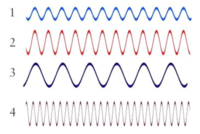
Which wave in the diagram has the greatest frequency?
2.
MULTIPLE CHOICE QUESTION
30 sec • 1 pt

Which of the following is TRUE about standing waves?
3.
MULTIPLE CHOICE QUESTION
30 sec • 1 pt

Based on the picture, which of the following is FALSE?
4.
MULTIPLE CHOICE QUESTION
30 sec • 1 pt

A standing wave is oscillating at 1 Hz on a string shown in the figure, creating fundamental pattern you can see. The boundary between the student's hand and the fixed end is 2 meters. Which of the following is TRUE?
5.
MULTIPLE CHOICE QUESTION
30 sec • 1 pt

Based on the picture: A string is 3.0 meters long is fixed at both ends. The speed of the wave is 18 m/s. What is the frequency of the standing wave shown in the figure?
*speed = frequency x wavelength
6.
MULTIPLE CHOICE QUESTION
30 sec • 1 pt

In the picture we see two waves approaching one another on opposite sides of equilibrium. Wave A has an amplitude of +2 and Wave B has an amplitude of -2. Which of the following is FALSE?
7.
MULTIPLE CHOICE QUESTION
30 sec • 1 pt

The speed of propagation of a transverse wave on a 2 meter long string fixed at both ends is 10 m/s. *Which frequency would NOT create standing waves?


Access all questions and much more by creating a free account
Create resources
Host any resource
Get auto-graded reports

Continue with Google

Continue with Email

Continue with Classlink

Continue with Clever
or continue with

Microsoft
%20(1).png)
Apple

Others
Already have an account?
Similar Resources on Wayground

10 questions
Supply Theory

Quiz
•
11th Grade
10 questions
LIQUID PRESSURE PHYSICS KSSM
Quiz
•
10th - 12th Grade
12 questions
HS Physics DO NOW Electric Fields
Quiz
•
9th - 12th Grade
10 questions
Wave-particle-debroglie
Quiz
•
10th - 12th Grade
10 questions
Magnetic Effects of electrict current
Quiz
•
10th Grade
12 questions
Kinematic (Uniform Motion and Non-Uniform Motion)
Quiz
•
11th Grade
11 questions
Straling VMBO-t 3
Quiz
•
9th - 10th Grade
12 questions
Chapter 10 - Magnetic Fields
Quiz
•
10th Grade
Popular Resources on Wayground
7 questions
History of Valentine's Day

Interactive video
•
4th Grade
15 questions
Fractions on a Number Line
Quiz
•
3rd Grade
20 questions
Equivalent Fractions
Quiz
•
3rd Grade
25 questions
Multiplication Facts
Quiz
•
5th Grade
22 questions
fractions
Quiz
•
3rd Grade
15 questions
Valentine's Day Trivia
Quiz
•
3rd Grade
20 questions
Main Idea and Details
Quiz
•
5th Grade
20 questions
Context Clues
Quiz
•
6th Grade
Discover more resources for Physics
10 questions
Exit Check 3.1 - Kepler's Laws
Quiz
•
9th Grade
10 questions
Exit Check 3.2 - Force of Gavity
Quiz
•
9th Grade
21 questions
Potential and Kinetic Energy
Quiz
•
11th Grade
27 questions
Simple Machines and Mechanical Advantage Quiz
Quiz
•
9th Grade
20 questions
Unit 8 - Energy Test - 2025-2026
Quiz
•
9th - 12th Grade
19 questions
Generators, Motors, and Transformers
Quiz
•
8th Grade - University
24 questions
IPC Thermal Energy Test Corrections
Quiz
•
9th Grade
14 questions
Bill Nye Waves
Interactive video
•
9th - 12th Grade