
Wave Basics
10th - 12th Grade
•30 Qs

Similar activities
BONUS TEST
10th - 12th Grade
•25 Qs
PHY: Electrostatics
7th - 10th Grade
•25 Qs
Radiation #1
8th Grade - University
•25 Qs
some things me + more!
KG - 12th Grade
•25 Qs
Chapter (11)
11th Grade
•25 Qs
Nature Of Physical World And Measurement.
11th Grade
•25 Qs
Cape Physics Unit 2 module 1
12th Grade
•25 Qs

Wave Basics

Quiz
•
Physics
•
10th - 12th Grade
•
Medium
+9
Standards-aligned

Aaron Locke
Used 2+ times
FREE Resource

Enhance your content in a minute
30 questions
Show all answers
1.
MULTIPLE CHOICE QUESTION
15 mins • 1 pt
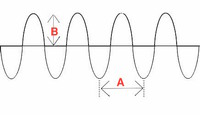
What property of the wave is represented by the letter "B"?
amplitude
crest
trough
wavelength
2.
MULTIPLE CHOICE QUESTION
1 min • 1 pt
The highest point on a wave is:
3.
MULTIPLE CHOICE QUESTION
1 min • 1 pt
The lowest point on a wave is the:
4.
MULTIPLE CHOICE QUESTION
1 min • 1 pt
The number of wavelengths that pass a point each per second is:
Tags
NGSS.HS-PS4-1
5.
MULTIPLE CHOICE QUESTION
30 sec • 1 pt
The type of waves that require medium to pass:
6.
MULTIPLE CHOICE QUESTION
1 min • 1 pt

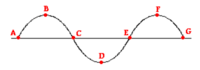
Which vocabulary term is used to identify the distance between points C & G?
Tags
CCSS.RI.11-12.7
CCSS.RI.8.7
CCSS.RI.9-10.7
CCSS.RL.11-12.7
CCSS.RL.9-10.7
7.
MULTIPLE CHOICE QUESTION
30 sec • 1 pt
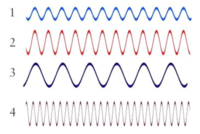
When the frequency of a wave increases, what happens to the wavelength?
Tags
NGSS.HS-PS4-1
Access all questions and much more by creating a free account
Create resources
Host any resource
Get auto-graded reports

Continue with Google

Continue with Email

Continue with Classlink

Continue with Clever
or continue with

Microsoft
%20(1).png)
Apple

Others
Already have an account?
Similar Resources on Wayground
25 questions
Induzione elettromagnetica
Quiz
•
10th - 12th Grade
25 questions
Kinematics in One Dimension (Concept Test)
Quiz
•
11th Grade
25 questions
The Law of Conservation of Energy
Quiz
•
10th - 12th Grade
25 questions
Electric Circuits Summative
Quiz
•
11th Grade
25 questions
Favours Assessment
Quiz
•
10th Grade
25 questions
Physics - End of the Year Assessment
Quiz
•
12th Grade - University
25 questions
Light and Emission Spectra
Quiz
•
10th Grade
25 questions
Review Quiz Statics, Dynamics and Fluids Mechanics
Quiz
•
10th - 12th Grade
Popular Resources on Wayground
15 questions
Fractions on a Number Line
Quiz
•
3rd Grade
20 questions
Equivalent Fractions
Quiz
•
3rd Grade
25 questions
Multiplication Facts
Quiz
•
5th Grade
54 questions
Analyzing Line Graphs & Tables
Quiz
•
4th Grade
22 questions
fractions
Quiz
•
3rd Grade
20 questions
Main Idea and Details
Quiz
•
5th Grade
20 questions
Context Clues
Quiz
•
6th Grade
15 questions
Equivalent Fractions
Quiz
•
4th Grade
Discover more resources for Physics
16 questions
Coulomb's Law
Quiz
•
11th Grade
10 questions
Understanding Heat, Thermal Energy, and Temperature

Interactive video
•
9th - 10th Grade
10 questions
Newton's Laws of Motion
Quiz
•
10th Grade
10 questions
unit 10 -- electric forces and fields

Lesson
•
9th - 12th Grade
21 questions
Diffraction, Reflection, Refraction
Quiz
•
9th - 12th Grade
15 questions
Position vs. Time and Velocity vs. Time Graphs
Quiz
•
10th - 12th Grade
10 questions
Types of Chemical Reactions
Quiz
•
10th Grade
11 questions
Conservation of Momentum: Physics in Motion Video
Interactive video
•
10th Grade