
Types of Bonds
Chemistry
9th - 10th Grade
NGSS covered
Used 3K+ times


AI Actions
Add similar questions
Adjust reading levels
Convert to real-world scenario
Translate activity
More...
About
This quiz covers chemical bonding, specifically focusing on ionic and covalent bonds as the primary topic within high school chemistry. The content is appropriate for grades 9-10, as evidenced by the fundamental concepts tested and the level of chemical reasoning required. Students need to understand electron behavior in atoms, including how metals lose electrons to form cations while nonmetals gain electrons to form anions during ionic bonding. They must grasp that ionic bonds typically form between metals and nonmetals through electron transfer, while covalent bonds form between nonmetals through electron sharing. The quiz also assesses knowledge of valence electrons, their role in bonding, and basic chemical terminology including ions, compounds, and chemical formulas. Students are expected to predict bond types based on element combinations and interpret simple molecular representations to count atoms and identify structural components. This quiz was created by a classroom teacher who designed it for students studying chemical bonding in grades 9-10. The assessment serves multiple instructional purposes, functioning effectively as a formative assessment tool to gauge student understanding before moving to more complex bonding concepts, or as targeted practice following initial instruction on ionic and covalent bonds. Teachers can deploy this quiz as a warm-up activity to activate prior knowledge, assign it as homework to reinforce classroom learning, or use it for review sessions before unit tests. The mix of conceptual questions and practical applications makes it particularly valuable for identifying students who may need additional support with electron transfer versus sharing concepts. This content aligns with NGSS HS-PS1-2, which focuses on chemical bonding and molecular interactions, and supports state chemistry standards that require students to analyze and predict chemical bonding patterns based on electron configurations and periodic trends.
Content View
Student View
20 questions
Show all answers
1.
MULTIPLE CHOICE QUESTION
30 sec • 1 pt
When forming an ionic bond, a metal atom
Tags
NGSS.HS-PS1-2
2.
MULTIPLE CHOICE QUESTION
30 sec • 1 pt
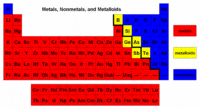
What elements generally make an ionic bond?
Tags
NGSS.HS-PS1-1
NGSS.HS-PS1-2
3.
MULTIPLE CHOICE QUESTION
30 sec • 1 pt
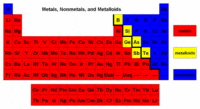
What elements generally make a covalent bond?
Tags
NGSS.HS-PS1-1
4.
MULTIPLE CHOICE QUESTION
30 sec • 1 pt

In chemical compounds, covalent bonds form when
Tags
NGSS.HS-PS1-1
NGSS.HS-PS1-2
5.
MULTIPLE CHOICE QUESTION
30 sec • 1 pt

An ionic bond forms when
Tags
NGSS.HS-PS1-2
6.
MULTIPLE CHOICE QUESTION
30 sec • 1 pt
Predict the bond that will form between Be and F.
Tags
NGSS.HS-PS1-1
NGSS.HS-PS1-2
7.
MULTIPLE CHOICE QUESTION
30 sec • 1 pt
Predict the bond that will form between Se and Cl.
Tags
NGSS.HS-PS1-1
NGSS.HS-PS1-2

Access all questions and much more by creating a free account
Create resources
Host any resource
Get auto-graded reports

Continue with Google

Continue with Email

Continue with Microsoft
or continue with

%20(1).png)
Apple

Others
By signing up, you agree to our Terms of Service & Privacy Policy
Already have an account?


