
Unit 9 - Target #2
11th Grade
•10 Qs

Similar activities
Annie J. Easley
9th - 12th Grade
•10 Qs
Call of Duty
KG - Professional Development
•12 Qs
getaran dan gelombang
11th Grade
•10 Qs
Story of Electricity Part 1
5th - 12th Grade
•13 Qs
เสียงและการได้ยิน
9th - 12th Grade
•10 Qs
Practice quiz PHYSICS Yr 10
9th - 11th Grade
•10 Qs
5th Ideal Gasses Follow up
10th - 11th Grade
•10 Qs
HEAT -
10th - 11th Grade
•10 Qs

Unit 9 - Target #2

Quiz
•
Physics
•
11th Grade
•
Medium
Standards-aligned

Deanna Warkins
Used 3+ times
FREE Resource

Enhance your content in a minute
10 questions
Show all answers
1.
MULTIPLE CHOICE QUESTION
30 sec • 1 pt
The points on the standing wave with the minimum, usually zero amplitude.
antinodes
amplitudes
nodes
harmonics
2.
MULTIPLE CHOICE QUESTION
1 min • 1 pt

A string is clamped at both ends and plucked so it vibrates in a standing mode as shown below. How many nodes and antinodes are there?
Tags
NGSS.HS-PS4-1
3.
MULTIPLE CHOICE QUESTION
30 sec • 1 pt
What happens when the crest of one wave meets the trough of another wave?
4.
MULTIPLE CHOICE QUESTION
30 sec • 1 pt
Constructive interference happens when two waves
5.
MULTIPLE CHOICE QUESTION
30 sec • 1 pt
Destructive interference happens when two waves
6.
MULTIPLE CHOICE QUESTION
1 min • 1 pt
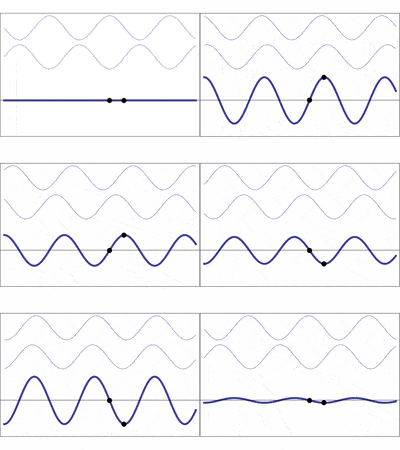
The moving black dot is called:
Tags
NGSS.HS-PS4-1
7.
MULTIPLE CHOICE QUESTION
1 min • 1 pt
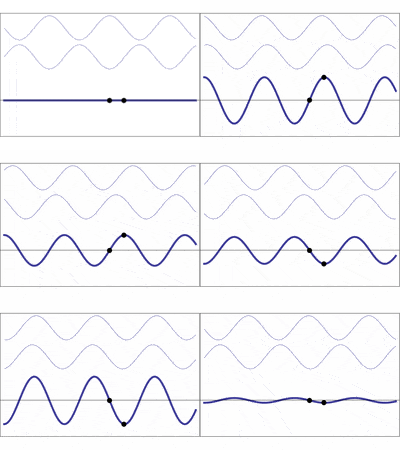
The stationary dot is called:
Tags
NGSS.HS-PS4-1


Access all questions and much more by creating a free account
Create resources
Host any resource
Get auto-graded reports

Continue with Google

Continue with Email

Continue with Classlink

Continue with Clever
or continue with

Microsoft
%20(1).png)
Apple

Others
Already have an account?
Similar Resources on Wayground
10 questions
Evaluasi Gelombang Mekanik
Quiz
•
11th Grade - University
13 questions
Uniform Circular Motion-Physics Interactive - Physics Classroom
Quiz
•
11th Grade
10 questions
Producing sound ม5
Quiz
•
11th Grade
10 questions
2.4 inertia
Quiz
•
11th Grade
12 questions
Generation of Energy(Transformer) Cikgu Sakinah
Quiz
•
6th - 12th Grade
10 questions
Gelombang Bunyi
Quiz
•
11th - 12th Grade
15 questions
Momentum and Impulse Review
Quiz
•
11th - 12th Grade
10 questions
BEST PRACTICE Friction
Quiz
•
10th - 12th Grade
Popular Resources on Wayground
15 questions
Fractions on a Number Line
Quiz
•
3rd Grade
20 questions
Equivalent Fractions
Quiz
•
3rd Grade
25 questions
Multiplication Facts
Quiz
•
5th Grade
22 questions
fractions
Quiz
•
3rd Grade
20 questions
Main Idea and Details
Quiz
•
5th Grade
20 questions
Context Clues
Quiz
•
6th Grade
15 questions
Equivalent Fractions
Quiz
•
4th Grade
20 questions
Figurative Language Review
Quiz
•
6th Grade
Discover more resources for Physics
18 questions
Universal Law of Gravitation

Lesson
•
11th Grade
20 questions
Potential and Kinetic Energy
Quiz
•
9th - 12th Grade
34 questions
Energy Review
Quiz
•
9th - 12th Grade
14 questions
Bill Nye Waves

Interactive video
•
9th - 12th Grade
24 questions
Reflection, Refraction & Diffraction
Quiz
•
6th - 12th Grade