
Linear Regression
Mathematics
8th - 12th Grade
CCSS covered
Used 613+ times


AI Actions
Add similar questions
Adjust reading levels
Convert to real-world scenario
Translate activity
More...
About
This quiz focuses on linear regression and correlation analysis, covering the fundamental concepts that form the foundation of statistical relationships in data. The content is most appropriate for grades 9-12, as it requires students to interpret linear equations, understand correlation coefficients, and make predictions using regression models. Students need a solid grasp of slope-intercept form, the ability to distinguish between positive and negative correlations, and skills in interpreting real-world contexts through mathematical models. The questions assess critical thinking about correlation strength, the difference between correlation and causation, and practical application of regression equations for making predictions. Students must understand that correlation coefficients range from -1 to 1, recognize that the absolute value determines strength regardless of sign, and interpret slope as a rate of change in context-specific situations like speed, cost per item, or other measurable relationships. This quiz was created by a classroom teacher who designed it for students studying statistics and linear relationships in grades 9-12. The assessment serves multiple instructional purposes, functioning effectively as a formative assessment tool to gauge student understanding of correlation and regression concepts, or as targeted practice for students learning to interpret scatter plots and linear models. Teachers can use this quiz as a warm-up activity to activate prior knowledge before diving deeper into statistical analysis, as homework to reinforce classroom learning, or as review material before summative assessments on linear relationships. The questions align with standards CCSS.MATH.CONTENT.HSA.CED.A.3 for representing constraints through systems and inequalities, and CCSS.MATH.CONTENT.HSS.ID.B.6 for representing data on scatter plots and fitting linear functions to data, making it an excellent resource for building statistical literacy and mathematical reasoning skills essential for advanced coursework.
Content View
Student View
20 questions
Show all answers
1.
MULTIPLE CHOICE QUESTION
45 sec • 1 pt

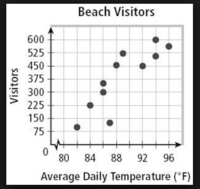
Describe the correlation in the graph shown.
Tags
CCSS.HSF-LE.A.1B
2.
MULTIPLE CHOICE QUESTION
45 sec • 1 pt

Describe the correlation in the graph shown.
Tags
CCSS.HSF-LE.A.1B
3.
MULTIPLE CHOICE QUESTION
45 sec • 1 pt

Describe the correlation in the graph shown.
Tags
CCSS.HSF-LE.A.1B
4.
MULTIPLE CHOICE QUESTION
15 mins • 1 pt

The linear regression equation is y = 61.93x - 1.79. Identify the slope of the equation.
Tags
CCSS.8.EE.B.5
5.
MULTIPLE CHOICE QUESTION
15 mins • 1 pt
The linear regression equation is y = 61.93x - 1.79. According to the model, the slope can be interpreted as:
Tags
CCSS.HSF.LE.B.5
6.
MULTIPLE CHOICE QUESTION
15 mins • 1 pt
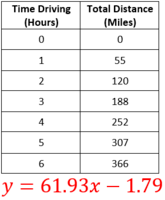
The linear regression equation is y = 61.93x - 1.79. Use the equation to predict how far this person will travel after 10 hours of driving.
Tags
CCSS.HSA.CED.A.2
CCSS.HSA.SSE.A.1
CCSS.HSF.IF.A.1
CCSS.HSF.IF.A.2
CCSS.HSS.ID.C.7
7.
MULTIPLE CHOICE QUESTION
15 mins • 1 pt

The linear regression equation for the data is y = 1.5x + 12. Interpret the slope of the equation.
Tags
CCSS.HSF.LE.B.5

Access all questions and much more by creating a free account
Create resources
Host any resource
Get auto-graded reports

Continue with Google

Continue with Email

Continue with Classlink

Continue with Clever
or continue with

Microsoft
%20(1).png)
Apple

Others
Already have an account?

