
Natural Selection
Authored by Ashley Toler
Biology
9th - 12th Grade
NGSS covered
Used 5K+ times


AI Actions
Add similar questions
Adjust reading levels
Convert to real-world scenario
Translate activity
More...
About
This quiz comprehensively covers natural selection, a fundamental concept in high school biology appropriate for grades 9-12. The questions systematically address the key mechanisms driving evolutionary change: genetic variation arising from mutations and sexual reproduction, environmental pressures that create differential survival and reproduction rates, and the resulting changes in population characteristics over time. Students must understand that advantageous traits increase an organism's fitness—its ability to survive and reproduce—leading to these traits becoming more common in subsequent generations. The quiz requires students to distinguish between natural selection and artificial selection, recognize that organisms do not consciously choose to evolve, and understand critical concepts like population dynamics, adaptation sources, and the relationship between genetic diversity and species survival. Students need strong foundational knowledge of genetics, including DNA structure, mutation effects, and inheritance patterns, combined with ecological understanding of predator-prey relationships and environmental pressures. Created by Ashley Toler, a Biology teacher in the US who teaches grades 9-12. This quiz serves as an excellent formative assessment tool to gauge student understanding before moving into more complex evolutionary concepts, and it works equally well as a review activity before summative assessments or standardized testing. The varied question formats—from basic definitions to application scenarios involving mice populations and predation—make it ideal for differentiated instruction, allowing teachers to identify specific misconceptions about evolution and natural selection. Teachers can use this as a warm-up activity to activate prior knowledge, assign it as homework to reinforce classroom learning, or implement it as a pre-lab assessment before conducting simulations of natural selection. The quiz aligns with NGSS standards HS-LS4-2 (natural selection leads to adaptation of populations) and HS-LS4-3 (environmental factors and genetic variation affect survival), while supporting Common Core literacy standards through scientific reasoning and evidence evaluation.
Content View
Student View
17 questions
Show all answers
1.
MULTIPLE CHOICE QUESTION
30 sec • 1 pt
Why are advantageous traits more likely to be passed onto offspring?
Because they are more likely to survive and reproduce.
Because they come from dominant alleles.
Because they come from recessive alleles.
Because the organism knew it needed that trait, survives, and passes it on.
Tags
NGSS.MS-LS4-4
2.
MULTIPLE CHOICE QUESTION
30 sec • 1 pt
Mutations are a change in what?
DNA
tRNA
protein
rRNA
Tags
NGSS.MS-LS3-1
3.
MULTIPLE CHOICE QUESTION
1 min • 1 pt
The differences among a species, like different bird beaks, are called
Tags
CCSS.RI.11-12.5
CCSS.RI.6.5
CCSS.RI.7.5
CCSS.RI.8.5
CCSS.RI.9-10.5
4.
MULTIPLE CHOICE QUESTION
1 min • 1 pt
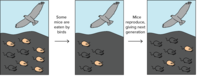
Why is the mouse population changing over time?
Tags
NGSS.MS-LS2-4
5.
MULTIPLE CHOICE QUESTION
1 min • 1 pt

What process is being shown in this image?
Tags
NGSS.MS-LS4-4
NGSS.MS-LS4-6
6.
MULTIPLE CHOICE QUESTION
30 sec • 1 pt
Where do adaptations come from?
The individual organism decides to adapt
Mutations that give an organism an advantage in its environment
Genetic recombination during meiosis
Both mutations and genetic recombination are sources of adaptation
Tags
NGSS.MS-LS4-4
NGSS.MS-LS3-1
7.
MULTIPLE CHOICE QUESTION
30 sec • 1 pt
"Organisms that are better adapted to the environment survive to pass traits to their offspring" is the definition of
Natural Selection
Evolution
Selective Breeding
Artificial Selection
Tags
NGSS.MS-LS4-4

Access all questions and much more by creating a free account
Create resources
Host any resource
Get auto-graded reports

Continue with Google

Continue with Email

Continue with Classlink

Continue with Clever
or continue with

Microsoft
%20(1).png)
Apple

Others
Already have an account?


