
Ploidy
Authored by Vicki Heupel
Biology
9th - 10th Grade
NGSS covered
Used 201+ times


AI Actions
Add similar questions
Adjust reading levels
Convert to real-world scenario
Translate activity
More...
About
This quiz focuses on ploidy and chromosomal abnormalities in biology, targeting the fundamental concepts of chromosome number and genetic disorders. Designed for 9th and 10th grade students, the questions assess understanding of diploid and haploid chromosome numbers, karyotype analysis, and chromosomal abnormalities such as trisomy and monosomy. Students need to grasp the relationship between diploid (2n) and haploid (n) chromosome numbers, understanding that gametes contain half the chromosome number of somatic cells. The quiz requires knowledge of human chromosome numbers (46 diploid, 23 haploid), the ability to interpret karyotypes for chromosomal disorders like Down syndrome (trisomy 21), and comprehension of how nondisjunction during meiosis leads to abnormal chromosome numbers. Additionally, students must understand practical applications of polyploidy in agriculture and distinguish between different types of chromosomal variations. Created by Vicki Heupel, a Biology teacher in the US who teaches grades 9 and 10. This quiz serves as an excellent formative assessment tool for students learning about genetics and chromosome structure, providing immediate feedback on their understanding of core genetic principles. Teachers can utilize this assessment as a warm-up activity before diving deeper into genetic disorders, as homework to reinforce classroom learning, or as review material before unit exams. The quiz effectively supports instructional goals by requiring students to apply mathematical relationships between chromosome numbers, analyze visual data from karyotypes, and connect theoretical knowledge to real-world applications in agriculture. This assessment aligns with NGSS standards HS-LS3-1 (Ask questions to clarify relationships about the role of DNA and chromosomes in coding the instructions for characteristic traits passed from parents to offspring) and supports Common Core mathematical practices through numerical problem-solving with chromosome calculations.
Content View
Student View
12 questions
Show all answers
1.
MULTIPLE CHOICE QUESTION
30 sec • 1 pt
If the Diploid number of Carrots is 18, the haploid number is...
18
9
19
36
17
Tags
NGSS.HS-LS3-2
2.
MULTIPLE CHOICE QUESTION
30 sec • 1 pt
A normal human zygote should have _____ chromosomes inside.
46
23
92
64
Tags
NGSS.HS-LS3-1
3.
MULTIPLE CHOICE QUESTION
30 sec • 1 pt
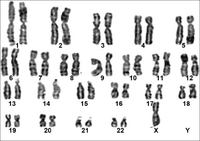
This karyotype shows trisomy 21.
This karyotype has no abnormality.
This karyotype monosomy 23.
This karyotypes has trisomy 23.
This karyotype has monosomy 17.
Tags
NGSS.HS-LS3-2
4.
MULTIPLE CHOICE QUESTION
30 sec • 1 pt

What disorder is displayed on the Karyotype shown?
Trisomy 21
Trisomy 23
Trisomy 20
Monosomy 21
Tags
NGSS.HS-LS3-2
5.
MULTIPLE CHOICE QUESTION
30 sec • 1 pt

What is the sex of the individual with this karyotype?
male
female
Tags
NGSS.HS-LS3-1
6.
MULTIPLE CHOICE QUESTION
30 sec • 1 pt
A normal human sperm cell has_____ chromosomes.
46
23
92
64
Tags
NGSS.HS-LS3-2
7.
MULTIPLE CHOICE QUESTION
30 sec • 1 pt
A normal human egg cell has _____ chromosomes.
46
23
92
64
Tags
NGSS.HS-LS3-2
Access all questions and much more by creating a free account
Create resources
Host any resource
Get auto-graded reports

Continue with Google

Continue with Email

Continue with Classlink

Continue with Clever
or continue with

Microsoft
%20(1).png)
Apple

Others
Already have an account?


