
Animal and Plant Adaptations
6th Grade
•10 Qs

Similar activities
Science P6 separtion technique
6th Grade
•13 Qs
FACING THE FUTURE - ADAPTING TO THE CHANGING CLIMATE
KG - 12th Grade
•11 Qs
Quiz on the Heart and Circulatory System
6th Grade - University
•10 Qs
Water Quiz
4th - 7th Grade
•12 Qs
LA CÈL·LULA
5th - 6th Grade
•14 Qs
3G Soil
KG - 6th Grade
•14 Qs
杠杆
6th Grade
•12 Qs
Post Check: Plants
5th - 8th Grade
•12 Qs
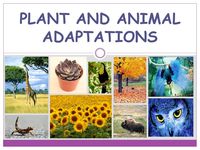
Animal and Plant Adaptations

Quiz
•
Science
•
6th Grade
•
Practice Problem
•
Hard
+1
Standards-aligned

Ms. Stone
Used 370+ times
FREE Resource

Enhance your content in a minute
10 questions
Show all answers
1.
MULTIPLE CHOICE QUESTION
3 mins • 1 pt
What is the best explanation for the relationship between animals and plants? Choose the best answer.
Bees need plants to spread pollen.
They need each other to reproduce and survive.
Birds pick up seeds on their beaks and eat them.
Plants can only reproduce if bees pollinate them.
Tags
NGSS.MS-LS1-4
2.
MULTIPLE CHOICE QUESTION
3 mins • 1 pt
According to "Plant Adaptations" which of the following colors would a seed need to be to help it not be eaten by an animal?
white
yellow
neon pink
brown
Tags
NGSS.MS-LS4-4
3.
MULTIPLE CHOICE QUESTION
3 mins • 1 pt
How does the adaptation of camouflage help protect animals from predators?
Animals are able to sleep during the cold winter months and do not have to look for food.
Animals are able to blend into their surroundings and not be seen by predators.
Animals are able to scare away their predators.
Animals are able to travel to a warmer habitat.
Tags
NGSS.MS-LS4-4
4.
MULTIPLE CHOICE QUESTION
3 mins • 1 pt
In "Plant Adaptations" the author wrote:
Many people are surprised to find plants in a dry desert climate.
Why are people MOST LIKELY surprised to see plants in the desert?
There is too much water in the desert for plants to grow.
Animals in the desert do not like plants to grow in their habitat.
The desert is a dry habitat with little water for plants.
People who live in the desert do not allow any types of plants to grow.
Tags
NGSS.MS-LS2-1
5.
MULTIPLE CHOICE QUESTION
3 mins • 1 pt
Which of the following choices best describes adaptations?
Adaptations form over time.
Animals can have body adaptations or behavior adaptations.
Insects are more attracted to brightly colored flowers.
Adaptations help plants survive.
6.
MULTIPLE CHOICE QUESTION
3 mins • 1 pt
Why do the spines on a cactus MOST LIKELY discourage animals from eating it?
The spines are sharp and pointy, so they may hurt the animals.
The spines contain toxins that will make the animals itch.
The animals are afraid of the color of the spines.
The spines contain water and the animals do not like to drink water.
Tags
NGSS.MS-LS1-4
7.
MULTIPLE SELECT QUESTION
3 mins • 1 pt
In the reading, why does the author include pictures of the pitcher plant? Choose the 2 best answers.
To show they exist and how they look.
To show how the pitcher plant eats bugs.
To show the shape of the pitcher plant and it's adaptations for survival.
To describe the adaptations for this particular plant.
Access all questions and much more by creating a free account
Create resources
Host any resource
Get auto-graded reports

Continue with Google

Continue with Email

Continue with Classlink

Continue with Clever
or continue with

Microsoft
%20(1).png)
Apple

Others
Already have an account?
Similar Resources on Wayground
9 questions
Science DCC#3 Review 2021
Quiz
•
6th Grade
12 questions
Forces
Quiz
•
6th - 8th Grade
10 questions
Changes of State
Quiz
•
6th Grade
14 questions
3G Soil
Quiz
•
KG - 6th Grade
10 questions
Brain
Quiz
•
4th - 6th Grade
10 questions
LAYERS OF EARTH
Quiz
•
5th - 7th Grade
10 questions
LiMiTiNg FaCtOrS
Quiz
•
6th Grade
10 questions
Substance and Mixtures
Quiz
•
6th Grade
Popular Resources on Wayground
15 questions
Fractions on a Number Line
Quiz
•
3rd Grade
20 questions
Equivalent Fractions
Quiz
•
3rd Grade
25 questions
Multiplication Facts
Quiz
•
5th Grade
22 questions
fractions
Quiz
•
3rd Grade
20 questions
Main Idea and Details
Quiz
•
5th Grade
20 questions
Context Clues
Quiz
•
6th Grade
15 questions
Equivalent Fractions
Quiz
•
4th Grade
20 questions
Figurative Language Review
Quiz
•
6th Grade
Discover more resources for Science
33 questions
Grade 6 Quarter 3 PMA 5 Review
Quiz
•
6th - 8th Grade
20 questions
Rocks and The Rock Cycle
Quiz
•
6th Grade
12 questions
Newton's Laws of Motion

Lesson
•
6th - 8th Grade
10 questions
Exploring the Rock Cycle: Types and Formation

Interactive video
•
6th - 8th Grade
10 questions
Exploring the Layers of the Earth
Interactive video
•
6th - 10th Grade
20 questions
Cells! Cell Theory and Characteristics of Eukaryotes/Prokaryotes
Quiz
•
6th Grade
15 questions
Punnett Squares
Quiz
•
6th Grade
13 questions
Cell Theory
Quiz
•
6th Grade