
7.11A Dichotomous Keys
Authored by Kyeona Lewis
Biology
7th Grade
NGSS covered
Used 522+ times


AI Actions
Add similar questions
Adjust reading levels
Convert to real-world scenario
Translate activity
More...
Content View
Student View
19 questions
Show all answers
1.
MULTIPLE CHOICE QUESTION
1 min • 1 pt
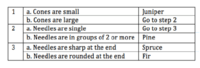
A dichotomous key for trees is provided. Hikers found a tree that has large brown cones and single sharp needles. What species of tree have the hikers found?
2.
MULTIPLE CHOICE QUESTION
20 sec • 1 pt
Which of the following characteristics will most likely be helpful in identifying a butterfly using a dichotomous key?
3.
MULTIPLE CHOICE QUESTION
1 min • 1 pt
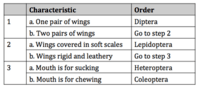
A dichotomous key for insects is given. To what order does an insect with two pairs of scaly wings belong?
4.
MULTIPLE CHOICE QUESTION
1 min • 1 pt
A dichotomous key for insects is given. To what order does an insect with two pairs of scaly wings belong?
5.
MULTIPLE CHOICE QUESTION
1 min • 1 pt
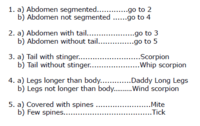
A student discovers an arachnid with a segmented abdomen, long legs, and a tail with no stinger. The student uses the dichotomous key below to identify it. Which arachnid has the student found?
Tags
NGSS.MS-LS4-2
6.
MULTIPLE CHOICE QUESTION
1 min • 1 pt

An illustration and a dichotomous key are given. What is the correct classification for this organism?
Tags
NGSS.MS-LS4-2
7.
MULTIPLE CHOICE QUESTION
45 sec • 1 pt

A labeled diagram of a fiddler crab is provided. Which of the following is an accurate observation of the structures of a fiddler crab? Fiddler crabs have -
Tags
NGSS.MS-LS4-2

Access all questions and much more by creating a free account
Create resources
Host any resource
Get auto-graded reports

Continue with Google

Continue with Email

Continue with Microsoft
or continue with

%20(1).png)
Apple

Others
By signing up, you agree to our Terms of Service & Privacy Policy
Already have an account?



