
HC VSEPR & Polarity Check-In
10th - 12th Grade
•24 Qs

Similar activities
Larutan Elektrolit dan Non Elektrolit
10th Grade
•20 Qs
ULANGAN IKATAN KIMIA
10th Grade
•19 Qs
aromatic
10th - 12th Grade
•20 Qs
HALOGEN
12th Grade - University
•20 Qs
sifat koligatif larutan
12th Grade
•20 Qs
REMIDI KIMIA KELAS X
10th Grade
•20 Qs
Chemical Bonding
12th Grade - University
•20 Qs
PENILAIAN HARIAN I(PH-1) KLS XII SKL
12th Grade
•20 Qs

HC VSEPR & Polarity Check-In

Quiz
•
Chemistry
•
10th - 12th Grade
•
Medium
+1
Standards-aligned

Matthew Owen
Used 4+ times
FREE Resource

Enhance your content in a minute
24 questions
Show all answers
1.
MULTIPLE CHOICE QUESTION
30 sec • 1 pt
According to VSEPR, molecules adjust their shapes to keep which of the following as far away as possible?
Pairs of valence electrons
Inner shell electrons
Mobile Electrons
Electrons closest to the nucleus
Answer explanation
According to VSEPR theory, molecules adopt shapes that minimize repulsion between electron pairs. Therefore, they adjust to keep pairs of valence electrons as far apart as possible, which is crucial for determining molecular geometry.
2.
MULTIPLE CHOICE QUESTION
30 sec • 1 pt

What geometry is this? (The balloon-like shapes are lone pairs!)
Linear
Trigonal Pyramidal
Bent
Tetrahedral
Answer explanation
The geometry is bent because the lone pairs (balloon-like shapes) repel the bonding pairs, causing the molecule to adopt a bent shape rather than a linear or tetrahedral arrangement.
3.
MULTIPLE CHOICE QUESTION
30 sec • 1 pt

What is the geometry of this molecule?
Tetrahedral
Linear
Trigonal Pyramidal
Trigonal Planar
Answer explanation
The molecule has a tetrahedral geometry, which occurs when a central atom is bonded to four other atoms with no lone pairs, resulting in bond angles of approximately 109.5 degrees.
4.
MULTIPLE CHOICE QUESTION
1 min • 1 pt
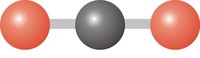
Which molecule would have this shape (linear)?
BF3
CH4
PCl3
CO2
Answer explanation
CO2 has a linear shape due to its two double bonds and no lone pairs on the central carbon atom, resulting in a bond angle of 180 degrees. In contrast, BF3, CH4, and PCl3 have different geometries.
5.
MULTIPLE CHOICE QUESTION
30 sec • 1 pt

What molecule could this be? (Look at how many domains it has!)
BF3
CH4
H2O
CO2
Answer explanation
BF3 has three bonding domains around the boron atom, indicating it is a trigonal planar molecule. In contrast, CH4, H2O, and CO2 have different numbers of domains, making BF3 the correct choice.
6.
MULTIPLE CHOICE QUESTION
30 sec • 1 pt
SiCl4 has what shape?
Trigonal pyramid
bent
tetrahedral
Trigonal planar
Answer explanation
SiCl4 has a tetrahedral shape due to its four bonding pairs of electrons around the central silicon atom, which repel each other equally, resulting in a three-dimensional arrangement.
7.
MULTIPLE CHOICE QUESTION
1 min • 1 pt
What Shape would BH3 form?
Trigonal Pyrimidal
Trigonal Planar
Tetrahedral
Bent
Answer explanation
BH3 has three hydrogen atoms bonded to a central boron atom with no lone pairs, resulting in a trigonal planar shape. The bond angles are approximately 120 degrees, confirming the trigonal planar geometry.


Access all questions and much more by creating a free account
Create resources
Host any resource
Get auto-graded reports

Continue with Google

Continue with Email

Continue with Classlink

Continue with Clever
or continue with

Microsoft
%20(1).png)
Apple

Others
Already have an account?
Similar Resources on Wayground
20 questions
ICFES 10° QUIMICA II PERIODO
Quiz
•
10th Grade
20 questions
Chemistry AS Module 2.2 Foundations
Quiz
•
12th Grade
19 questions
Chapter 3 - Lesson 2
Quiz
•
10th - 12th Grade
20 questions
IKATAN KIMIA
Quiz
•
11th Grade
20 questions
Chemical Bonding
Quiz
•
12th Grade - University
20 questions
Orbitales hidridos e Isomería
Quiz
•
12th Grade
20 questions
Larutan Elektrolit dan Non Elektrolit
Quiz
•
10th Grade
22 questions
Enlace Químico
Quiz
•
1st - 12th Grade
Popular Resources on Wayground
15 questions
Fractions on a Number Line
Quiz
•
3rd Grade
20 questions
Equivalent Fractions
Quiz
•
3rd Grade
25 questions
Multiplication Facts
Quiz
•
5th Grade
22 questions
fractions
Quiz
•
3rd Grade
20 questions
Main Idea and Details
Quiz
•
5th Grade
20 questions
Context Clues
Quiz
•
6th Grade
15 questions
Equivalent Fractions
Quiz
•
4th Grade
20 questions
Figurative Language Review
Quiz
•
6th Grade
Discover more resources for Chemistry
20 questions
Types of Chemical Reactions
Quiz
•
9th - 12th Grade
20 questions
Energy Transformations
Quiz
•
9th - 12th Grade
20 questions
Periodic Table & Trends
Quiz
•
10th Grade
17 questions
Reaction Rates
Quiz
•
11th Grade
20 questions
Periodic Trends
Quiz
•
10th Grade
24 questions
Identifying Types of Chemical Reactions
Quiz
•
10th - 12th Grade
20 questions
Naming & Writing Chemical Formulas
Quiz
•
10th Grade
20 questions
Atomic Structure
Quiz
•
10th - 12th Grade