
Particle theory and changes of states of matter
Authored by Leni Rosos
Chemistry
7th Grade
NGSS covered
Used 296+ times


AI Actions
Add similar questions
Adjust reading levels
Convert to real-world scenario
Translate activity
More...
Content View
Student View
28 questions
Show all answers
1.
MULTIPLE CHOICE QUESTION
1 min • 1 pt
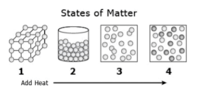
Number 2 represents a ________
solid
liquid
gas
plasma
Tags
NGSS.MS-PS1-4
2.
MULTIPLE CHOICE QUESTION
1 min • 1 pt
Particles in a _____________ are tightly packed together.
Tags
NGSS.2-PS1-1
3.
MULTIPLE CHOICE QUESTION
30 sec • 1 pt
Particles in a _________ take the shape of the container.
solid
liquid
gas
plasma
4.
MULTIPLE CHOICE QUESTION
1 min • 1 pt
As particles are exposed to warmer temperatures they __________
move faster
slow down
stay the same
vibrate on its spot
Tags
NGSS.MS-PS1-4
5.
MULTIPLE CHOICE QUESTION
1 min • 1 pt
An inflated balloon is placed in a refrigerator. Which statement describes the movement of the gas particles in the balloon?
Tags
NGSS.MS-PS1-4
6.
MULTIPLE CHOICE QUESTION
1 min • 1 pt
The amount of matter in an object is a measure of the object's ________________.
7.
MULTIPLE CHOICE QUESTION
1 min • 1 pt
A student added sugar to a cup of water and stirred with a spoon. After 10 minutes you could not see the sugar anymore. What happened to the sugar?
the sugar evaporated
the sugar dissolved
the sugar disappeared
the sugar reacted with water making a new substance
Tags
NGSS.MS-PS1-2
Access all questions and much more by creating a free account
Create resources
Host any resource
Get auto-graded reports

Continue with Google

Continue with Email

Continue with Microsoft
or continue with

%20(1).png)
Apple

Others
By signing up, you agree to our Terms of Service & Privacy Policy
Already have an account?


