
Fission and Fusion + Half-Life
Authored by Rico Molato
Science
9th - 11th Grade
NGSS covered
Used 38+ times


AI Actions
Add similar questions
Adjust reading levels
Convert to real-world scenario
Translate activity
More...
Content View
Student View
10 questions
Show all answers
1.
MULTIPLE CHOICE QUESTION
30 sec • 1 pt
There are 2 distinct types of nuclear reactions: fusion and fission reactions. In which reaction is the nucleus of an atom split into 2 or more atoms?
Fusion reactions
Fission reactions
Both nuclear reactions
Neither nuclear reaction
Tags
NGSS.HS-PS1-8
2.
MULTIPLE CHOICE QUESTION
30 sec • 1 pt
In order for fission reactions to be successful, they must be self-perpetuating, meaning they must be able to keep themselves going. What do you call the minimum amount of material that is needed for the reaction to keep going?
isotope
mass defect
critical mass
neutron
Tags
NGSS.HS-PS1-8
3.
MULTIPLE CHOICE QUESTION
30 sec • 1 pt
Our sun is a star that is fueled by a specific type of nuclear reaction. Which type of nuclear reaction is this?
Fusion
Solar
Fission
Radioactive
Tags
NGSS.HS-PS1-8
NGSS.HS-ESS1-1
4.
MULTIPLE CHOICE QUESTION
30 sec • 1 pt
Why is the fusion reaction not currently used to produce energy, especially as it is a "clean" form of energy that does not create radioactive or nuclear byproducts?
There are currently not enough fuels for fusion reactions
Fusion reactions are highly endothermic, making them dangerous
Fusion reactioons do not yet produce enough energy
The heat it takes to start a fusion reaction is too high to contain.
Tags
NGSS.HS-ETS1-3
5.
MULTIPLE CHOICE QUESTION
30 sec • 1 pt
Fission reactions are currently used to provide energy for many different sources. Where does the energy produced during the reaction come from?
From the mass lost during the reaction, or mass defect
From the mass created during the reaction, or the mass increase
From the critical mass of the reaction
From the protons created during the reaction
Tags
NGSS.HS-PS1-8
6.
MULTIPLE CHOICE QUESTION
30 sec • 1 pt

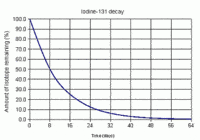
The time required for one half of a sample of a radioisotope to decay is called:
Tags
NGSS.HS-PS1-8
7.
MULTIPLE CHOICE QUESTION
2 mins • 1 pt
After the third half-life, how much of the sample is left?
Tags
NGSS.HS-PS1-8
Access all questions and much more by creating a free account
Create resources
Host any resource
Get auto-graded reports

Continue with Google

Continue with Email

Continue with Classlink

Continue with Clever
or continue with

Microsoft
%20(1).png)
Apple

Others
Already have an account?


