
Waves
Authored by Shelley Kozlowski
Physics
8th - 12th Grade
NGSS covered
Used 2K+ times


AI Actions
Add similar questions
Adjust reading levels
Convert to real-world scenario
Translate activity
More...
About
This quiz covers the fundamental properties and behavior of waves, representing core physics content typically taught at the middle school through early high school level, spanning grades 8-10. Students need to understand the anatomical parts of waves including crests, troughs, amplitude, and wavelength for transverse waves, as well as compressions and rarefactions for longitudinal waves. The questions assess students' ability to distinguish between mechanical and electromagnetic waves, identify wave types like transverse versus longitudinal, and recognize real-world examples such as sound and light waves. Mathematical proficiency is essential as students must apply the wave equation (speed = wavelength × frequency) to solve quantitative problems, manipulate algebraic relationships between wave properties, and work with scientific notation. Students also need conceptual understanding of energy transfer through waves, the inverse relationship between frequency and wavelength, and the requirement for media in mechanical wave propagation. Created by Shelley Kozlowski, a Physics teacher in the US who teaches grades 8-12. This comprehensive assessment tool serves multiple instructional purposes, from introducing wave concepts as a diagnostic pre-assessment to reinforcing learning through practice sessions and homework assignments. The quiz works exceptionally well for formative assessment, allowing teachers to quickly identify misconceptions about wave terminology and mathematical relationships before moving to more complex wave phenomena. The mix of conceptual and computational questions makes it ideal for review sessions before unit tests, while individual question sets can serve as targeted warm-ups focusing on specific wave properties. The content aligns with Next Generation Science Standards MS-PS4-1 and HS-PS4-1, which require students to develop and use models of waves to describe patterns in terms of amplitude and wavelength, and to use mathematical representations to support explanations of wave properties and their applications in technologies.
Content View
Student View
36 questions
Show all answers
1.
MULTIPLE CHOICE QUESTION
1 min • 1 pt
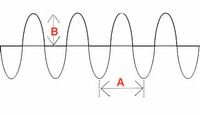
What property of this wave is represented by the letter "A"
Tags
NGSS.MS-PS4-1
2.
MULTIPLE CHOICE QUESTION
1 min • 1 pt
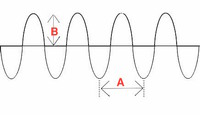
What property of the wave is represented by the letter "B"?
Tags
NGSS.HS-PS4-1
3.
MULTIPLE CHOICE QUESTION
1 min • 1 pt
The highest point on a wave is:
4.
MULTIPLE CHOICE QUESTION
1 min • 1 pt
The lowest point on a wave is the:
5.
MULTIPLE CHOICE QUESTION
30 sec • 1 pt
The type of waves that require medium to pass:
6.
MULTIPLE CHOICE QUESTION
20 sec • 1 pt
What types of waves carry energy at a right angle or perpendicular to the direction of the energy flow?
Tags
NGSS.MS-PS4-1
7.
MULTIPLE CHOICE QUESTION
15 mins • 1 pt
What do waves carry from place to place?
Tags
NGSS.MS-PS4-1
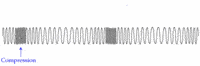
Access all questions and much more by creating a free account
Create resources
Host any resource
Get auto-graded reports

Continue with Google

Continue with Email

Continue with Microsoft
or continue with

%20(1).png)
Apple

Others
By signing up, you agree to our Terms of Service & Privacy Policy
Already have an account?


