
19 BOWER stars !
Authored by krystina bower
Science
6th Grade
NGSS covered
Used 83+ times


AI Actions
Add similar questions
Adjust reading levels
Convert to real-world scenario
Translate activity
More...
Content View
Student View
27 questions
Show all answers
1.
MULTIPLE CHOICE QUESTION
2 mins • 1 pt
Eduardo observes the stars through his telescope. He states that the star Regulus is brighter than the star Rigel. In reality, Rigel has a greater absolute brightness than Regulus. What can explain Eduardo’s observation?
Regulus is much closer to Earth than Rigel
Rigel is much closer to Earth than Regulus.
Regulus is a hotter star than Rigel
Rigel is a hotter star than Regulus
2.
MULTIPLE CHOICE QUESTION
2 mins • 1 pt
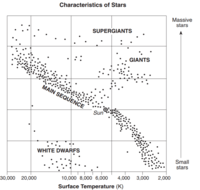
The graph above shows the relative sizes and surface temperatures of four groups of stars. The surface temperature of the stars is measured in Kelvin (K). The Sun is part of the main sequence group.
According to the graph, the Sun is best described as
average sized, with a surface temperature of approximately 6,000 K
massive sized, with a surface temperature of approximately 10,000 K
massive sized, with a surface temperature of approximately 20,000 K
average sized, with a surface temperature of approximately 8,000 K
Tags
NGSS.HS-ESS1-1
NGSS.HS-ESS1-3
3.
MULTIPLE CHOICE QUESTION
2 mins • 1 pt
One physical property of a star is apparent magnitude. Which of the following is used in determining the apparent magnitude of a star?
the constellation the star is in
the number of times the star rotates
the distance the star is from Earth
the number of prominences the star makes
4.
MULTIPLE CHOICE QUESTION
2 mins • 1 pt
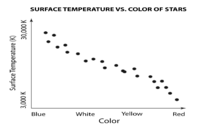
Which statement most accurately describes the relationship between the color and temperature of stars?
yellow stars are cooler than red.
Red stars are hotter than white stars
White stars are cooler than yellow stars
Blue stars are hotter than red stars
5.
MULTIPLE CHOICE QUESTION
2 mins • 1 pt
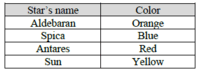
Which of the groups below best orders the stars from hottest to coolest?
Antares, Spica, Sun, Aldebaran
Sun, Spica, Antares, Aldebaran
Spica, Sun, Aldebaran, Antares
Antares, Aldebaran, Sun, Spica
6.
MULTIPLE CHOICE QUESTION
2 mins • 1 pt
The sun is an averaged sized star that was formed by the same processes that form most other stars. Which of the following describes what astronomers would expect to see if they examined most other stars?
Most are the same age
They all use the same fuel
Most appear to be white in color
Most are found outside of galaxies
7.
MULTIPLE CHOICE QUESTION
2 mins • 1 pt

In the following diagram, which star is most likely to be the coolest and dimmest?
C
A
B
E
Access all questions and much more by creating a free account
Create resources
Host any resource
Get auto-graded reports

Continue with Google

Continue with Email

Continue with Classlink

Continue with Clever
or continue with

Microsoft
%20(1).png)
Apple

Others
Already have an account?
Similar Resources on Wayground

22 questions
NATURAL SCIENCE. UNIT 5: HEALTHY BODY

Quiz
•
5th - 6th Grade
22 questions
Seasons and Climate Change
Quiz
•
5th - 8th Grade
24 questions
Natural Hazards Quiz
Quiz
•
6th - 8th Grade
25 questions
Rocks and Minerals 2019
Quiz
•
6th Grade
25 questions
Science Skills and Attitudes
Quiz
•
6th - 12th Grade
22 questions
Speed and Density
Quiz
•
6th Grade
24 questions
Unit 8 Vocab Review
Quiz
•
6th Grade
28 questions
Quizizz: Process Skills and Scientific Variables
Quiz
•
5th - 6th Grade
Popular Resources on Wayground
15 questions
Fractions on a Number Line
Quiz
•
3rd Grade
10 questions
Probability Practice
Quiz
•
4th Grade
15 questions
Probability on Number LIne
Quiz
•
4th Grade
20 questions
Equivalent Fractions
Quiz
•
3rd Grade
25 questions
Multiplication Facts
Quiz
•
5th Grade
22 questions
fractions
Quiz
•
3rd Grade
6 questions
Appropriate Chromebook Usage

Lesson
•
7th Grade
10 questions
Greek Bases tele and phon
Quiz
•
6th - 8th Grade
Discover more resources for Science
20 questions
Rocks and The Rock Cycle
Quiz
•
6th Grade
10 questions
Exploring the Rock Cycle

Interactive video
•
6th - 8th Grade
8 questions
Newton's Second Law
Lesson
•
6th - 8th Grade
20 questions
Thermal Energy - Heat Transfer
Quiz
•
6th Grade
10 questions
Exploring the Rock Cycle: Types and Formation
Interactive video
•
6th - 8th Grade
25 questions
Evolution and Natural Selection Review
Quiz
•
6th - 8th Grade
22 questions
Layers of the Atmosphere
Quiz
•
6th Grade
15 questions
Punnett Squares
Quiz
•
6th Grade