
Half-Life
Authored by Alex Feulner
Social Studies
8th - 10th Grade
Used 927+ times


AI Actions
Add similar questions
Adjust reading levels
Convert to real-world scenario
Translate activity
More...
Content View
Student View
10 questions
Show all answers
1.
MULTIPLE CHOICE QUESTION
30 sec • 1 pt
Radioactive carbon-14 is often useful in determining the absolute age of geologic samples because radioactive isotopes
decay at a regular rate
become less stable during decay
remain unchanged over time
stabilize after four half-lives
2.
MULTIPLE CHOICE QUESTION
1 min • 1 pt
What percentage of rubidium-87 atoms will be left after four half lives?
25.0%
12.5%
6.25%
3.125%
3.
MULTIPLE CHOICE QUESTION
1 min • 1 pt
Radioactive decay of 40K atoms in an igneous rock has resulted in a ratio of 25 percent 40K atoms to 75 percent. 40Ar and 40Ca atoms. How many years old is this rock?
0.3 x 10^9 years
1.3 x 10^9 years
2.6 x 10^9 years
3.9 x 10^9 years
4.
MULTIPLE CHOICE QUESTION
1 min • 1 pt

The solid black sections of the bars on the graph represent the percentages of
carbon-14 from the original sample that has not decayed
lead-206 decay product resulting from the radioactive decay
nitrogen-14 decay product resulting from the radioactive decay
uranium-238 from the original sample that has not decayed
5.
MULTIPLE CHOICE QUESTION
1 min • 1 pt
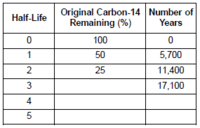
After 22,800 years, approximately what percentage of the original carbon-14 remains?
15%
12.5%
6.25%
3.125%
6.
MULTIPLE CHOICE QUESTION
1 min • 1 pt
Which radioactive element is used to determine the absolute age of late Pleistocene animal remains?
rubidium-87
uranium-238
potassium-40
carbon-14
7.
MULTIPLE CHOICE QUESTION
1 min • 1 pt
How much of an 800-gram sample of potassium-40 will remain after 3.9 × 10^9 years of radioactive decay?
50 grams
100 grams
200 grams
400 grams


Access all questions and much more by creating a free account
Create resources
Host any resource
Get auto-graded reports

Continue with Google

Continue with Email

Continue with Classlink

Continue with Clever
or continue with

Microsoft
%20(1).png)
Apple

Others
Already have an account?
Similar Resources on Wayground

10 questions
Citizenship

Quiz
•
7th - 8th Grade
15 questions
Trade Routes and Empries
Quiz
•
9th - 10th Grade
9 questions
Ancient Rome Vocabulary #2
Quiz
•
6th Grade - University
13 questions
Immigration Nation
Quiz
•
6th - 8th Grade
10 questions
World History Trivia
Quiz
•
9th Grade
15 questions
Criminal Justice
Quiz
•
9th - 12th Grade
10 questions
Convicts in Bermuda Part 1
Quiz
•
9th - 12th Grade
10 questions
Cradle of Democracy - Ancient Greece/Athens & Rome
Quiz
•
7th - 9th Grade
Popular Resources on Wayground
15 questions
Fractions on a Number Line
Quiz
•
3rd Grade
20 questions
Equivalent Fractions
Quiz
•
3rd Grade
25 questions
Multiplication Facts
Quiz
•
5th Grade
22 questions
fractions
Quiz
•
3rd Grade
20 questions
Main Idea and Details
Quiz
•
5th Grade
20 questions
Context Clues
Quiz
•
6th Grade
15 questions
Equivalent Fractions
Quiz
•
4th Grade
20 questions
Figurative Language Review
Quiz
•
6th Grade
Discover more resources for Social Studies
11 questions
Early Statehood Vocabulary Lesson

Lesson
•
6th - 8th Grade
10 questions
Exploring the Executive Branch and Presidential Powers

Interactive video
•
6th - 10th Grade
19 questions
New South
Quiz
•
8th Grade
19 questions
SS8H6 GMAS PREP
Quiz
•
8th Grade
11 questions
Westward Expansion 1
Quiz
•
8th Grade
8 questions
Unit 6, Quiz 1 - Rise of Fascism
Quiz
•
9th Grade
2 questions
WW1 - GA's Contributions
Lesson
•
8th Grade
15 questions
Solar System
Quiz
•
9th Grade