
Evolution (for the FINAL!)
Authored by ELLA CARAWAY
Biology
8th - 12th Grade
NGSS covered
Used 412+ times


AI Actions
Add similar questions
Adjust reading levels
Convert to real-world scenario
Translate activity
More...
Content View
Student View
25 questions
Show all answers
1.
MULTIPLE CHOICE QUESTION
15 mins • 1 pt
Which of the following is NOT an example of natural selection?
Tags
NGSS.HS-LS4-4
2.
MULTIPLE CHOICE QUESTION
15 mins • 1 pt
The environment around Manchester, England, changed during the Industrial Revolution, darkening the trees. How did this change affect peppered moths living in the area?
Natural selection favored moths with dark wings because predators could not see them on the soot-colored trees.
Natural selection favored moths with white wings that were easy for predators to see.
Natural selection favored moths with white wings because predators could not see them on the soot-colored trees.
Natural selection caused moths with white wings to become extinct.
3.
MULTIPLE CHOICE QUESTION
15 mins • 1 pt
Evolution is best defined as:
the process which organisms die.
the process by which organisms change over time.
the process which organisms that are extinct become revived.
the process which non-living things fossilize.
4.
MULTIPLE CHOICE QUESTION
15 mins • 1 pt

What type of evidence for evolution is represented in the picture above:
Fossils
Vestigial Structures
DNA
Homologous Structures
5.
MULTIPLE CHOICE QUESTION
15 mins • 1 pt

What type of evidence for evolution is shown in this picture?
Fossils
Homologous Structures
Vestigial Structures
DNA
6.
MULTIPLE CHOICE QUESTION
15 mins • 1 pt
Adaptations are:
never related to an organism's niche and environment.
physical or behavioral characteristics that help an organisms survive and reproduce.
physical or behavioral characteristics that do not help the organism in any way.
genetic mutations that have gone wrong.
7.
MULTIPLE CHOICE QUESTION
15 mins • 1 pt
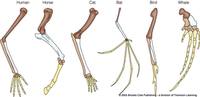
The similarities of the bones in the diagram provide evidence that---
Tags
NGSS.HS-LS4-1
Access all questions and much more by creating a free account
Create resources
Host any resource
Get auto-graded reports

Continue with Google

Continue with Email

Continue with Classlink

Continue with Clever
or continue with

Microsoft
%20(1).png)
Apple

Others
Already have an account?
Similar Resources on Wayground

20 questions
BIOLOGY 101

Quiz
•
8th Grade
20 questions
Zoo Nutrition
Quiz
•
10th Grade - University
20 questions
keys and variation
Quiz
•
8th Grade
20 questions
Alligator Farming & Grow-out Quiz
Quiz
•
12th Grade
20 questions
GB1-LT3
Quiz
•
12th Grade
20 questions
Monogastric Digestive System Structure and Function
Quiz
•
10th - 11th Grade
20 questions
Biochemistry EOC Review
Quiz
•
9th - 10th Grade
24 questions
Adaptation
Quiz
•
6th - 8th Grade
Popular Resources on Wayground
15 questions
Fractions on a Number Line
Quiz
•
3rd Grade
20 questions
Equivalent Fractions
Quiz
•
3rd Grade
25 questions
Multiplication Facts
Quiz
•
5th Grade
22 questions
fractions
Quiz
•
3rd Grade
20 questions
Main Idea and Details
Quiz
•
5th Grade
20 questions
Context Clues
Quiz
•
6th Grade
15 questions
Equivalent Fractions
Quiz
•
4th Grade
20 questions
Figurative Language Review
Quiz
•
6th Grade
Discover more resources for Biology
20 questions
Cell Organelles
Quiz
•
10th Grade
20 questions
Cell Organelles
Quiz
•
9th Grade
20 questions
DNA & Protein Synthesis
Quiz
•
9th Grade
7 questions
Amoeba Sisters Dihybrid Cross Punnett Square

Interactive video
•
9th - 12th Grade
25 questions
photosynthesis and cellular respiration
Quiz
•
9th Grade
20 questions
Human Body Systems
Quiz
•
9th Grade
19 questions
Natural Selection
Quiz
•
9th Grade
20 questions
Pedigree Practice
Quiz
•
9th Grade