
Taxonomy
9th Grade
•22 Qs

Similar activities
Ecosystem Test Review
6th - 9th Grade
•23 Qs
Population Dynamics
8th - 10th Grade
•19 Qs
5.1 and 5.2 Practice Quiz
9th - 12th Grade
•20 Qs
PTS BIOLOGI X IPS
1st - 12th Grade
•20 Qs
Photosynthesis
9th Grade
•20 Qs
Cell Quiz
6th - 9th Grade
•20 Qs
quiz1
9th Grade
•17 Qs
Protists and fungi
5th - 11th Grade
•20 Qs
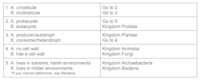
Taxonomy

Quiz
•
Biology
•
9th Grade
•
Practice Problem
•
Easy
+2
Standards-aligned

Brittany Vogt
Used 89+ times
FREE Resource

Enhance your content in a minute
22 questions
Show all answers
1.
MULTIPLE CHOICE QUESTION
5 mins • 1 pt
Which of the following organisms are LEAST closely related?
Tags
NGSS.MS-LS4-2
2.
MULTIPLE CHOICE QUESTION
30 sec • 1 pt
The scientific name for an organism is made from the:
3.
MULTIPLE CHOICE QUESTION
30 sec • 1 pt
The 8 levels of classification, most broad to most specific.
4.
MULTIPLE CHOICE QUESTION
30 sec • 1 pt
Term given to describe the 2 name naming system is:
5.
MULTIPLE CHOICE QUESTION
30 sec • 1 pt
Who first proposed binomial nomenclature as a way of classifying organisms?
6.
MULTIPLE CHOICE QUESTION
20 sec • 1 pt
Cells that do not have a true nucleus are called....
7.
MULTIPLE CHOICE QUESTION
20 sec • 1 pt
Cells that have a true nucleus are called....
Tags
NGSS.MS-LS1-1


Access all questions and much more by creating a free account
Create resources
Host any resource
Get auto-graded reports

Continue with Google

Continue with Email

Continue with Classlink

Continue with Clever
or continue with

Microsoft
%20(1).png)
Apple

Others
Already have an account?
Similar Resources on Wayground
20 questions
Cycling of Matter- Water Cycle + Carbon and Oxygen Cycles-UA
Quiz
•
9th - 12th Grade
20 questions
Biology, Chapter 1 Biology in the 21st Century, Post Assessment
Quiz
•
7th - 12th Grade
18 questions
Photosynthesis and Respiration
Quiz
•
9th - 10th Grade
25 questions
Chapter 1 Review
Quiz
•
7th - 9th Grade
20 questions
Biochemistry Review
Quiz
•
7th - 9th Grade
20 questions
Photosynthesis, Cellular Respiration and Enzyme Review
Quiz
•
9th Grade
20 questions
Bio 2.1, 2.2 Ecosystems EOC Review
Quiz
•
9th - 12th Grade
18 questions
Macromolecules
Quiz
•
9th - 10th Grade
Popular Resources on Wayground
15 questions
Fractions on a Number Line
Quiz
•
3rd Grade
20 questions
Equivalent Fractions
Quiz
•
3rd Grade
25 questions
Multiplication Facts
Quiz
•
5th Grade
54 questions
Analyzing Line Graphs & Tables
Quiz
•
4th Grade
22 questions
fractions
Quiz
•
3rd Grade
20 questions
Main Idea and Details
Quiz
•
5th Grade
20 questions
Context Clues
Quiz
•
6th Grade
15 questions
Equivalent Fractions
Quiz
•
4th Grade
Discover more resources for Biology
20 questions
Cell Organelles
Quiz
•
9th Grade
14 questions
Ecological Succession: Primary and Secondary
Quiz
•
9th Grade
22 questions
Human Body Systems Overview
Quiz
•
9th Grade
25 questions
photosynthesis and cellular respiration
Quiz
•
9th Grade
10 questions
Comparing Mitosis and Meiosis: Key Differences and Stages

Interactive video
•
6th - 10th Grade
13 questions
Amoeba Sisters Viruses Video quiz
Interactive video
•
9th Grade
20 questions
Carbon Cycle
Quiz
•
9th Grade
97 questions
Benchmark 2
Quiz
•
9th Grade