
Atomic Theory, Periodic Table, Isotopes
Authored by Kelly Deutsche
Chemistry
9th - 12th Grade
NGSS covered
Used 1+ times


AI Actions
Add similar questions
Adjust reading levels
Convert to real-world scenario
Translate activity
More...
Content View
Student View
39 questions
Show all answers
1.
MULTIPLE CHOICE QUESTION
30 sec • 1 pt
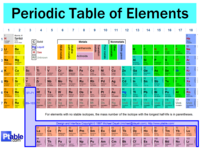
Jane needs a replacement for lithium for a science experiment. She tries silicon, but it does not work. Using what you know about patterns in the periodic table, which advice would you give Jane? (SC.8.P.8.6)
Try a metal from the alkali metal group.
Try a non-metal from the noble gas group.
Try an element in the same group as lithium.
Try an element in the same period as lithium.
Tags
NGSS.HS-PS1-1
2.
MULTIPLE CHOICE QUESTION
30 sec • 1 pt
Using a periodic table, determine which of the following pairs of elements would have the most similar properties: (SC.8.P.8.6)
(H) Hydrogen and (He) Helium
(N) Nitrogen and (Si) Silicon
(Ca) Calcium and (Fe) Iron
(Li) Lithium and (K) Potassium
3.
MULTIPLE CHOICE QUESTION
30 sec • 1 pt

Use this element from the periodic table to answer the question. (SC.8.P.8.6)
What is the atomic mass for silicon?
14.0
14.1
28.1
42.1
4.
MULTIPLE CHOICE QUESTION
30 sec • 1 pt
Which of the following statements best describes the basic structure of an atom? (SC.8.P.8.7)
Electrons and protons are in motion around a nucleus that contains neutrons.
Neutrons are in motion around a nucleus that contains protons and electrons.
Protons are in motion around a nucleus that contains electrons and neutrons.
Electrons are in motion around a nucleus that contains protons and neutrons.
5.
MULTIPLE CHOICE QUESTION
30 sec • 1 pt
Which statement about electrons is true? (SC.8.P.8.7)
Electrons are much smaller than protons and neutrons.
Electrons are in the nucleus of an atom.
Electrons have a positive electric charge.
Electrons are the largest subatomic particle.
6.
MULTIPLE CHOICE QUESTION
30 sec • 1 pt
Which of the following comparisons correctly describes subatomic particles? (SC.8.P.8.7)
An electron has a negative charge and a mass larger than the mass of a proton.
A neutron has a negative charge and a mass smaller than the mass of a proton.
A neutron has a neutral charge and a mass larger than the mass of an electron.
A proton has a positive charge and a mass smaller than the mass of an electron.
7.
MULTIPLE CHOICE QUESTION
30 sec • 1 pt
What does the atomic mass tell you?

Access all questions and much more by creating a free account
Create resources
Host any resource
Get auto-graded reports

Continue with Google

Continue with Email

Continue with Classlink

Continue with Clever
or continue with

Microsoft
%20(1).png)
Apple

Others
Already have an account?



