
Macromolecule Quiz
Authored by Tamarah Files
Biology
9th Grade
NGSS covered
Used 197+ times


AI Actions
Add similar questions
Adjust reading levels
Convert to real-world scenario
Translate activity
More...
Content View
Student View
25 questions
Show all answers
1.
MULTIPLE CHOICE QUESTION
2 mins • 1 pt
Proteins are composed of what smaller building blocks?
amino acids
nucleic acids
fatty acids
nucleotides
Answer explanation
Proteins are made up of amino acids, which are the fundamental building blocks. Nucleic acids, fatty acids, and nucleotides are different types of biomolecules and do not compose proteins.
Tags
NGSS.HS-LS1-6
2.
MULTIPLE CHOICE QUESTION
2 mins • 1 pt
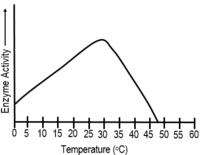
Based on the graph, what temperature does this enzyme work best?
15 C
40 C
30 C
Answer explanation
The graph indicates that the enzyme's activity peaks at 30 C, making it the optimal temperature for its function. Other temperatures, like 15 C and 40 C, show lower enzyme activity.
Tags
NGSS.HS-PS1-5
3.
MULTIPLE CHOICE QUESTION
2 mins • 1 pt
Enzymes are
nucleic acids
proteins
lipids
carbohydrates
Answer explanation
Enzymes are biological catalysts that speed up chemical reactions in the body. They are primarily made of proteins, which are composed of amino acids. Therefore, the correct answer is proteins.
Tags
NGSS.HS-LS1-6
4.
MULTIPLE CHOICE QUESTION
2 mins • 1 pt
Enzymes are _________ that __________ chemical reactions.
proteins, slow down
proteins, speed up
lipids, slow down
lipids, speed up
Answer explanation
Enzymes are proteins that act as catalysts, meaning they speed up chemical reactions without being consumed in the process. Therefore, the correct choice is 'proteins, speed up'.
Tags
NGSS.HS-PS1-5
5.
MULTIPLE CHOICE QUESTION
2 mins • 1 pt

Which of the following conclusions can be drawn from this graph?
The optimum pH of the enzyme is 6.6.
The optimum pH of the enzyme is 5.8
The enzyme’s activity increases as pH increases 5.0 to 9.0
The enzyme’s activity is greater around pH of 8.0 .
Answer explanation
The graph indicates that the enzyme's activity peaks at a pH of 6.6, making it the optimum pH. Other options either misstate the optimum pH or do not accurately reflect the enzyme's activity across the pH range.
6.
MULTIPLE CHOICE QUESTION
2 mins • 1 pt
What happens when enzymes are heated to a high temperature?
The enzymes die.
The shapes of the enzyme are altered or denatured
The enzymes' amino acid sequence changes.
The enzymes remain the same
Answer explanation
When enzymes are heated to a high temperature, their shapes are altered or denatured, which affects their functionality. This is the correct answer, as the enzyme's amino acid sequence remains unchanged.
7.
MULTIPLE CHOICE QUESTION
3 mins • 1 pt
Which factors can change the shape of an enzyme and thus denatures a enzyme?
Excessive heat and changes in pH
Nothing can
Exposure to light and sound
Exposure to bacteria and amoebas
Answer explanation
Excessive heat and changes in pH can disrupt the hydrogen bonds and ionic interactions that maintain an enzyme's structure, leading to denaturation. This alters the enzyme's shape and function, making this choice correct.


Access all questions and much more by creating a free account
Create resources
Host any resource
Get auto-graded reports

Continue with Google

Continue with Email

Continue with Classlink

Continue with Clever
or continue with

Microsoft
%20(1).png)
Apple

Others
Already have an account?


