
Evolution Test Review
Authored by Nicholas Hull
Biology
9th Grade
NGSS covered
Used 16+ times


AI Actions
Add similar questions
Adjust reading levels
Convert to real-world scenario
Translate activity
More...
Content View
Student View
57 questions
Show all answers
1.
MULTIPLE CHOICE QUESTION
30 sec • 1 pt
How does embryology support the Theory of Evolution?
Tags
NGSS.MS-LS4-2
NGSS.MS-LS4-3
2.
MULTIPLE CHOICE QUESTION
30 sec • 1 pt
A change in the inherited characteristics of an organism over time is ________
Tags
NGSS.MS-LS4-2
NGSS.MS-LS4-1
NGSS.MS-LS4-4
NGSS.MS-LS4-6
3.
MULTIPLE CHOICE QUESTION
30 sec • 1 pt
The most recent ancestral form or species from which two different species evolved is known as ________________________.
Tags
NGSS.MS-LS4-2
NGSS.MS-LS4-3
4.
MULTIPLE CHOICE QUESTION
30 sec • 1 pt

In stage one (top row) of these embryos, most of the embryos________
Tags
NGSS.MS-LS4-2
NGSS.MS-LS4-3
5.
MULTIPLE CHOICE QUESTION
30 sec • 1 pt

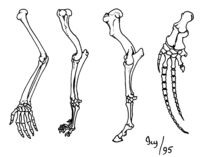
What type of evidence is represented in the picture above:
Fossils
Vestigial Structures
DNA
Homologous Structures
Tags
NGSS.MS-LS4-2
6.
MULTIPLE CHOICE QUESTION
30 sec • 1 pt

What type of evidence are shown in the picture above?
Fossils
Embryology
Homologous Structures
Vestigial Structures
Tags
NGSS.MS-LS4-3
7.
MULTIPLE CHOICE QUESTION
30 sec • 1 pt
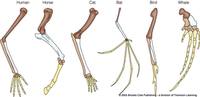
The similarities of the bones in the diagram provide evidence that---
Tags
NGSS.MS-LS4-2

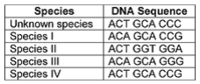
Access all questions and much more by creating a free account
Create resources
Host any resource
Get auto-graded reports

Continue with Google

Continue with Email

Continue with Classlink

Continue with Clever
or continue with

Microsoft
%20(1).png)
Apple

Others
Already have an account?


