
8.9AB Plate Tectonics
Authored by Kyeona Lewis
Science
8th Grade
NGSS covered
Used 445+ times


AI Actions
Add similar questions
Adjust reading levels
Convert to real-world scenario
Translate activity
More...
Content View
Student View
15 questions
Show all answers
1.
MULTIPLE CHOICE QUESTION
30 sec • 1 pt
The earthquakes experienced in California are related to tectonic plates because these catastrophic events are the result of -
two tectonic plates sliding past each other.
tectonic plates melting as they slide into the mantle.
tectonic plates being weathered over time.
two tectonic plates pulling away from each other.
Tags
NGSS.MS-ESS2-2
NGSS.MS-ESS3-2
2.
MULTIPLE CHOICE QUESTION
30 sec • 1 pt
Which of the following features is likely to form where two tectonic plates push toward each other?
Ocean shoreline
Mountain range
Mid-ocean ridge
Rift valley
Tags
NGSS.MS-ESS2-2
3.
MULTIPLE CHOICE QUESTION
30 sec • 1 pt
A mid-ocean RIDGE is located at the boundary of two tectonic plates. Which diagram correctly models the relative plate motion on each side of a mid ocean ridge?


Tags
NGSS.MS-ESS2-3
4.
MULTIPLE CHOICE QUESTION
30 sec • 1 pt

The San Andreas fault is a transform fault. The map below shows a student's approximation of where the fault line crosses through the United States. Students were asked to make maps predicting which way land would most likely move over thousands of years.


Tags
NGSS.MS-ESS2-3
NGSS.MS-ESS2-2
NGSS.MS-ESS3-2
5.
MULTIPLE CHOICE QUESTION
30 sec • 1 pt

The image shows a plate boundary. Arrows have been added to indicate the movement of the plates.What plate boundary feature is also shown?
A ridge formed by an inactive convergent boundary
A valley forming at an active divergent boundary
A fault forming at an active transform boundary
A volcano formed by an active transform boundary
Tags
NGSS.MS-ESS2-3
NGSS.MS-ESS2-2
6.
MULTIPLE CHOICE QUESTION
30 sec • 1 pt

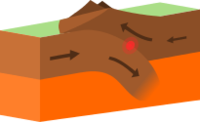
The diagram shows a model of the movement of two tectonic plates. When the plates collide, on plate often moves below the other plate. The rising magma that can result from this type of plate movement may produce-
fossil layers
volcanic islands
deep-sea sediment
seafloor spreading
Tags
NGSS.MS-ESS2-3
NGSS.MS-ESS2-2
7.
MULTIPLE CHOICE QUESTION
2 mins • 1 pt
This landform can occur at a divergent plate boundary.
ocean trench
mid-ocean ridge
tall mountains
transform fault
Tags
NGSS.MS-ESS2-3


Access all questions and much more by creating a free account
Create resources
Host any resource
Get auto-graded reports

Continue with Google

Continue with Email

Continue with Classlink

Continue with Clever
or continue with

Microsoft
%20(1).png)
Apple

Others
Already have an account?
Similar Resources on Wayground

20 questions
Chapter 7: Glaciers, Wind and Deserts

Quiz
•
8th Grade
10 questions
NCERT class 8 Materials : Metals and Non - Metals
Quiz
•
8th Grade
15 questions
Science & Technology Grade 8
Quiz
•
8th Grade
10 questions
PARTICLE NATURE OF MATTER
Quiz
•
8th Grade
20 questions
Second Form Quiz - Variables and Graphs
Quiz
•
8th Grade
14 questions
General knowledge
Quiz
•
2nd - 12th Grade
20 questions
วาเลนไทน์สดใส ลูก พ.น ห่างไกลโควิท 19
Quiz
•
6th - 12th Grade
12 questions
8.8ABC
Quiz
•
8th Grade
Popular Resources on Wayground
7 questions
History of Valentine's Day

Interactive video
•
4th Grade
15 questions
Fractions on a Number Line
Quiz
•
3rd Grade
20 questions
Equivalent Fractions
Quiz
•
3rd Grade
25 questions
Multiplication Facts
Quiz
•
5th Grade
22 questions
fractions
Quiz
•
3rd Grade
15 questions
Valentine's Day Trivia
Quiz
•
3rd Grade
20 questions
Main Idea and Details
Quiz
•
5th Grade
20 questions
Context Clues
Quiz
•
6th Grade
Discover more resources for Science
11 questions
Valentines Day
Quiz
•
6th - 8th Grade
25 questions
Valentine's Day Trivia
Quiz
•
8th Grade
20 questions
Cell Organelles and Functions
Quiz
•
6th - 8th Grade
8 questions
Newton's Second Law

Lesson
•
6th - 8th Grade
10 questions
Exploring the Rock Cycle: Types and Formation
Interactive video
•
6th - 8th Grade
10 questions
Carbon Cycle
Lesson
•
6th - 8th Grade
13 questions
Plate Tectonics and Earth's Structure
Lesson
•
6th - 8th Grade
20 questions
Heredity Punnett square review
Quiz
•
8th Grade