
Limiting Factors in Ecosystems
7th Grade
•10 Qs

Similar activities
Science Quiz - 12/04/2023
7th Grade
•11 Qs
WARM UP QUIZ!
7th Grade
•10 Qs
Reproduction in plants - Introduction
7th Grade
•12 Qs
Metodología de la investigación
3rd Grade - University
•11 Qs
Quiz No. 2 Component of Ecosystems
7th Grade
•10 Qs
Structure of the Flower
6th - 8th Grade
•10 Qs
Microbiology - 8th Grade
7th - 8th Grade
•10 Qs
Unit 11 Retest
7th Grade
•15 Qs

Limiting Factors in Ecosystems

Quiz
•
Science
•
7th Grade
•
Medium
+4
Standards-aligned

Nathan Lewallen
Used 26+ times
FREE Resource

Enhance your content in a minute
10 questions
Show all answers
1.
MULTIPLE CHOICE QUESTION
15 mins • 1 pt
All the organisms of a particular type living in the same place at the same time is called a _______. An example is a herd of deer.
2.
MULTIPLE CHOICE QUESTION
30 sec • 1 pt
How does the coyote act as a limiting factor on a population of birds that it consumes?
coyotes typically have 10 offspring per year.
coyotes are predators that remove birds from the population.
coyotes create habitat for birds
coyotes pee on plants to help them grow
Tags
NGSS.MS-LS2-4
3.
MULTIPLE CHOICE QUESTION
30 sec • 1 pt
This factor describes how long it takes an organism to reproduce, how many offspring an organism has, and how long it takes an organism to reach maturity.
reproductive environment
climate
reproductive potential
reproductive power
Tags
NGSS.MS-LS3-2
4.
MULTIPLE CHOICE QUESTION
30 sec • 1 pt
Which is NOT a way that reproductive potential limits a population size?
Organisms may have few offspring each time they reproduce.
Organisms may not reproduce frequently.
Organisms may not have the right environment to reproduce.
Organisms may take a long time to reach reproductive maturity.
Tags
NGSS.MS-LS1-4
NGSS.MS-LS4-4
5.
FILL IN THE BLANK QUESTION
15 mins • 1 pt
Things or organisms that regulate or limit the size of a population, for example predators or climate are known as __________.
Tags
NGSS.MS-LS2-4
6.
MULTIPLE CHOICE QUESTION
1 min • 1 pt
Temperature, light, air, water, and soil are all _____ parts of the environment
Tags
NGSS.MS-LS2-3
7.
MULTIPLE CHOICE QUESTION
30 sec • 1 pt
What happens when an environment reaches its carrying capacity?
Limiting factors will cause populations to stay stable or decrease.
Resources such as food, water, and space will be unlimited
Populations will increase
Species will go extinct
Tags
NGSS.MS-LS2-1
NGSS.MS-LS2-4
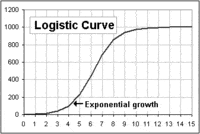
Access all questions and much more by creating a free account
Create resources
Host any resource
Get auto-graded reports

Continue with Google

Continue with Email

Continue with Classlink

Continue with Clever
or continue with

Microsoft
%20(1).png)
Apple

Others
Already have an account?
Similar Resources on Wayground
10 questions
LESSON 2 QUIZ
Quiz
•
6th Grade - University
15 questions
Unit of Life
Quiz
•
7th Grade
14 questions
The Environment & Climate
Quiz
•
6th - 9th Grade
10 questions
Ecosystems Part 1
Quiz
•
5th - 7th Grade
8 questions
Genetic Mutations
Quiz
•
6th - 8th Grade
12 questions
Relationships in Ecosystems Unit Quiz
Quiz
•
7th Grade
11 questions
Ecology-Set 3
Quiz
•
7th Grade - University
12 questions
Natural Selection vs. Artificial Selection
Quiz
•
7th Grade
Popular Resources on Wayground
15 questions
Fractions on a Number Line
Quiz
•
3rd Grade
20 questions
Equivalent Fractions
Quiz
•
3rd Grade
25 questions
Multiplication Facts
Quiz
•
5th Grade
22 questions
fractions
Quiz
•
3rd Grade
20 questions
Main Idea and Details
Quiz
•
5th Grade
20 questions
Context Clues
Quiz
•
6th Grade
15 questions
Equivalent Fractions
Quiz
•
4th Grade
20 questions
Figurative Language Review
Quiz
•
6th Grade
Discover more resources for Science
33 questions
Grade 6 Quarter 3 PMA 5 Review
Quiz
•
6th - 8th Grade
12 questions
Ecological Succession
Quiz
•
7th Grade
12 questions
Newton's Laws of Motion

Lesson
•
6th - 8th Grade
10 questions
Exploring the Rock Cycle: Types and Formation

Interactive video
•
6th - 8th Grade
10 questions
Exploring the Layers of the Earth
Interactive video
•
6th - 10th Grade
22 questions
Wave Properties
Lesson
•
7th Grade
20 questions
Food Chains & Food Webs
Quiz
•
5th - 7th Grade
20 questions
Earth's Spheres
Quiz
•
6th - 8th Grade