
AD/AS
12th Grade
•4 Qs

Similar activities
The Moment of Lift
10th Grade - Professional Development
•9 Qs
Classical Conditioning
9th - 12th Grade
•9 Qs
AP human Geography important people/theories
9th - 12th Grade
•9 Qs
Civil War
7th Grade - Professional Development
•9 Qs
My india
1st Grade - Professional Development
•9 Qs
About World and Countries
6th Grade - Professional Development
•8 Qs
Roblox
KG - Professional Development
•8 Qs
SSt
KG - 12th Grade
•9 Qs

AD/AS

Quiz
•
Social Studies
•
12th Grade
•
Medium

Melissa Amy McDonald
Used 7+ times
FREE Resource

Enhance your content in a minute
4 questions
Show all answers
1.
MULTIPLE CHOICE QUESTION
30 sec • 1 pt
What does the vertical axis represent on the aggregate demand curve?
2.
MULTIPLE CHOICE QUESTION
1 min • 1 pt
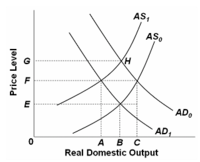
Refer to the above diagram. If the initial aggregate demand and supply curves are AD0 and AS0, the equilibrium price level and level of real domestic output will be:
3.
MULTIPLE CHOICE QUESTION
30 sec • 1 pt

The diagram above shows the aggregate demand (AD), the short-run aggregate supply
(SRAS) and the long-run aggregate supply (LRAS) curves for an economy.
The economy is currently operating at point X. At this point, the economy must be
experiencing
inflation caused by excess demand.
inflation caused by increasing costs.
unemployment of labour.
a low rate of economic growth.
4.
MULTIPLE CHOICE QUESTION
45 sec • 1 pt

Point A is the initial economic equilibrium and then the economy moves to point B, then there was
an increase in Aggregate Supply
a decrease in Aggregate Supply
an increase in Aggregate Demand
a decrease in Aggregate Demand
Access all questions and much more by creating a free account
Create resources
Host any resource
Get auto-graded reports

Continue with Google

Continue with Email

Continue with Classlink

Continue with Clever
or continue with

Microsoft
%20(1).png)
Apple

Others
Already have an account?
Similar Resources on Wayground
8 questions
Sociology: 2. Theories - MArxism
Quiz
•
12th Grade
9 questions
Unit 2 ~ constitution
Quiz
•
9th - 12th Grade
9 questions
Second Industrial Revolution
Quiz
•
9th - 12th Grade
9 questions
3.4 Long-Run Aggregate Supply - AP Econ
Quiz
•
12th Grade
9 questions
Foundations of American Government
Quiz
•
9th Grade - University
9 questions
Rick Hansen Quiz
Quiz
•
9th - 12th Grade
9 questions
Unit 2 Homework
Quiz
•
12th Grade - University
9 questions
MS- Unit 3 Vocabulary Review
Quiz
•
7th - 12th Grade
Popular Resources on Wayground
15 questions
Fractions on a Number Line
Quiz
•
3rd Grade
20 questions
Equivalent Fractions
Quiz
•
3rd Grade
25 questions
Multiplication Facts
Quiz
•
5th Grade
22 questions
fractions
Quiz
•
3rd Grade
20 questions
Main Idea and Details
Quiz
•
5th Grade
20 questions
Context Clues
Quiz
•
6th Grade
15 questions
Equivalent Fractions
Quiz
•
4th Grade
20 questions
Figurative Language Review
Quiz
•
6th Grade
Discover more resources for Social Studies
26 questions
APUSH Period 6 Review
Quiz
•
12th Grade
20 questions
WG Vocabulary List 21 2025
Quiz
•
9th - 12th Grade
73 questions
AP Psychology - Developmental Psychology
Quiz
•
10th - 12th Grade
15 questions
American and French Revolutions
Quiz
•
9th - 12th Grade
20 questions
Napoleon and European History Quiz
Quiz
•
9th - 12th Grade
15 questions
PFLE: Unit 2 Review
Quiz
•
12th Grade
16 questions
Unit 4 Industrial Revolution
Quiz
•
12th Grade
11 questions
Supremacy Clause 5d

Lesson
•
9th - 12th Grade