
Earth, Moon, and Sun
Authored by Devin DiIorio
Science
6th - 8th Grade
NGSS covered
Used 1K+ times


AI Actions
Add similar questions
Adjust reading levels
Convert to real-world scenario
Translate activity
More...
Content View
Student View
18 questions
Show all answers
1.
MULTIPLE CHOICE QUESTION
2 mins • 1 pt

The diagrams above show Earth and the Moon in different positions, as seen from above (top view). Sunlight is coming from the left, but these diagrams do not show what parts of Earth or the Moon are light or dark.
3. Could the half of the Moon that faces Earth ever be completely dark in any of these diagrams?
No, the Moon is always lit by the sun.
Yes, always in Diagrams 2 and 3, but never in Diagram 1.
Yes, always in Diagram 2, but never in Diagrams 1 or 3.
Yes, always in Diagram 2 and sometimes in Diagram 3.
Tags
NGSS.MS-ESS1-1
2.
MULTIPLE CHOICE QUESTION
2 mins • 1 pt
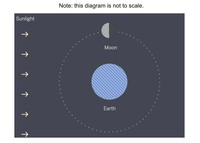
Leticia is a space scientist who made this diagram of the Moon and Earth as seen from above (top view), with sunlight coming from the left, as shown by the arrows. Why does Leticia’s diagram show that it’s brighter on the left half of the Moon?
Because Leticia’s diagram is showing that the half of the Moon that is facing the sun is lit by the sun, and the other half is dark.
Because the Moon has some lighter-colored rock and some darker-colored rock, and Leticia’s diagram is showing that the half of the Moon with the lighter-colored rock has rotated to the left.
Because as the Moon gets closer to the sun, more of it is lit by the sun, so Leticia’s diagram is showing sunlight on half of the Moon.
Because there is a shadow from Earth falling on half of the Moon, and Leticia’s diagram is showing that shadow on the right half of the Moon.
Tags
NGSS.MS-ESS1-1
3.
MULTIPLE CHOICE QUESTION
2 mins • 1 pt
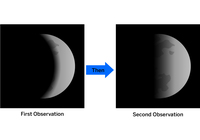
Tania went outside and made two observations of the Moon that were several days apart. Her observations are shown in the diagram above. The light part of the Moon appeared to get larger over time. Why did this happen?
Between the first observation and the second observation, the Moon moved so that Tania was able to see more of the half that faces the sun.
Between the first observation and the second observation, the Moon moved closer to the sun so more sunlight reached the Moon’s surface.
Between the first observation and the second observation, the Moon rotated so that more of the light-colored rock on the Moon’s surface faced Earth.
Between the first observation and the second observation, Earth moved so its shadow was blocking less of the Moon so Tania was able to see more of it.
Tags
NGSS.MS-ESS1-1
4.
MULTIPLE CHOICE QUESTION
2 mins • 1 pt
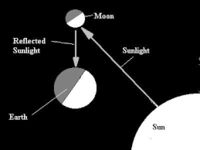
How does light travel?
Light travels in straight lines only.
Light travels like a river, wherever there is an open path.
Light travels in unpredictable ways.
It depends; if the light is bright enough it can change direction.
Tags
NGSS.MS-PS4-2
5.
MULTIPLE CHOICE QUESTION
2 mins • 1 pt
Shira looked up one night and saw a full moon. How long will it be before she can see a full moon again?
About one week.
About one month.
There is no way to tell because the Moon’s pattern is always changing.
It could be two weeks or a month, depending on what time of year it is.
Tags
NGSS.MS-ESS1-1
6.
MULTIPLE CHOICE QUESTION
2 mins • 1 pt

Three students made the diagrams above to show what they think the Moon looks like when it is seen from above (top view). In these diagrams, the sunlight is coming from the left, as shown by the arrows. Which diagram is accurate and why?
Diagram A is accurate because the whole Moon is bright as long as there are no shadows covering parts of it.
Diagram B is accurate because the Moon is almost as close as it can be to the sun, so the Moon is almost fully lit by the sun.
Diagram C is accurate because the half of the Moon that is facing the sun is lit by the sun, and the other half is dark.
All three diagrams are sometimes accurate because the Moon has some lighter-colored rock and some darker-colored rock, and the half of the Moon with the lighter-colored rock rotates to face different directions.
Tags
NGSS.MS-ESS1-1
7.
MULTIPLE CHOICE QUESTION
2 mins • 1 pt

A student astronomer went out and took photographs of the Moon that were several days apart. Images that look like her photographs are shown above. The light part of the Moon appeared to get smaller over time. Why did this happen?
Between the first photograph and the second photograph, the Moon moved farther away from the sun so less sunlight reached the Moon’s surface.
Between the first photograph and the second photograph, Earth moved so its shadow was blocking more of the Moon so the student astronomer was able to see less of it.
Between the first photograph and the second photograph, the Moon rotated so that less of the light-colored rock on the Moon’s surface faced Earth.
Between the first photograph and the second photograph, the Moon moved so that the student astronomer was able to see less of the half that faces the sun.
Tags
NGSS.MS-ESS1-1

Access all questions and much more by creating a free account
Create resources
Host any resource
Get auto-graded reports

Continue with Google

Continue with Email

Continue with Microsoft
or continue with

%20(1).png)
Apple

Others
By signing up, you agree to our Terms of Service & Privacy Policy
Already have an account?

