
EVIDENCE FOR EVOLUTION
Authored by K K
Science
1st Grade
NGSS covered
Used 9+ times


AI Actions
Add similar questions
Adjust reading levels
Convert to real-world scenario
Translate activity
More...
Content View
Student View
25 questions
Show all answers
1.
MULTIPLE CHOICE QUESTION
45 sec • 1 pt
The most recent ancestral form or species from which two different species evolved is known as ________________________.
Tags
NGSS.MS-LS4-2
2.
MULTIPLE CHOICE QUESTION
45 sec • 1 pt

In stage one (top row) of these embryos, most of the embryos________
Tags
NGSS.MS-LS4-2
NGSS.MS-LS4-3
3.
MULTIPLE CHOICE QUESTION
45 sec • 1 pt

What type of evidence is represented in the picture above:
Fossils
Vestigial Structures
DNA
Homologous Structures
Tags
NGSS.MS-LS4-2
4.
MULTIPLE CHOICE QUESTION
45 sec • 1 pt

What type of evidence are shown in the picture above?
Fossils
Embryology
Homologous Structures
Vestigial Structures
Tags
NGSS.MS-LS4-3
5.
MULTIPLE CHOICE QUESTION
45 sec • 1 pt
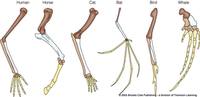
The similarities of the bones in the diagram provide evidence that---
Tags
NGSS.MS-LS4-2
6.
MULTIPLE CHOICE QUESTION
45 sec • 1 pt

The diagram shows fossils in different rock layers. Which of these statements about the age of these fossils is most likely correct?
Tags
NGSS.MS-LS4-1
NGSS.MS-ESS1-4
7.
MULTIPLE CHOICE QUESTION
45 sec • 1 pt

Body parts similar in structure and origin
evolution
embryology
homologous
variation
Tags
NGSS.MS-LS4-2
NGSS.MS-LS4-3
Access all questions and much more by creating a free account
Create resources
Host any resource
Get auto-graded reports

Continue with Google

Continue with Email

Continue with Classlink

Continue with Clever
or continue with

Microsoft
%20(1).png)
Apple

Others
Already have an account?
Similar Resources on Wayground

20 questions
SCIENCE GRADE 1

Quiz
•
1st Grade
20 questions
Review (Part 1)
Quiz
•
1st Grade
20 questions
OUR ENVIROMENT
Quiz
•
KG - 3rd Grade
20 questions
Bhutan Space week
Quiz
•
KG - University
20 questions
Earth and Beyond Topic Test 1
Quiz
•
1st - 4th Grade
20 questions
What is an ENGINEER?
Quiz
•
1st - 5th Grade
21 questions
PLANTS ARE USEFUL
Quiz
•
1st - 2nd Grade
20 questions
Metals and Non Metals
Quiz
•
1st - 3rd Grade
Popular Resources on Wayground
15 questions
Fractions on a Number Line
Quiz
•
3rd Grade
20 questions
Equivalent Fractions
Quiz
•
3rd Grade
25 questions
Multiplication Facts
Quiz
•
5th Grade
22 questions
fractions
Quiz
•
3rd Grade
20 questions
Main Idea and Details
Quiz
•
5th Grade
20 questions
Context Clues
Quiz
•
6th Grade
15 questions
Equivalent Fractions
Quiz
•
4th Grade
20 questions
Figurative Language Review
Quiz
•
6th Grade
Discover more resources for Science
10 questions
Identifying Physical and Chemical Changes

Interactive video
•
1st - 5th Grade
10 questions
Exploring the 11 Human Body Systems
Interactive video
•
1st - 5th Grade
41 questions
CA3 review
Quiz
•
1st - 5th Grade
10 questions
Exploring Food Chains and Webs in Ecosystems
Interactive video
•
1st - 5th Grade
34 questions
KVES Review
Quiz
•
1st - 5th Grade
10 questions
Exploring Earth's Changing Landscapes
Interactive video
•
1st - 5th Grade
14 questions
Life Cycles
Quiz
•
1st Grade