
Periodic Table
Authored by Sondra Glenn
Chemistry
10th - 12th Grade
NGSS covered
Used 7+ times


AI Actions
Add similar questions
Adjust reading levels
Convert to real-world scenario
Translate activity
More...
Content View
Student View
20 questions
Show all answers
1.
MULTIPLE CHOICE QUESTION
30 sec • 1 pt
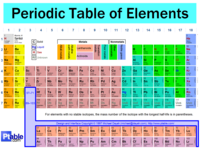
The vertical (up and down) columns in the Periodic Table are called
groups
towers
periods
atomic numbers
2.
MULTIPLE CHOICE QUESTION
30 sec • 1 pt
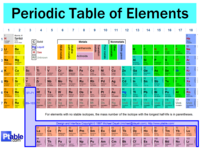
The horizontal (side to side) rows in the Periodic Table are called
groups
families
periods
atomic numbers
3.
MULTIPLE CHOICE QUESTION
30 sec • 1 pt
Alkali metals have 1 valence electron, making them highly reactive. With the exception of hydrogen, they tend to be very soft metals with low melting points. Examples include sodium and potassium.
Alkaline earth metals have 2 valence electrons and also are highly reactive and have high melting points. Examples include calcium and magnesium.
Halogens have 7 valence electrons and therefore are highly reactive. They tend to form compounds in nature. Examples include chlorine and fluorine.
Noble gases have a complete outer shell with 8 valence electrons, making them nonreactive. They are typically colorless, odorless gases. Examples include helium, neon, and argon.
Which group is highly reactive with high melting points?
Alkaline metals
Alkaline earth metals
Halogens
Noble gases
4.
MULTIPLE CHOICE QUESTION
3 mins • 1 pt
Elements which are shiny, conduct electricity and heat are called
Tags
NGSS.HS-PS1-1
5.
MULTIPLE CHOICE QUESTION
3 mins • 1 pt
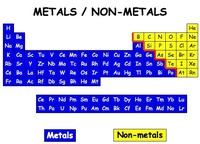
The atoms along the staircase are called
Tags
NGSS.HS-PS1-1
6.
MULTIPLE CHOICE QUESTION
30 sec • 1 pt
Which two subatomic particles are found in the NUCLEUS of at atom?
Tags
NGSS.MS-PS1-1
7.
MULTIPLE CHOICE QUESTION
30 sec • 1 pt
If an element has 6 protons, 7 neutrons, and 6 electrons, what type of charge does the element have?
Tags
NGSS.MS-PS1-1
Access all questions and much more by creating a free account
Create resources
Host any resource
Get auto-graded reports

Continue with Google

Continue with Email

Continue with Classlink

Continue with Clever
or continue with

Microsoft
%20(1).png)
Apple

Others
Already have an account?
Similar Resources on Wayground

20 questions
Solutions

Quiz
•
9th - 12th Grade
20 questions
UNIT 6- PARTICLES WITH INTERNAL STRUCTURE (REVIEW)
Quiz
•
10th - 12th Grade
15 questions
Another Bohr-ing Atomic Model
Quiz
•
9th - 12th Grade
15 questions
Periodic Trends,Lewis Dot, and Electronegativity
Quiz
•
9th - 12th Grade
20 questions
Acids and Bases in Everyday Life
Quiz
•
9th - 12th Grade
15 questions
Particle nature of light Quiz
Quiz
•
10th Grade
18 questions
Elements and Atoms Review
Quiz
•
8th - 10th Grade
15 questions
Chemistry Essentials: Drawing Molecules
Quiz
•
9th - 12th Grade
Popular Resources on Wayground
15 questions
Fractions on a Number Line
Quiz
•
3rd Grade
20 questions
Equivalent Fractions
Quiz
•
3rd Grade
25 questions
Multiplication Facts
Quiz
•
5th Grade
29 questions
Alg. 1 Section 5.1 Coordinate Plane
Quiz
•
9th Grade
22 questions
fractions
Quiz
•
3rd Grade
11 questions
FOREST Effective communication

Lesson
•
KG
20 questions
Main Idea and Details
Quiz
•
5th Grade
20 questions
Context Clues
Quiz
•
6th Grade
Discover more resources for Chemistry
22 questions
Unit 9 Gas Law Quiz
Quiz
•
10th Grade
10 questions
Exploring Types of Chemical Reactions

Interactive video
•
6th - 10th Grade
20 questions
Types of Chemical Reactions
Quiz
•
9th - 12th Grade
20 questions
Acids and Bases
Quiz
•
10th Grade
7 questions
GCSE Chemistry - Balancing Chemical Equations #4
Interactive video
•
9th - 10th Grade
20 questions
Chemistry: Classification of Matter
Quiz
•
10th Grade
40 questions
Unit 3 (Part 1) Chemical Equations & Reactions Review Game
Quiz
•
8th - 12th Grade
20 questions
Stoichiometry Review
Quiz
•
10th Grade