
17.2 Phylogeny and taxonomy AP BIO
Authored by Wendel Landes
Biology
12th Grade
NGSS covered
Used 7+ times


AI Actions
Add similar questions
Adjust reading levels
Convert to real-world scenario
Translate activity
More...
Content View
Student View
23 questions
Show all answers
1.
MULTIPLE CHOICE QUESTION
30 sec • 1 pt

Genetic variation can arise from a random change in the DNA of a gene. The change is called a(n)
Tags
NGSS.HS-LS3-2
2.
MULTIPLE CHOICE QUESTION
3 mins • 1 pt

When scientists compare animals currently living on different continents, they often find those with similar characteristics, who are not actually close relatives, living in similar environmental conditions even though they are geographically very distant. One example is the Anteater/Armadillos of the Americas and the Pangolin of Africa. What can we deduce from this evidence?
Tags
NGSS.HS-LS4-1
NGSS.HS-LS4-4
NGSS.HS-LS4-5
3.
MULTIPLE CHOICE QUESTION
1 min • 1 pt
What does the term variation mean?
The same traits in a population.
The different genetic traits present in a population
The ways traits are expressed in a population.
The place where an animal lives.
Tags
NGSS.HS-LS4-2
NGSS.HS-LS3-2
NGSS.HS-LS3-3
4.
MULTIPLE CHOICE QUESTION
1 min • 1 pt

Using the phylogenetic tree or cladogram: a common ancestor of amphibians and ray-finned fish would have had ___________.
a bony skeleton
four limbs
scaly skin
eggs with shells
Tags
NGSS.HS-LS4-1
5.
MULTIPLE CHOICE QUESTION
30 sec • 1 pt
The wing of a bat and a humans' arm have different functions and appear very different. Yet, the underlying anatomy is basically the same. Therefore, these structures are examples of
geographic isolation
analogous structures
homologous structures
reproductive isolation
Tags
NGSS.HS-LS4-4
6.
MULTIPLE CHOICE QUESTION
30 sec • 1 pt

The thylacine is a marsupial that resembles the North America wolf, which is a placental mammal. The two species are not very closely related. How is this explained?
adaptive radiation
divergent evolution
founder effect
convergent evolution
Tags
NGSS.HS-LS4-2
7.
MULTIPLE CHOICE QUESTION
1 min • 1 pt
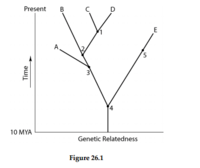
A common ancestor for both C and E could be at position __.
Tags
NGSS.HS-LS4-1


Access all questions and much more by creating a free account
Create resources
Host any resource
Get auto-graded reports

Continue with Google

Continue with Email

Continue with Classlink

Continue with Clever
or continue with

Microsoft
%20(1).png)
Apple

Others
Already have an account?



