
Evolution-Bio
Authored by Carol Marshall
Biology
9th - 10th Grade
NGSS covered
Used 139+ times


AI Actions
Add similar questions
Adjust reading levels
Convert to real-world scenario
Translate activity
More...
Content View
Student View
25 questions
Show all answers
1.
MULTIPLE CHOICE QUESTION
1 min • 1 pt
Which term is used to support Darwin’s theory of evolution and explains that only the the organisms best suited to their environment will survive?
2.
MULTIPLE CHOICE QUESTION
1 min • 1 pt

Which term best describes describes the structures shown in the picture?
heterologous
analogous
homologous
vestigial
Tags
NGSS.MS-LS4-2
3.
MULTIPLE CHOICE QUESTION
1 min • 1 pt

What is the term for a feature that allows an organism to survive in its environment?
Tags
NGSS.HS-LS4-2
NGSS.HS-LS4-4
4.
MULTIPLE CHOICE QUESTION
1 min • 1 pt

Which species’ DNA is most similar to the DNA of the toothed whale?
Tags
NGSS.HS-LS4-2
NGSS.HS-LS4-1
5.
MULTIPLE CHOICE QUESTION
1 min • 1 pt
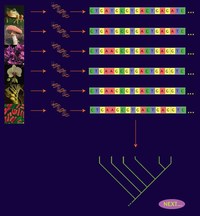
Two organisms that are closely related would have
very similar DNA sequence
exactly the same DNA sequences
no proteins in common
completely different DNA sequence
6.
MULTIPLE CHOICE QUESTION
1 min • 1 pt
The law of superposition states
Tags
NGSS.MS-ESS1-4
7.
MULTIPLE CHOICE QUESTION
1 min • 1 pt
Ostrich wings are examples of
Tags
NGSS.MS-LS4-2

Access all questions and much more by creating a free account
Create resources
Host any resource
Get auto-graded reports

Continue with Google

Continue with Email

Continue with Classlink

Continue with Clever
or continue with

Microsoft
%20(1).png)
Apple

Others
Already have an account?
Similar Resources on Wayground

20 questions
KIỂM TRA 15 PHÚT- SINH 10

Quiz
•
10th Grade
23 questions
lymphatic system
Quiz
•
10th - 12th Grade
20 questions
Circulatory System - JC
Quiz
•
7th - 10th Grade
20 questions
ÔN TẬP KIỂM TRA GIỮA HK1- MÔN SINH HỌC (P1)
Quiz
•
9th Grade - University
20 questions
WJEC AS Biology Unit 2: Evolution
Quiz
•
10th - 12th Grade
23 questions
AP Bio Ecology Quiz #1 Practice
Quiz
•
10th - 12th Grade
20 questions
DNA and Cell Division
Quiz
•
10th Grade
20 questions
Explorando a Vida na Terra
Quiz
•
1st Grade - University
Popular Resources on Wayground
15 questions
Fractions on a Number Line
Quiz
•
3rd Grade
20 questions
Equivalent Fractions
Quiz
•
3rd Grade
25 questions
Multiplication Facts
Quiz
•
5th Grade
22 questions
fractions
Quiz
•
3rd Grade
20 questions
Main Idea and Details
Quiz
•
5th Grade
20 questions
Context Clues
Quiz
•
6th Grade
15 questions
Equivalent Fractions
Quiz
•
4th Grade
20 questions
Figurative Language Review
Quiz
•
6th Grade
Discover more resources for Biology
20 questions
Cell Organelles
Quiz
•
10th Grade
20 questions
Cell Organelles
Quiz
•
9th Grade
20 questions
DNA & Protein Synthesis
Quiz
•
9th Grade
7 questions
Amoeba Sisters Dihybrid Cross Punnett Square

Interactive video
•
9th - 12th Grade
25 questions
photosynthesis and cellular respiration
Quiz
•
9th Grade
20 questions
Human Body Systems
Quiz
•
9th Grade
19 questions
Natural Selection
Quiz
•
9th Grade
20 questions
Pedigree Practice
Quiz
•
9th Grade