
3.5 & 3.6 - Equilibrium and Changes in the AS-AD Model
Authored by Melinda Unger
Social Studies
9th - 12th Grade
Used 19+ times


AI Actions
Add similar questions
Adjust reading levels
Convert to real-world scenario
Translate activity
More...
Content View
Student View
10 questions
Show all answers
1.
MULTIPLE CHOICE QUESTION
1 min • 1 pt
When an economy is in equilibrium at potential gross domestic product, the actual unemployment rate is
equal to the cyclical rate
greater than the natural rate
less than the natural rate
equal to the natural rate
equal to zero
2.
MULTIPLE CHOICE QUESTION
1 min • 1 pt
The intersection of the aggregate supply curve and the aggregate demand curve occurs at the economy's equilibrium level of
real investment and the interest rate
real disposable income and unemployment
real national output and the price level
government expenditures and taxes
imports and exports
3.
MULTIPLE CHOICE QUESTION
1 min • 1 pt
In the AD−AS model, which of the following is true?
The economy is in an inflationary gap when the short-run equilibrium real output is below the long-run equilibrium real output.
The economy is in an inflationary gap when the short-run equilibrium real output is at the long-run equilibrium real output.
The economy is in a recessionary gap when the short-run equilibrium real output is at the long-run equilibrium real output.
The economy is in a recessionary gap when the short-run equilibrium real output is below the long-run equilibrium real output.
The economy is in a recessionary gap when the short-run equilibrium real output is above the long-run equilibrium real output.
4.
MULTIPLE CHOICE QUESTION
2 mins • 1 pt
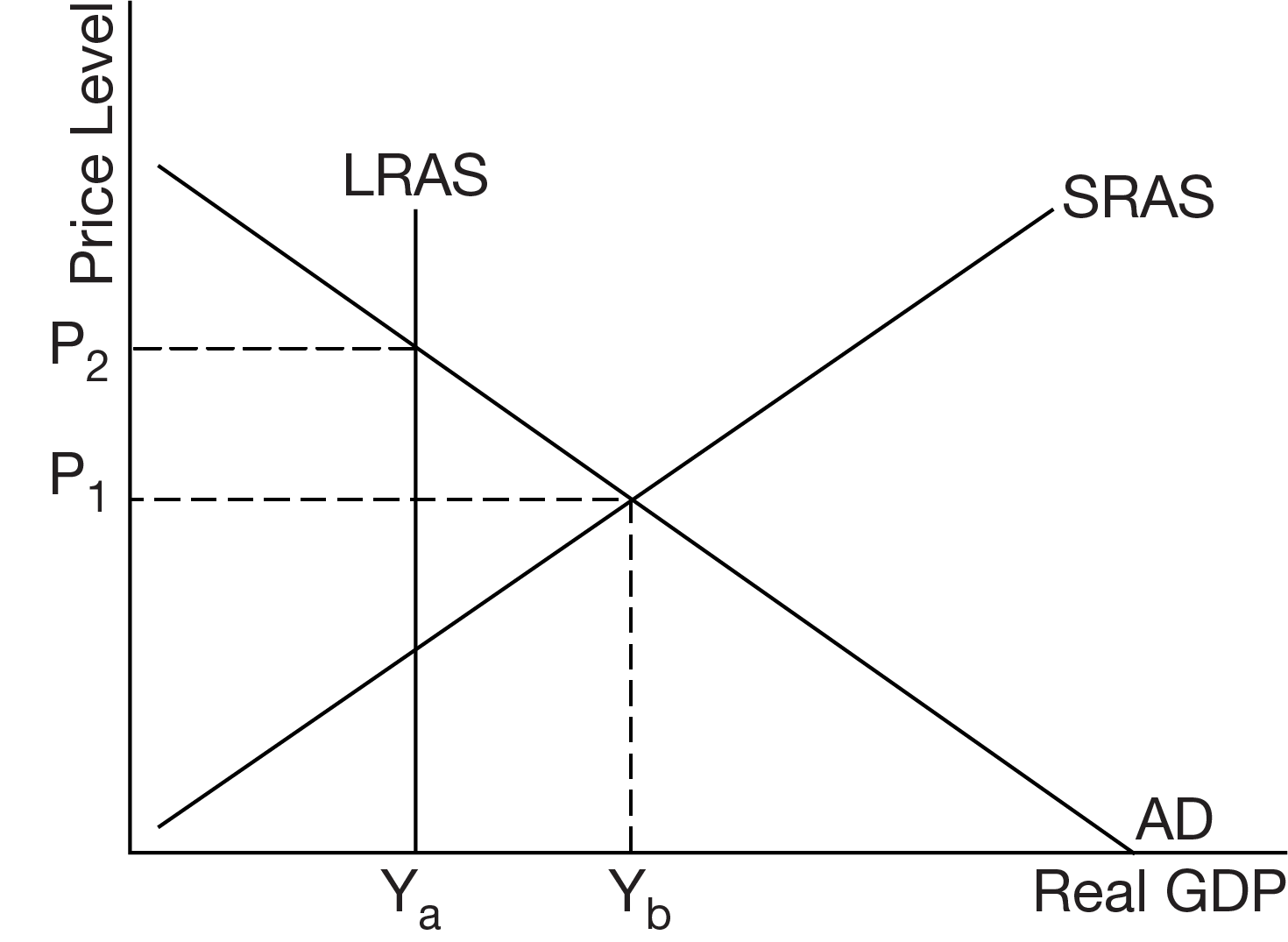
The diagram above shows a nation’s short-run aggregate supply curve (SRAS), long-run aggregate supply curve (LRAS), and aggregate demand curve (AD).
Based on the diagram above, which of the following describes the short-run equilibrium?
The economy is operating at full employment.
The economy is operating below full employment.
The economy is operating above full employment.
There will be downward pressure on the price level.
There is a recessionary gap.
5.
MULTIPLE CHOICE QUESTION
2 mins • 1 pt
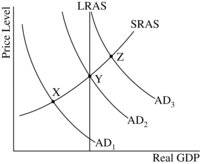
Given the graph of the short-run aggregate supply (SRAS) and long-run aggregate supply (LRAS) curves above, which of the following is true?
At point Z, the economy has cyclical unemployment.
At point Z, the economy is in long-run equilibrium but not in short-run equilibrium.
At point Y, the natural rate of unemployment is zero.
At point X, the economy is experiencing a recessionary gap.
At point X, there is no frictional unemployment.
6.
MULTIPLE CHOICE QUESTION
1 min • 1 pt
With an upward-sloping short-run aggregate supply curve, an increase in government expenditure will most likely
reduce the price level
reduce the level of nominal gross domestic product
increase real gross domestic product
shift the short-run aggregate supply curve to the right
shift both the aggregate demand curve and the long-run aggregate supply curve to the left
7.
MULTIPLE CHOICE QUESTION
2 mins • 1 pt
With an increase in the real interest rate, consumption and real gross domestic product will most likely change in which of the following ways?
Consumption - Increase
Real Gross Domestic Product - Increase
Consumption - Increase
Real Gross Domestic Product - Decrease
Consumption - Decrease
Real Gross Domestic Product - Increase
Consumption - Decrease
Real Gross Domestic Product - Decrease
Consumption - No change
Real Gross Domestic Product - Increase
Access all questions and much more by creating a free account
Create resources
Host any resource
Get auto-graded reports

Continue with Google

Continue with Email

Continue with Classlink

Continue with Clever
or continue with

Microsoft
%20(1).png)
Apple

Others
Already have an account?


