
AP Biology Enzymes Part 1
Biology
9th - 12th Grade
NGSS covered
Used 14+ times


AI Actions
Add similar questions
Adjust reading levels
Convert to real-world scenario
Translate activity
More...
Content View
Student View
16 questions
Show all answers
1.
MULTIPLE CHOICE QUESTION
10 sec • 1 pt
The part of the enzyme that the substrate bonds to is called the _____.
2.
MULTIPLE CHOICE QUESTION
20 sec • 1 pt
Which of these is NOT true?
Tags
NGSS.HS-PS1-5
3.
MULTIPLE CHOICE QUESTION
20 sec • 1 pt
Which of the following is directly responsible for the shape of an enzyme/protein?
The amino acid sequence of the protein and the properties of the amino acids that make up the protein.
The temperature of the surrounding environment.
The pH of the surrounding environment.
The amount of substrate present.
4.
MULTIPLE CHOICE QUESTION
10 sec • 1 pt
Blocking Active site of an enzyme
5.
MULTIPLE CHOICE QUESTION
1 min • 1 pt
A series of enzymes catalyze the reaction X →Y→ Z →A. Product A binds to the enzyme that converts X to Y at a position remote from its active site. This binding decreases the activity of the enzyme. What is substance X?
Tags
NGSS.HS-LS1-7
6.
MULTIPLE CHOICE QUESTION
1 min • 1 pt
Succinate dehydrogenase catalyzes the conversion of succinate to fumarate. The reaction is inhibited by malonic acid, which resembles succinate but cannot be acted upon by succinate dehydrogenase. Increasing the ratio of succinate to malonic acid reduces the inhibitory effect of malonic acid. What is malonic acid's role with respect to succinate dehydrogenase?
7.
MULTIPLE CHOICE QUESTION
20 sec • 1 pt
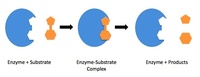
When a molecule can occupy the same active site as the substrate, a situation called __________________ can result
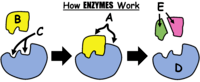


Access all questions and much more by creating a free account
Create resources
Host any resource
Get auto-graded reports

Continue with Google

Continue with Email

Continue with Classlink

Continue with Clever
or continue with

Microsoft
%20(1).png)
Apple

Others
Already have an account?

