
Periodic Table and Trends
Authored by KYLE O'KEEFE
Chemistry
9th - 12th Grade
NGSS covered
Used 10+ times


AI Actions
Add similar questions
Adjust reading levels
Convert to real-world scenario
Translate activity
More...
Content View
Student View
60 questions
Show all answers
1.
MULTIPLE CHOICE QUESTION
30 sec • 1 pt
The periodic table is a chart that organizes the elements based on their atomic properties. Elements in the periodic table are organized according to the periodic law. The periodic law states that chemical and physical properties of elements are periodic functions of their atomic numbers (the number of protons in the nucleus). As the atomic number of elements increases, different elements display similar characteristics at regular intervals.
Periodic law states that elements are arranged _______________________________________________________________.
in alphabetical order.
from largest to smallest.
as periodic functions of their atomic numbers.
there is no rhyme or reason.
2.
MULTIPLE CHOICE QUESTION
2 mins • 1 pt
Each column in the periodic table is called a
3.
MULTIPLE CHOICE QUESTION
2 mins • 1 pt
The atomic number tells you what?
4.
MULTIPLE CHOICE QUESTION
2 mins • 1 pt
Which group of the periodic table is composed of inert (not reactive) gases?
5.
MULTIPLE CHOICE QUESTION
2 mins • 1 pt
Elements which are shiny, conduct electricity and heat are called
Tags
NGSS.HS-PS1-1
6.
MULTIPLE CHOICE QUESTION
2 mins • 1 pt
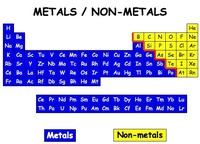
The atoms along the staircase are called
Tags
NGSS.HS-PS1-1
7.
MULTIPLE CHOICE QUESTION
2 mins • 1 pt

How many electrons does a Copper atom have?
Tags
NGSS.MS-PS1-1

Access all questions and much more by creating a free account
Create resources
Host any resource
Get auto-graded reports

Continue with Google

Continue with Email

Continue with Classlink

Continue with Clever
or continue with

Microsoft
%20(1).png)
Apple

Others
Already have an account?
Similar Resources on Wayground

56 questions
Stoichiometry

Quiz
•
10th - 12th Grade
62 questions
Integrated Science Final Exam Review
Quiz
•
9th Grade
64 questions
Unit 3 Quiz
Quiz
•
10th Grade
60 questions
Quiz Nuclear Review
Quiz
•
11th Grade - University
65 questions
Acid, Base, and Salts
Quiz
•
11th Grade - University
55 questions
TEST Simple Present
Quiz
•
10th Grade
58 questions
Chemistry Final Review
Quiz
•
11th Grade
57 questions
Module 3 Review
Quiz
•
9th - 12th Grade
Popular Resources on Wayground
15 questions
Fractions on a Number Line
Quiz
•
3rd Grade
20 questions
Equivalent Fractions
Quiz
•
3rd Grade
25 questions
Multiplication Facts
Quiz
•
5th Grade
29 questions
Alg. 1 Section 5.1 Coordinate Plane
Quiz
•
9th Grade
22 questions
fractions
Quiz
•
3rd Grade
11 questions
FOREST Effective communication

Lesson
•
KG
20 questions
Main Idea and Details
Quiz
•
5th Grade
20 questions
Context Clues
Quiz
•
6th Grade
Discover more resources for Chemistry
22 questions
Unit 9 Gas Law Quiz
Quiz
•
10th Grade
10 questions
Exploring Types of Chemical Reactions

Interactive video
•
6th - 10th Grade
20 questions
Types of Chemical Reactions
Quiz
•
9th - 12th Grade
20 questions
Acids and Bases
Quiz
•
10th Grade
30 questions
Energy Review
Quiz
•
9th Grade
7 questions
GCSE Chemistry - Balancing Chemical Equations #4
Interactive video
•
9th - 10th Grade
20 questions
Chemistry: Classification of Matter
Quiz
•
10th Grade
40 questions
Unit 3 (Part 1) Chemical Equations & Reactions Review Game
Quiz
•
8th - 12th Grade