
Bonding Review
Authored by Danielle Hankins
Chemistry
9th Grade
NGSS covered
Used 6+ times


AI Actions
Add similar questions
Adjust reading levels
Convert to real-world scenario
Translate activity
More...
Content View
Student View
30 questions
Show all answers
1.
MULTIPLE CHOICE QUESTION
1 min • 1 pt
Valence electrons are:
Tags
NGSS.HS-PS1-2
NGSS.HS-PS1-1
2.
MULTIPLE CHOICE QUESTION
1 min • 1 pt
When electrons are transferred from cations to anions ________ bond is formed
A Covalent
A Metallic
An Ionic
Tags
NGSS.HS-PS1-2
3.
MULTIPLE CHOICE QUESTION
1 min • 1 pt
When electrons are shared a ________ bond is formed
Tags
NGSS.HS-PS1-4
4.
MULTIPLE CHOICE QUESTION
1 min • 1 pt
A charged particle that has gained or lost electrons is called a _____.
5.
MULTIPLE CHOICE QUESTION
1 min • 1 pt
When forming an ionic bond, a metal atom
Tags
NGSS.HS-PS1-2
6.
MULTIPLE CHOICE QUESTION
1 min • 1 pt
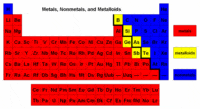
What elements generally make a covalent bond?
Tags
NGSS.HS-PS1-1
7.
MULTIPLE CHOICE QUESTION
1 min • 1 pt
In chemical compounds, covalent bonds form when
the electronegativity difference between two atoms is very large.
electrons are completely transferred between two metals.
pairs of electrons are shared between two nonmetal atoms.
two nonmetal atoms are attracted to each other by opposite charges.
Access all questions and much more by creating a free account
Create resources
Host any resource
Get auto-graded reports

Continue with Google

Continue with Email

Continue with Classlink

Continue with Clever
or continue with

Microsoft
%20(1).png)
Apple

Others
Already have an account?
Similar Resources on Wayground

25 questions
The Periodic table

Quiz
•
9th - 12th Grade
25 questions
Periodic Table 2
Quiz
•
9th - 12th Grade
25 questions
Ionic and Covalent Bonds
Quiz
•
9th - 12th Grade
25 questions
IPC Ch. 16: Properties of Atoms and the Periodic Table
Quiz
•
9th - 10th Grade
25 questions
Particulate Nature of Matter
Quiz
•
9th - 11th Grade
30 questions
Chemical Quantities Test
Quiz
•
9th Grade - University
25 questions
Physical/Chemical changes + Pure Substances/Mixtures
Quiz
•
9th Grade
26 questions
Year 10: Chemistry
Quiz
•
9th - 11th Grade
Popular Resources on Wayground
15 questions
Fractions on a Number Line
Quiz
•
3rd Grade
20 questions
Equivalent Fractions
Quiz
•
3rd Grade
25 questions
Multiplication Facts
Quiz
•
5th Grade
22 questions
fractions
Quiz
•
3rd Grade
20 questions
Main Idea and Details
Quiz
•
5th Grade
20 questions
Context Clues
Quiz
•
6th Grade
15 questions
Equivalent Fractions
Quiz
•
4th Grade
20 questions
Figurative Language Review
Quiz
•
6th Grade
Discover more resources for Chemistry
20 questions
Types of Chemical Reactions
Quiz
•
9th - 12th Grade
20 questions
Energy Transformations
Quiz
•
9th - 12th Grade
10 questions
Identifying Types of Chemical Reactions

Interactive video
•
6th - 10th Grade
10 questions
Converting Grams to Moles: Mastering Molar Mass Calculations
Interactive video
•
6th - 10th Grade
21 questions
Introduction to Moles

Lesson
•
9th - 12th Grade
13 questions
Balanced Eqns & Cons of Mass
Quiz
•
9th - 12th Grade
11 questions
Practice with Mole Ratios
Lesson
•
9th - 12th Grade
23 questions
Ternary Ionic Compounds
Quiz
•
9th - 12th Grade