
Evidence of Evolution & Natural Selection
Authored by Laura Moore
Biology
7th Grade
NGSS covered
Used 42+ times


AI Actions
Add similar questions
Adjust reading levels
Convert to real-world scenario
Translate activity
More...
Content View
Student View
23 questions
Show all answers
1.
MULTIPLE CHOICE QUESTION
1 min • 1 pt

Two organisms that are closely related would have
very similar DNA sequence
exactly the same DNA sequences
completely different DNA sequence
Tags
NGSS.HS-LS3-1
2.
MULTIPLE CHOICE QUESTION
1 min • 1 pt
Scientists compare organisms' DNA to support the theory that all species share a common _________________
species
ancestor
population
environment
Tags
NGSS.MS-LS4-2
3.
MULTIPLE CHOICE QUESTION
1 min • 1 pt
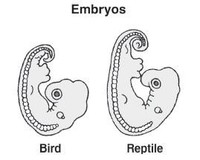
The diagram shows the embryos of a bird and a reptile.
Which of the following can be determined by observing the embryos shown in the diagram?
The organisms share a common ancestor.
The organisms belong to the same genus.
The organisms live in the same geographic areas.
The organisms will grow into anatomically similar adults.
Tags
NGSS.MS-LS4-2
NGSS.MS-LS4-3
4.
MULTIPLE CHOICE QUESTION
1 min • 1 pt

The diagram shows fossils in different rock layers. Which of these statements about the age of these fossils is most likely correct?
Tags
NGSS.MS-LS4-1
NGSS.MS-ESS1-4
5.
MULTIPLE CHOICE QUESTION
1 min • 1 pt
The process by which populations slowly change over time is called__________
Tags
NGSS.MS-LS4-4
NGSS.MS-LS4-2
6.
MULTIPLE CHOICE QUESTION
1 min • 1 pt

The picture shows the members of the Camelidae family. The physical features and the geographical origin of these animals provide evidence that they
live in the same type of environment.
have slowly evolved to become herbivores.
likely have a common ancestor.
exchanged DNA in the past.
Tags
NGSS.MS-LS4-2
7.
MULTIPLE CHOICE QUESTION
1 min • 1 pt
What is the fossil record?
The remains or evidence of once-living organisms
The change over time in populations of related organisms
All the fossils ever discovered on Earth
Occurs when the last individual organism of a species dies
Tags
NGSS.MS-LS4-1

Access all questions and much more by creating a free account
Create resources
Host any resource
Get auto-graded reports

Continue with Google

Continue with Email

Continue with Classlink

Continue with Clever
or continue with

Microsoft
%20(1).png)
Apple

Others
Already have an account?



