
Giant covalent structures
Authored by Connor Fowler
Chemistry
9th - 11th Grade
NGSS covered
Used 11+ times


AI Actions
Add similar questions
Adjust reading levels
Convert to real-world scenario
Translate activity
More...
Content View
Student View
14 questions
Show all answers
1.
MULTIPLE CHOICE QUESTION
30 sec • 1 pt
Elements such as Silicon, diamond and graphite are examples of
simple covalent molecules
metallic
ionic
giant covalent structures
2.
MULTIPLE CHOICE QUESTION
30 sec • 1 pt
Low melting and boiling points which increase with increasing molecule size due to increased intermolecular forces.
Tags
NGSS.MS-PS1-1
3.
MULTIPLE CHOICE QUESTION
30 sec • 1 pt
Melting points are very high – a large amount of energy is needed to break all the covalent bonds
Tags
NGSS.MS-PS1-4
NGSS.MS-PS3-4
4.
MULTIPLE CHOICE QUESTION
30 sec • 1 pt
Formulae of these might include H2O, CO2, Cl2
simple covalent molecules
metallic
ionic
giant covalent
5.
MULTIPLE CHOICE QUESTION
30 sec • 1 pt
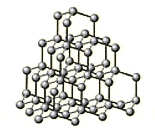
What structure is shown in the diagram?
Tags
NGSS.HS-PS1-3
6.
MULTIPLE CHOICE QUESTION
30 sec • 1 pt

Why is diamond strong?
It's made of carbon
Each carbon forms 3 strong covalent bonds
Each carbon forms 4 strong covalent bonds
So it can cut glass
7.
MULTIPLE CHOICE QUESTION
30 sec • 1 pt
Why is graphite so soft?
Tags
NGSS.HS-PS1-3

Access all questions and much more by creating a free account
Create resources
Host any resource
Get auto-graded reports

Continue with Google

Continue with Email

Continue with Classlink

Continue with Clever
or continue with

Microsoft
%20(1).png)
Apple

Others
Already have an account?


