
Biology Review: Ecology, Evolution, & Classification
Authored by Neva Winters
Biology
9th - 10th Grade
NGSS covered
Used 2+ times


AI Actions
Add similar questions
Adjust reading levels
Convert to real-world scenario
Translate activity
More...
Content View
Student View
30 questions
Show all answers
1.
MULTIPLE CHOICE QUESTION
3 mins • 1 pt
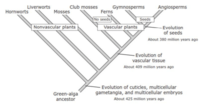
The cladogram shows the evolution of land plants as indicated by fossil records.
Which discovery would challenge the validity of this cladogram?
A large aquatic vascular plant about 200 million years old
A species of algae that has existed for less than one million years
A moss species that has existed for less than 380 million years
A fossil of a fern more than 425 million years old
Tags
NGSS.MS-LS4-2
NGSS.MS-LS4-1
2.
MULTIPLE CHOICE QUESTION
3 mins • 1 pt
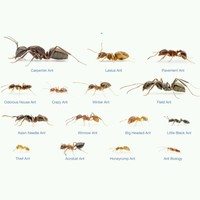
Scientists estimate that there are more than 20,000 species of ants. The species range in size from 1 mm long to 38 mm long and live in most environments. The diets of ants range from flowers and seeds to fluids from their own larvae. Ants have been able to successfully inhabit so many different environments because their populations have been able to --
hybridize with other species of insects
adapt to a variety of habitats and food sources
fill niches usually occupied by mammals
occupy habitats that have no other life-forms
Tags
NGSS.MS-LS2-4
NGSS.MS-LS2-2
3.
MULTIPLE CHOICE QUESTION
3 mins • 1 pt

Two populations of mice living in the same forest are separated by a large water-filled ditch. After a rainstorm, flooding brings several mice from one population to the other population. When the mice from the first population reproduce with members of the second population, which of the following will likely occur?
All of the offspring will die as a result of reproductive mutations.
The offspring will be forced to leave the second population.
The offspring will be genetically identical to their parent from the first population.
The offspring in the second population will have greater genetic variety.
Tags
NGSS.MS-LS4-4
NGSS.MS-LS3-2
4.
MULTIPLE CHOICE QUESTION
3 mins • 1 pt
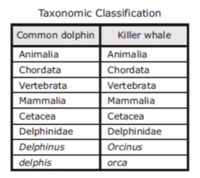
Organisms are classified today using the Linnaean system, and the following table shows the taxonomic classification of two marine organisms living along the Pacific Coast.
Taxonomic classification is important to marine biologists because it provides a way to -
prove that marine evolution occurs
discover and name every marine organism on Earth
designate Latin as the universal language of marine biology
identify marine organisms and find evolutionary relationships between them
Tags
NGSS.MS-LS4-2
5.
MULTIPLE CHOICE QUESTION
3 mins • 1 pt

A student conducted an investigation to study phototropism in grasses. The only difference between the control group and the experimental group was the light conditions. The control group was provided full light, while the experimental group was shaded on one side. The diagrams show the average heights and positions of blades of grass in the investigation. (View Image)
Which statement best explains why the grass tips of the experimental group bent toward the light?
Water evaporated faster on the side of the plant having full light.
Light sensors in the grass tips simulated a hormone in the shoot system.
The xylem in the roots system absorbed more nutrients from the shaded side.
The side facing the light has greater chance of absorbing carbon dioxide from the atmosphere.
Tags
NGSS.MS-LS1-5
NGSS.MS-LS2-1
6.
MULTIPLE CHOICE QUESTION
3 mins • 1 pt

The energy pyramid shows the energy made available by producers. (View Image)
Base on the energy flow between trophic levels in an energy pyramid, how much energy would be expected to be found at the secondary consumer level in this pyramid?
100 joules
500 joules
1,000 joules
50 joules
Tags
NGSS.MS-LS2-3
7.
MULTIPLE CHOICE QUESTION
3 mins • 1 pt

Nitrogenous bases are located on both strands of the DNA double helix. What is the significance of the nitrogenous bases?
The number of adenines and cytosines determines the type of RNA that will be produced.
The order of nitrogenous bases determines the order of amino acids in the proteins synthesized.
The amount of thymine and guanine in the DNA molecules determines the length of the genes.
The type of hydrogen bonding between the nitrogenous bases determines which amino acid will be added to the peptide chain.
Tags
NGSS.MS-LS3-1

Access all questions and much more by creating a free account
Create resources
Host any resource
Get auto-graded reports

Continue with Google

Continue with Email

Continue with Classlink

Continue with Clever
or continue with

Microsoft
%20(1).png)
Apple

Others
Already have an account?
Similar Resources on Wayground

35 questions
Missouri Biology EOC Reveiw

Quiz
•
9th - 10th Grade
25 questions
Unit Test #5 Review
Quiz
•
9th - 12th Grade
25 questions
Applied RNA and Protein Synthesis Quiz Review
Quiz
•
9th - 10th Grade
25 questions
9 Senses & Disease
Quiz
•
9th - 10th Grade
28 questions
genetics
Quiz
•
9th - 10th Grade
25 questions
Trimester 1 Final
Quiz
•
9th - 10th Grade
29 questions
Grade 9 Ecology
Quiz
•
9th Grade
25 questions
SINH HOC 9 - ON TN CUOI KY 1
Quiz
•
9th Grade
Popular Resources on Wayground
15 questions
Fractions on a Number Line
Quiz
•
3rd Grade
20 questions
Equivalent Fractions
Quiz
•
3rd Grade
25 questions
Multiplication Facts
Quiz
•
5th Grade
29 questions
Alg. 1 Section 5.1 Coordinate Plane
Quiz
•
9th Grade
22 questions
fractions
Quiz
•
3rd Grade
11 questions
FOREST Effective communication

Lesson
•
KG
20 questions
Main Idea and Details
Quiz
•
5th Grade
20 questions
Context Clues
Quiz
•
6th Grade
Discover more resources for Biology
22 questions
Human Body Systems Overview
Quiz
•
9th Grade
25 questions
photosynthesis and cellular respiration
Quiz
•
9th Grade
12 questions
Check Mitosis Vs. Meiosis
Quiz
•
9th Grade
15 questions
DNA Structure and Replication
Quiz
•
9th Grade
21 questions
Cell Cycle and mitosis
Quiz
•
9th - 10th Grade
18 questions
Enzymes and Their Functions Quiz
Quiz
•
9th Grade
20 questions
Food Chains and Food Webs
Quiz
•
7th - 12th Grade
10 questions
Exploring Food Webs and Energy Pyramids

Interactive video
•
6th - 10th Grade