
GMAS Cell processes Review
Authored by Rachel Brown
Biology
9th - 12th Grade
Used 4+ times


AI Actions
Add similar questions
Adjust reading levels
Convert to real-world scenario
Translate activity
More...
Content View
Student View
15 questions
Show all answers
1.
MULTIPLE CHOICE QUESTION
30 sec • 1 pt

this diagram is an example of
simple diffusion
facilitated diffusion
active transport
osmosis
2.
MULTIPLE CHOICE QUESTION
30 sec • 1 pt
if a cell with 20% sodium is placed into a solution with 25% sodium. the solution is said to be ____________. (hint: which direction is the water going to move)
hypertonic
hypotonic
isotonic
impossible to tell
3.
MULTIPLE CHOICE QUESTION
2 mins • 1 pt
Inside of a particular cell, there is a high level of ATP production near the plasma membrane. Which of the following is most likely true?
The cell is undergoing active transport
The cell is removing toxins via passive transport
The cell is using ribosomes to create specialized enzymes
The cell's mitochondria are working in tandem with the chloroplasts to complete essential processes.
4.
MULTIPLE CHOICE QUESTION
30 sec • 1 pt
which type of human cell would you expect to find a higher number of mitochondria? (hint: think about what the mitochondria does)
muscle cells
hair cells
skin cells
red blood cells
5.
MULTIPLE CHOICE QUESTION
30 sec • 1 pt
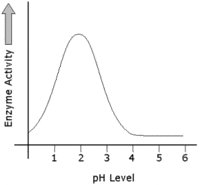
The graph above how the activity of an enzyme changes over a range of pH values. Which of the following conclusions is supported by the data?
The optimum pH of the enzyme is 1.0
The optimum pH of the enzyme is 2.0
The enzyme's activity is greater around pH of 4 than around pH of 1
The enzyme's activity continually increases as pH increases from 1.0 to 6.0
6.
MULTIPLE CHOICE QUESTION
30 sec • 1 pt

This picture represents what type of cell transport?
7.
MULTIPLE CHOICE QUESTION
30 sec • 1 pt
What type of macromolecule are enzymes?

Access all questions and much more by creating a free account
Create resources
Host any resource
Get auto-graded reports

Continue with Google

Continue with Email

Continue with Classlink

Continue with Clever
or continue with

Microsoft
%20(1).png)
Apple

Others
Already have an account?
Similar Resources on Wayground

10 questions
G10 - 13.1 Identifying The Substance of The Gene

Quiz
•
10th Grade
20 questions
Repaso general IB1
Quiz
•
12th Grade
20 questions
FOR MARKS - Cardiovascular Terms
Quiz
•
11th - 12th Grade
14 questions
Protists
Quiz
•
9th Grade
12 questions
Cell SA:V
Quiz
•
11th - 12th Grade
10 questions
Chapter 14 Quiz 2
Quiz
•
7th - 9th Grade
15 questions
Molecular Basis of Inheritance 2
Quiz
•
12th Grade
15 questions
Sense Organs
Quiz
•
9th - 10th Grade
Popular Resources on Wayground
7 questions
History of Valentine's Day

Interactive video
•
4th Grade
15 questions
Fractions on a Number Line
Quiz
•
3rd Grade
20 questions
Equivalent Fractions
Quiz
•
3rd Grade
25 questions
Multiplication Facts
Quiz
•
5th Grade
22 questions
fractions
Quiz
•
3rd Grade
15 questions
Valentine's Day Trivia
Quiz
•
3rd Grade
20 questions
Main Idea and Details
Quiz
•
5th Grade
20 questions
Context Clues
Quiz
•
6th Grade
Discover more resources for Biology
22 questions
Human Body Systems Overview
Quiz
•
9th Grade
25 questions
photosynthesis and cellular respiration
Quiz
•
9th Grade
15 questions
African American Impact in the 1980s
Quiz
•
9th Grade
20 questions
Symbiotic Relationships
Quiz
•
9th Grade
20 questions
Food Chains and Food Webs
Quiz
•
7th - 12th Grade
10 questions
Exploring Food Webs and Energy Pyramids
Interactive video
•
6th - 10th Grade
20 questions
Cladogram Practice
Quiz
•
10th Grade
20 questions
CFA #2 Unit 3 Human Body Systems (21.2 & 21.3)
Quiz
•
9th - 12th Grade