
AP Physics 1 Unit 5 Progress Check 1
Authored by Trial Student
Physics
9th - 12th Grade
NGSS covered
Used 135+ times


AI Actions
Add similar questions
Adjust reading levels
Convert to real-world scenario
Translate activity
More...
About
This quiz focuses on momentum and impulse, specifically covering the fundamental relationships between force, time, mass, velocity, and momentum changes in various physical scenarios. The content is appropriate for grades 11-12, aligning with AP Physics 1 curriculum standards. Students must understand that momentum equals mass times velocity, that impulse equals the change in momentum, and that momentum is conserved in isolated systems. The problems require students to analyze collision scenarios, apply the impulse-momentum theorem, interpret force-time graphs to calculate impulse, and predict motion outcomes in both elastic and inelastic collisions. Students need strong conceptual understanding of Newton's laws, particularly how net force over time produces momentum changes, and they must be able to distinguish between situations where kinetic energy is conserved versus where only momentum is conserved. The quiz also tests experimental design skills, requiring students to identify the necessary measuring instruments to determine momentum changes and average forces in various scenarios. This quiz was created by a classroom teacher who designed it for students studying AP Physics 1 momentum and impulse concepts. This assessment serves as an excellent formative evaluation tool to gauge student understanding before moving to more complex momentum applications. Teachers can use this as a comprehensive review assignment after completing the momentum unit, as homework to reinforce classroom learning, or as a diagnostic tool to identify areas where students need additional support. The quiz effectively combines conceptual reasoning questions with practical experimental design problems, making it valuable for both individual practice and classroom discussion. The varied question formats help students prepare for AP exam-style problems while building confidence in momentum calculations and collision analysis. This assessment supports NGSS HS-PS2-2 and HS-PS2-3 standards, which require students to use mathematical representations to support claims about momentum conservation and to apply scientific principles to design and evaluate collision experiments.
Content View
Student View
14 questions
Show all answers
1.
MULTIPLE CHOICE QUESTION
2 mins • 1 pt
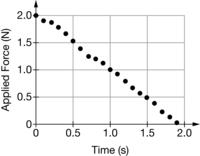
A student conducts an experiment in which a cart is pulled by a variable applied force during a 2 s time interval. In trial 1, the student exerts the force on a cart of mass M. In trial 2, the student exerts the force on a cart of mass 3M. In trial 3, the student exerts the force on a cart of 5M. In which trial will the cart experience the greatest change in momentum from 0 s to 2 s?
Trial 1
Trial 2
Trial 3
The change in momentum is equal for all three trials from 0 s to 2 s
Tags
NGSS.HS-PS2-1
2.
MULTIPLE CHOICE QUESTION
2 mins • 1 pt
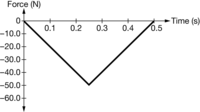
A block of mass of 10 kg travels in the positive direction along a surface with negligible friction. The block has an initial momentum 18kg⋅ms. The block collides with an object of an unknown mass that is at rest. The force exerted on the block as a function of time is shown on the graph. Which of the following best predicts the speed and direction of the block immediately after the collision?
Speed - Increases Direction - Same Direction
Speed - Decreases Direction - Same Direction
Speed - Increases Direction - Opposite Direction
Speed - Decreases Direction - Opposite Direction
Tags
NGSS.HS-PS2-1
NGSS.HS-PS2-2
3.
MULTIPLE CHOICE QUESTION
2 mins • 1 pt
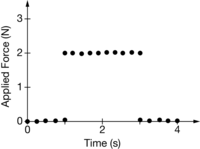
A force is applied to a 2 kg object as shown. Which of the following are possible values for its initial and final velocities?
Tags
NGSS.HS-PS2-1
4.
MULTIPLE CHOICE QUESTION
2 mins • 1 pt

A cart is attached to a hanging block by a string that passes over a pulley, as shown in the figure. The pulley has negligible friction in its axle and negligible mass. A student must determine the change in momentum of the cart as it is pulled across the horizontal surface from the moment the cart is released from rest to the moment immediately before the cart collides with the pulley. Which of the following lists the measuring devices that are needed to determine the change in momentum of the cart?
Timer
Timer and mass balance
Timer, mass balance, and meterstick
Timer, mass balance, meterstick, and force probe
Tags
NGSS.HS-PS2-1
NGSS.HS-PS2-2
5.
MULTIPLE CHOICE QUESTION
2 mins • 1 pt
During an experiment, a toy car accelerates forward for a total time of 5s. Which of the following procedures could a student use to determine the average net force exerted on the car during the 5s that the car accelerates?
Use a meterstick and stopwatch to measure the distance the car travels for the 5s.
Use a balance to determine the mass of the car. Use a motion sensor to measure the speed of the car at a time of 0s and a time of 5s.
Use a balance to determine the mass of the car. Use a meterstick to measure the distance the car travels for the 5s.
Use a motion sensor to measure the speed of the car at a time of 0s and a time of 5s. Use a meterstick to determine the distance the car travels for 5s.
Tags
NGSS.HS-PS2-1
6.
MULTIPLE CHOICE QUESTION
2 mins • 1 pt

A motorcycle and car are both out of gas. The car has twice the mass of the motorcycle. After Waluigi pushes the motorcycle and car for the same amount of time with the same force, what can you say about the momentum and speed of the motorcycle and the car?
They have the same momentum and the same velocity.
The motorcycle has more momentum and a higher velocity than the car.
The car has more momentum and higher velocity than the motorcycle.
They have the same momentum, but the motorcycle has a higher velocity than the car.
Tags
NGSS.HS-PS2-1
NGSS.HS-PS2-2
7.
MULTIPLE CHOICE QUESTION
2 mins • 1 pt

Two carts of equal mass are on a horizontal surface with negligible friction. Cart A is approaching cart B, which is at rest, as shown in Figure 1 above. Attached to cart B is a spring that is initially compressed. At the moment cart A collides with cart B, the spring is released and pushes on cart A, as shown in Figure 2 above. Which of the following correctly states what happens to the kinetic energy and the momentum of the two-cart system as a result of the collision compared to those quantities before the collision?
KE - Increases Momentum - Increases
KE - Increases Momentum - Stays the same
KE - Stays the same Momentum - Increases
KE - Stays the same Momentum - Stays the same
Tags
NGSS.HS-PS2-2


Access all questions and much more by creating a free account
Create resources
Host any resource
Get auto-graded reports

Continue with Google

Continue with Email

Continue with Classlink

Continue with Clever
or continue with

Microsoft
%20(1).png)
Apple

Others
Already have an account?
Similar Resources on Wayground

10 questions
Producing sound ม5

Quiz
•
11th Grade
17 questions
Chapter 16 8th Grade Science Putman
Quiz
•
6th - 12th Grade
10 questions
Kinetic Model of Matter
Quiz
•
9th - 10th Grade
13 questions
Capacitors
Quiz
•
12th Grade
15 questions
Momentum and Impulse Review
Quiz
•
11th - 12th Grade
10 questions
Class Test - Electricity
Quiz
•
10th Grade
15 questions
Science 9 Physics
Quiz
•
9th Grade
10 questions
Cinemática 1: Graficos de MUR
Quiz
•
10th Grade
Popular Resources on Wayground
15 questions
Fractions on a Number Line
Quiz
•
3rd Grade
10 questions
Probability Practice
Quiz
•
4th Grade
15 questions
Probability on Number LIne
Quiz
•
4th Grade
20 questions
Equivalent Fractions
Quiz
•
3rd Grade
25 questions
Multiplication Facts
Quiz
•
5th Grade
22 questions
fractions
Quiz
•
3rd Grade
6 questions
Appropriate Chromebook Usage

Lesson
•
7th Grade
10 questions
Greek Bases tele and phon
Quiz
•
6th - 8th Grade
Discover more resources for Physics
10 questions
Exit Check 3.3 - Universal Gravitation
Quiz
•
9th Grade
10 questions
Exit Check 3.4 - Moon's Orbit
Quiz
•
9th Grade
10 questions
Exit Check 3.5 - Earth's Orbit
Quiz
•
9th Grade
22 questions
Waves
Quiz
•
KG - University
21 questions
EM Spectrum
Quiz
•
6th - 9th Grade
20 questions
Position vs. Time Graphs
Quiz
•
9th Grade
10 questions
Exploring the Properties of Waves

Interactive video
•
9th - 12th Grade
14 questions
Bill Nye Waves
Interactive video
•
9th - 12th Grade